
Mingsha Mountain and Crescent Spring

Two things to hold on to. First, the online-plus-paper rule: a foreign passport can buy full-price online, but you must still have the booking converted into a paper ticket at the sales window and scan that paper ticket to enter — arriving with only a phone screen and no paper ticket will leave you outside, so allow time at the window. Second, prices and packages: the dune activities (camel rides, sand-sledding, off-road desert driving, parachute-style rides) are separately priced inside the park and should be clearly posted — agree the cost before mounting, and be sceptical of cheap 'combo' bundles or touts bridging this site and the Mogao, which are wholly separate. The scenic area is genuinely close to the city, so beware inflated long-drive claims.
Taxi & Street Navigation Help
师傅,去【鸣沙山月牙泉景区】(敦煌市区西南),谢谢!
Opening Hours & Best Time
The site currently opens around 06:30 and closes in the mid-to-late evening, with ticketing and gate checks under one combined window and no separately published last-entry cut-off; the exact hours shift with the season and the manager's notices, so check the day's posted times before targeting a specific light. Because the draw is sunrise and sunset over the dunes, the practical rhythm is early and late — the middle of a summer day is hot, bright and the least pleasant hour to be on open sand.
💡 Pro Tip: A national 5A scenic area and part of a UNESCO Global Geopark, this is Dunhuang's signature natural marvel: the 'Singing Sand' dunes (Mingsha — so named because sliding sand reportedly hums in clear weather) and, cupped at their foot, the Crescent Spring (Yueya Quan), a naturally crescent-shaped pool that has stayed clear and unburied by the surrounding desert for over a thousand years. The paradox — a living spring that the encroaching sand never swallows, 'the mountain spirits so it sings, the water godly so it stays' — made it one of ancient Dunhuang's Eight Scenes and a standing emblem of desert defiance. The classic experience is camel-string or sand-sledding on the dunes at golden hour, then watching the sun drop behind the ridge and the lanterns come on around the spring. It sits only about five kilometres south-west of the city — the easiest big landscape day in Dunhuang.
Accessibility & Luggage Lockers
Accessibility: ⚠️ Step thresholds, limited access
Open soft-sand dunes with steep slip-faces and a waterside spring stroll; despite boardwalks near the spring, the core dune experience — climbing and sliding the sand — is not wheelchair- or stroller-practicable.
🧳 Luggage Storage: Storage at the visitor/ticket centre at the entrance; carry light onto the sand. As it is close to the city, dropping bags at your hotel is often the simpler option.
Nearby Landmarks
The 2 places within reach of this spot — each one opens straight into Apple Maps or Amap, with the Chinese name you can show a driver.
- The Mogao Caves, a separate operator and ticketLandmarkNearbydifferent entity entirely
Also worth pairing: Dunhuang Museum in the city, for the Silk Road context — real picks, just left off the grid so the cards stay in pairs.
Chinese names and pins are matched against each city's own map data at build time; a place only gets Directions once its pin has been verified, otherwise the button searches by name.
About Mingsha Mountain and Crescent Spring
1. Historical Origins: The Spring the Desert Never Swallowed
Long before it was a scenic area, this pairing of singing dunes and an unwithering spring entered Dunhuang’s register as one of its classic ‘Eight Scenes’ — a natural puzzle that pre-modern writers read as proof the place was spirit-haunted. The Mingsha (‘Singing Sand’) ridges got their name from the reported hum that rises when sand slides down their faces in dry, clear weather; at their foot the Crescent Spring holds a permanent, moon-shaped pool that the very sand pressing in on every side never fills.
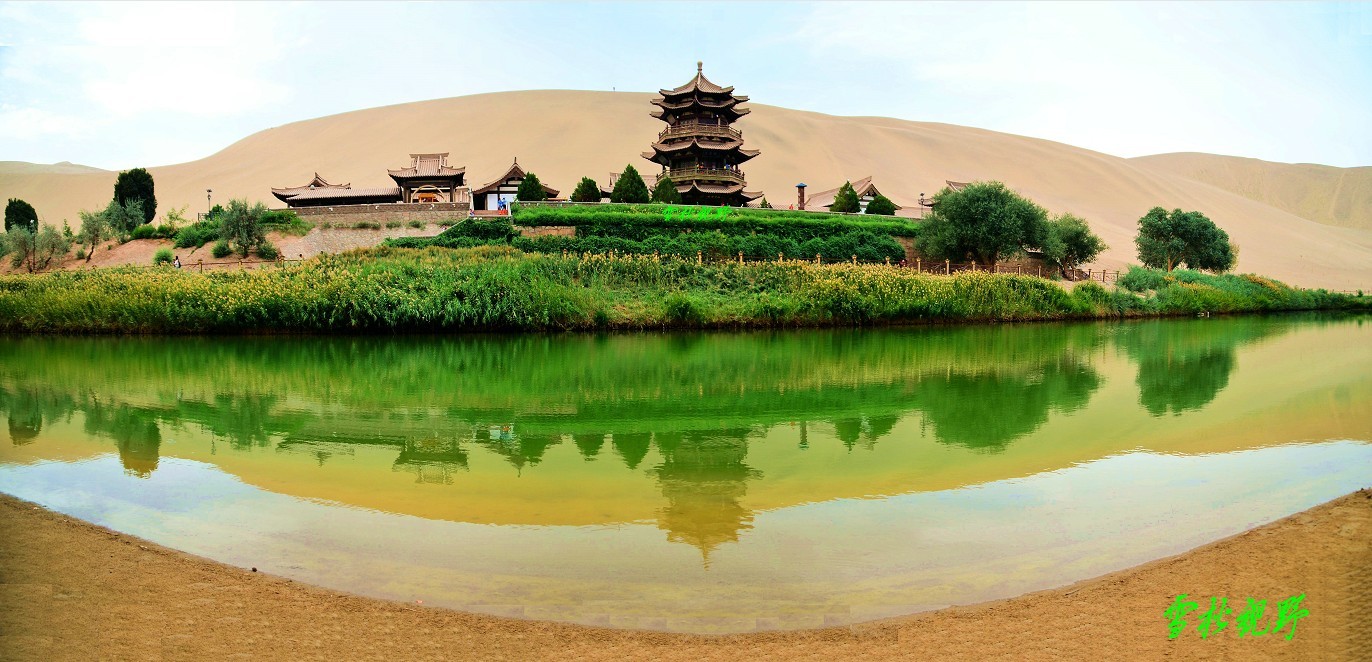
The old explanation was mythic — mountain spirits make the sand sing; a water god keeps the spring clear. The modern one is hydrology: a local spring-fed depression with a water table and wind patterns that conspire against burial. Either way, the scene is the frontier landscape in miniature: Dunhuang sat where the Silk Road squeezed between desert and mountain, and a living oasis spring in the dunes was exactly the miracle a caravan city built its identity around. Today it is a national 5A site and a UNESCO Global Geopark landmark, just kilometres from the modern city.
2. What to Spot: The Spring, the Dunes, the Desert Light
🌙 The Crescent Spring
- The Story: A permanent crescent-shaped pool that desert sand never swallows — the oasis paradox itself.
- What to Look For: The moon shape and pavilions at the water’s edge, best mirrored at dawn or in the last evening light.
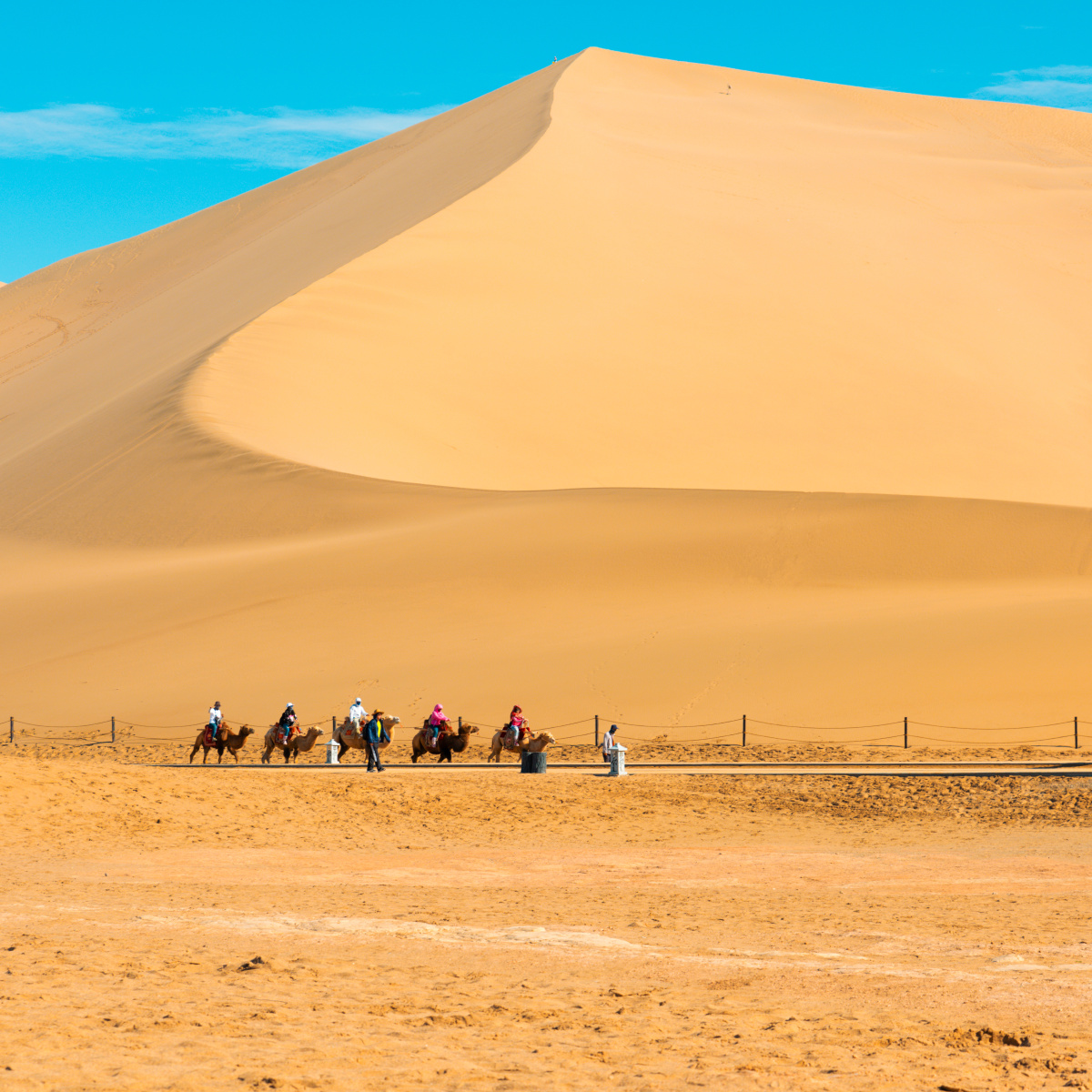
🐫 The Singing Sand Dunes
- The Story: Tall rippled ridges that ‘sing’ when sand runs down them; the great play-ground of the site.
- What to Look For: Camel strings in silhouette on the crest, and the long slide-and-climb rhythm of people on the slip-faces.
🌅 Sunset and the Lantern Hour
- The Story: The site’s signature hour, when the crowd gathers on a west-facing ridge for the drop.
- What to Look For: The sun sinking behind the ridgeline, then the spring and lanes glowing with lanterns as cool air arrives.
3. Cultural Contrast: A Desert That Is a Stage, Not a Wasteland
For most travellers a desert is emptiness to cross; for Dunhuang the desert is the destination itself — a landscape with a thousand years of literary and folk prestige attached. The ‘singing’ was recorded as a marvel by ancient gazetteers, the spring celebrated as one of the canonical Eight Scenes, and the whole tableau functions as China’s most accessible taste of the great Silk Road Gobi — the same backdrop that made frontier poets wax about departing caravans and vast, lonely beauty.
That reframing changes how to use an afternoon here. Treat it as a staged natural theatre rather than a viewpoint: climb a dune at the golden hour and you join a camel string, a sand-sledding queue and a crowd waiting for the same sunset — a lively, almost festive scene that is very far from desert solitude. The honest contrast to the West’s ‘sublime loneliness’ is that the Chinese desert experience is social and sensory — the hum of sliding sand, lanterns at dusk, the shared hush when the sun drops. Accept the crowd as part of the show, rise early or stay late to thin it, and the Mingsha delivers one of China’s most photogenic and physically fun landscapes minutes from a city.
4. Practical Essentials: Tickets, Passport & Scam Alerts
Tickets & Passport Booking
- Price: Two-season fare with a lower winter-spring rate, and the buy-once / re-enter-within-three-days rule that suits chasing both a sunset and a sunrise; half-price/free tiers are for mainland ID only, a foreign passport buys full-price. No amount is fixed here — confirm the adult fare on the official channel.
- Passport & the paper-ticket rule: you can buy full-price online with a passport, but must still convert it to a paper ticket at the sales window and scan that paper ticket to enter — budget time at the window, because a phone screen alone will not get you in.
How to Get There
- Where it is: only about five kilometres south-west of Dunhuang city centre (official figure), so taxi, city bus or even cycling are realistic; Dunhuang publishes no official drive time from the airport or rail station, so treat mapping estimates as indicative.
- Show Your Driver: 师傅,去【鸣沙山月牙泉景区】(敦煌市区西南),谢谢!
Inside Tips & Scam Alerts
- Go at the shoulder hours — dawn and the sunset-and-lantern window; avoid harsh midday summer heat on open sand. Guard gear from sand: scarf and goggles for wind, seal cameras and phones (fine sand is the enemy). Agree activity prices before you ride or slide — camel, sand-sledding and off-road drives are separately priced inside. Mind that this and the Mogao are different tickets run by different bodies. Complaints / lost property: 12345, free from a local number.
Quick Answers
The 6 things visitors ask before setting out, answered from the same verified record used across this page.
- How much does it cost to visit Mingsha Mountain and Crescent Spring?
- Seasonal; 3-day re-entry.
- What are the opening hours at Mingsha Mountain and Crescent Spring?
- The site currently opens around 06:30 and closes in the mid-to-late evening, with ticketing and gate checks under one combined window and no separately published last-entry cut-off; the exact hours shift with the season and the manager's notices, so check the day's posted times before targeting a specific light. Because the draw is sunrise and sunset over the dunes, the practical rhythm is early and late — the middle of a summer day is hot, bright and the least pleasant hour to be on open sand.
- Is Mingsha Mountain and Crescent Spring wheelchair accessible?
- Not fully. Open soft-sand dunes with steep slip-faces and a waterside spring stroll; despite boardwalks near the spring, the core dune experience — climbing and sliding the sand — is not wheelchair- or stroller-practicable.
- How do I tell a taxi driver to take me to Mingsha Mountain and Crescent Spring?
- Copy this line into DiDi or show it to the driver: 师傅,去【鸣沙山月牙泉景区】(敦煌市区西南),谢谢!
- Can I leave my luggage at Mingsha Mountain and Crescent Spring?
- Storage at the visitor/ticket centre at the entrance; carry light onto the sand. As it is close to the city, dropping bags at your hotel is often the simpler option.
- Is there anything to watch out for at Mingsha Mountain and Crescent Spring?
- Two things to hold on to. First, the online-plus-paper rule: a foreign passport can buy full-price online, but you must still have the booking converted into a paper ticket at the sales window and scan that paper ticket to enter — arriving with only a phone screen and no paper ticket will leave you outside, so allow time at the window. Second, prices and packages: the dune activities (camel rides, sand-sledding, off-road desert driving, parachute-style rides) are separately priced inside the park and should be clearly posted — agree the cost before mounting, and be sceptical of cheap 'combo' bundles or touts bridging this site and the Mogao, which are wholly separate. The scenic area is genuinely close to the city, so beware inflated long-drive claims.
Where to go next
Three short lists, recomputed at build time from the same coordinates and categories as the pages themselves — no paid placement, no hand-picked names. Every card is a published guide.
Next stop in Dunhuang
Straight-line distance from this spot, so you can judge what is walkable and what needs a taxi.


More like this, elsewhere in China
If park or garden is what you came for, these are the closest equivalents you can reach in another city — ordered by distance, one city per card.


Change the subject
Deliberately a different category, for when one more temple or garden would blur into the last one.


Lists are derived from coordinates and category alone. Fix a wrong pin or re-tag a place and every list that mentions it moves with it.
Before you go · arrival essentials
Practical guides that pair with this kind of place — picked by category, not sponsored placement.