
Famen Temple

Taxi & Street Navigation Help
师傅,请带我到法门寺景区大门。谢谢!
Opening Hours & Best Time
8:30 - 18:00
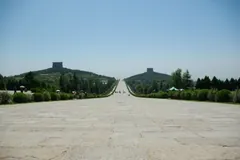
💡 Pro Tip: The site is two temples in one: the ancient pagoda courtyard (the real 1,700-year-old temple, where the relics were found) and the 2009-built 'cultural scenic area' (a 1.2 km monumental esplanade). Walk the esplanade once for the scale, but spend your time in the old courtyard and the underground museum — that is where the actual Tang treasures are.
Accessibility & Luggage Lockers
Accessibility: ♿ Wheelchair & Stroller Friendly
The electric cart (included in the ticket) covers the 1.2 km esplanade; the old temple courtyard and museum are step-free.
🧳 Luggage Storage: Lockers at the scenic area entrance.
Nearby Landmarks
The 2 places within reach of this spot — each one opens straight into Apple Maps or Amap, with the Chinese name you can show a driver.
 乾陵Qianling MausoleumLandmark40 min drive — the natural pairing31.97 km
Also worth pairing: Baoji city (30 min west) — real picks, just left off the grid so the cards stay in pairs.
Chinese names and pins are matched against each city's own map data at build time; a place only gets Directions once its pin has been verified, otherwise the button searches by name.
About Famen Temple
1. Historical Origins: A Crypt Sealed in 874
Famen Temple grew up around a relic: a finger bone said to be the Buddha’s, kept here for roughly 1,700 years and venerated by the Tang court. Emperors sent treasures to it, and the pagoda that housed it was rebuilt repeatedly after fires and earthquakes.
The decisive date is 874. The Tang emperor Xizong had the underground crypt sealed, and it stayed sealed for more than a thousand years — through dynastic collapse, war and revolution, forgotten by everyone except the monks who knew the story. In 1987 the collapsed pagoda was being repaired, the crypt was found, and inside it was the largest Tang treasure hoard ever recovered: nested gold and silver caskets, Persian glass, imported textiles, secret-colour celadon, and the relic itself.
That find is why Famen is a national site rather than a local temple. The objects went into a purpose-built underground museum beside the old courtyard, where they remain.

2. What to Spot: The Old Pagoda, the Museum, the Esplanade
🛕 The Old Courtyard
- The Story: This is the actual temple — the walled compound where the relic was kept and where the crypt was found, century-old halls around a rebuilt pagoda.
- What to Look For: The paving and the courtyard scale. This is a working religious site; incense and monks, not turnstiles.
💰 The Underground Museum
- The Story: The core of the visit. The Tang hoard is displayed in a crypt-level gallery beside the old courtyard, much of it in the arrangement it was buried in.
- What to Look For: The nested reliquaries — gold casket inside silver casket inside stone, like a set of Russian dolls, eight layers deep. Then the Persian glass and the secret-colour celadon, objects that prove how far Tang trade reached.
🗼 The Namaste Pagoda and Esplanade
- The Story: Built in 2009, the 148-metre tower and its 1.2 km approach were added as a monument, not a reconstruction.
- What to Look For: The scale, once. In midday sun the tower’s faceted surface throws hard light; the long approach is exposed with little shade.


3. Cultural Contrast: Old Temple, New Monument
Famen is two sites in one ticket, and the two halves attract different people. Chinese tour groups come for the monumental esplanade and the new tower, which photograph well and can be walked in an hour without reading anything. Pilgrims and historians go straight to the old courtyard and the museum, where the actual objects are.
Foreign visitors almost always prefer the second half. The museum is small, cool and specific: it explains a single event — a hoard buried in 874 and found in 1987 — and everything in it is Tang. The esplanade explains nothing; it is a processional route on a monumental scale, and its content is the building itself.
A note on the relic: the true finger bone is displayed only on specific holy days. Most of the year the crypt chamber you see holds a substitute, and the museum’s objects are the real draw regardless.

4. Practical Essentials: Tickets, Transit & Scam Alerts
Tickets & Passport Booking
- Price: ¥100 for entry, including the ¥20 electric cart that runs the length of the esplanade. Confirm the current price on the official site before you go.
- How to Book: Buy at the gate with a passport or through the official WeChat account. Card payment is usually possible at the main ticket office; carry cash for the cart and small vendors.
How to Get There
- By Metro: No metro. Take the high-speed train from Xi’an North to Famen or Qishan Station (about 40 minutes), then a 20-minute taxi. Tourist coaches from the city bus station take about two hours. It pairs naturally with Qianling, roughly 40 minutes away by car.
- Show Your Driver: 师傅,请带我到法门寺景区大门。谢谢!
Inside Tips & Scam Alerts
- Budget your time for the museum, not the esplanade. The 1.2 km approach is a walk, not a sight; the Tang treasures are in the underground gallery.
- Take the cart one way at least. Walking the full esplanade in summer costs an hour of heat for no information.
- The relic is shown only on holy days. Do not plan the trip around seeing it; plan it around the museum.
- Opening hours are about 8:30 to 18:00. The museum is indoors and unaffected by weather.
- Complaints: the national 12345 hotline is free to call from any local phone.
Quick Answers
The 6 things visitors ask before setting out, answered from the same verified record used across this page.
- How much does it cost to visit Famen Temple?
- ¥100 (includes electric cart ¥20).
- What are the opening hours at Famen Temple?
- 8:30 - 18:00.
- Is Famen Temple wheelchair accessible?
- Yes. The electric cart (included in the ticket) covers the 1.2 km esplanade; the old temple courtyard and museum are step-free.
- How do I tell a taxi driver to take me to Famen Temple?
- Copy this line into DiDi or show it to the driver: 师傅,请带我到法门寺景区大门。谢谢!
- Can I leave my luggage at Famen Temple?
- Lockers at the scenic area entrance.
- Will English work at Famen Temple?
- Yes — staff used to foreign visitors handle English, and the site scores 3/5 on our foreign-friendliness scale.
Where to go next
Three short lists, recomputed at build time from the same coordinates and categories as the pages themselves — no paid placement, no hand-picked names. Every card is a published guide.
Next stop in Xi'an
Straight-line distance from this spot, so you can judge what is walkable and what needs a taxi.


More like this, elsewhere in China
If temple is what you came for, these are the closest equivalents you can reach in another city — ordered by distance, one city per card.


Change the subject
Deliberately a different category, for when one more temple or garden would blur into the last one.


Lists are derived from coordinates and category alone. Fix a wrong pin or re-tag a place and every list that mentions it moves with it.
Before you go · arrival essentials
Practical guides that pair with this kind of place — picked by category, not sponsored placement.