
Laojun Mountain

The risks are logistical, not a rip-off at the gate. First, pricing opacity: because entry is sold via OTA and the ropeways are separate add-ons, treat any single headline 'ticket' figure as partial — confirm exactly what it includes and what the cable cars cost on the day. Second, the far bigger cost is a wasted trip: Laojun is genuinely remote (deep in the Funiu Mountains in Luanchuan, a long drive from Luoyang), and its famous sea-of-clouds and gold-summit views are entirely weather-dependent, with ropeways closing in wind or ice. Book and verify conditions close to the day, allow a lot of transit time, and don't chain it onto the same day as the city sights.
Taxi & Street Navigation Help
师傅,请带我到老君山景区(洛阳栾川),谢谢!
Opening Hours & Best Time
There is no simple daily timetable to assume here: a high mountain park opens around daylight but its practical window is set by the cable-car operating hours and, decisively, by weather — the ropeways suspend in high wind, icing or poor visibility, and closures can be announced only shortly before. Given how far the mountain is, check the scenic area's and ropeway's current operating notice on the day before you set out, so you don't make a long journey into a shut-down ascent.
💡 Pro Tip: Laojun ('Old Lord's Peak') is a sacred Daoist mountain — the legendary retreat of Laozi (Li Er), founder of Daoism, said to have refined his elixir here — and one of Daoism's great named mountains. Its signature look is a cluster of gilded summit temples (the Golden Hall, Liangbao Terrace and Yuhuang Peak temple) perched on granite spires, wreathed at their best by a rolling sea of clouds or, in winter, snow — the 'one glimpse of a flourishing-age countenance' imagery that made Laojun a viral phenomenon. Reaching the gold-summit zone means ropeway plus sustained stairs; even in summer the summit is cool, so bring a layer. Sunrise, sea-of-clouds and snow are the money shots — all luck-of-weather.
Accessibility & Luggage Lockers
Accessibility: ⚠️ Step thresholds, limited access
A high mountain reached by cable car then long flights of stone stairs up to the summit temples; the core experience is inherently stair-based and not wheelchair- or stroller-accessible.
🧳 Luggage Storage: Storage is at the base/service area, not the summit — leave city luggage at your Luanchuan base or hotel; you'll ascend light.
Nearby Landmarks
The 2 places within reach of this spot — each one opens straight into Apple Maps or Amap, with the Chinese name you can show a driver.
Also worth pairing: Baiyun Mountain, further in the Funiu range — real picks, just left off the grid so the cards stay in pairs.
Chinese names and pins are matched against each city's own map data at build time; a place only gets Directions once its pin has been verified, otherwise the button searches by name.
About Laojun Mountain
1. Historical Origins: Where the Daoist Sage Retreated
Laojun Mountain, deep in the Funiu range in Luoyang’s remote Luanchuan county, takes its name from Laojun, an honorific of Laozi — the semi-legendary sage, author of the Dao De Jing and founder-figure of philosophical and religious Daoism. Tradition holds that he withdrew to this peak to refine the elixir of immortality, and over the centuries the mountain became one of Daoism’s great sacred sites, its summits crowned with temples to the faith.
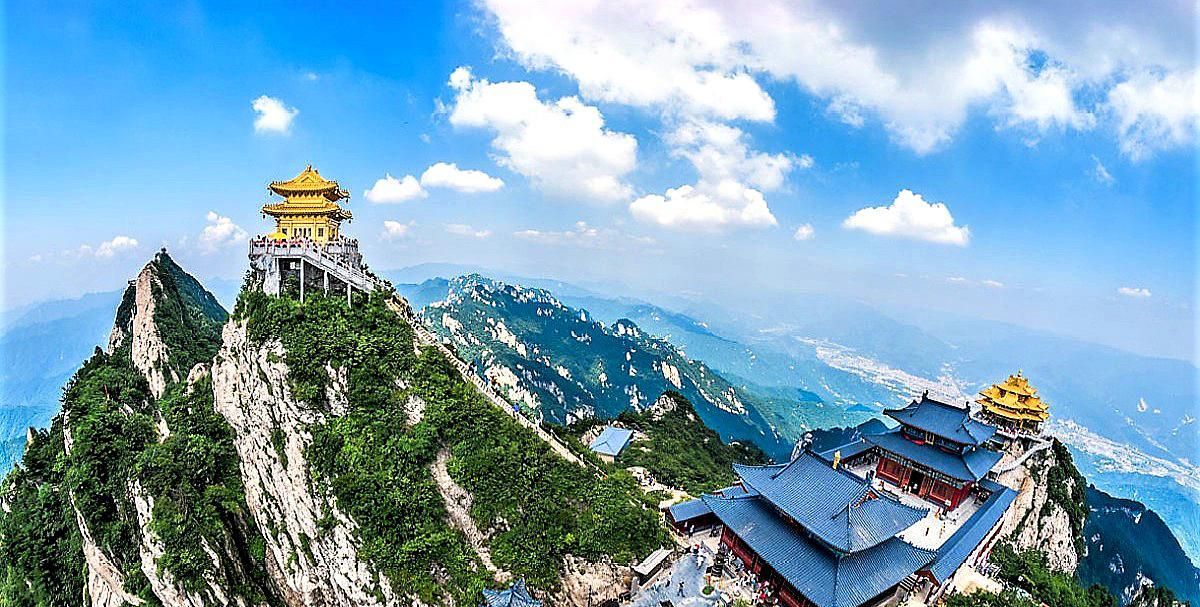
The mountain’s modern fame, though, is visual as much as religious. Its granite peak-walls rise in a natural ‘forest’ of stone spires, and when cloud floods the valleys the temples appear to float — a scene long celebrated in verse and now, through photography and short video, turned into a national bucket-list image, especially after snow or at sunrise. Laojun is where Daoist sacred geography met social-media iconography.
2. What to Spot: The Golden Summit, the Sea of Clouds, the Peak Forest
🏔️ The Golden-Summit Temple Cluster
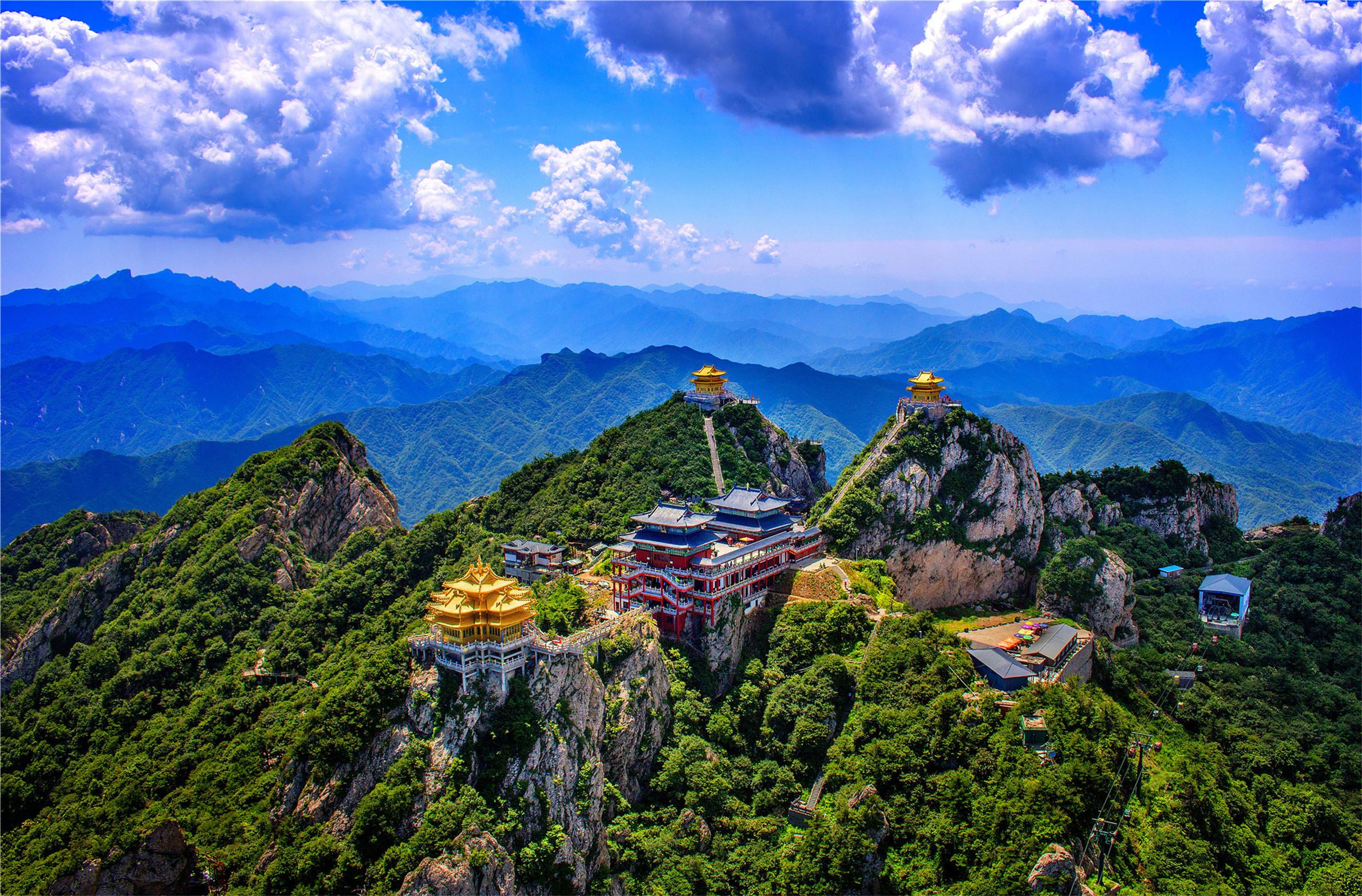
- The Story: Gilded Daoist halls crowning the top — the Golden Hall, Liangbao Terrace and Yuhuang Peak temple.
- What to Look For: The roofs catching first or last light; this is the frame everyone makes the climb for.
☁️ The Sea of Clouds
- The Story: Valley cloud surging below the peaks so the temples seem to drift — a weather gift, most common after rain and in cold seasons.
- What to Look For: Check conditions and give yourself more than one window; the sea of clouds cannot be scheduled.
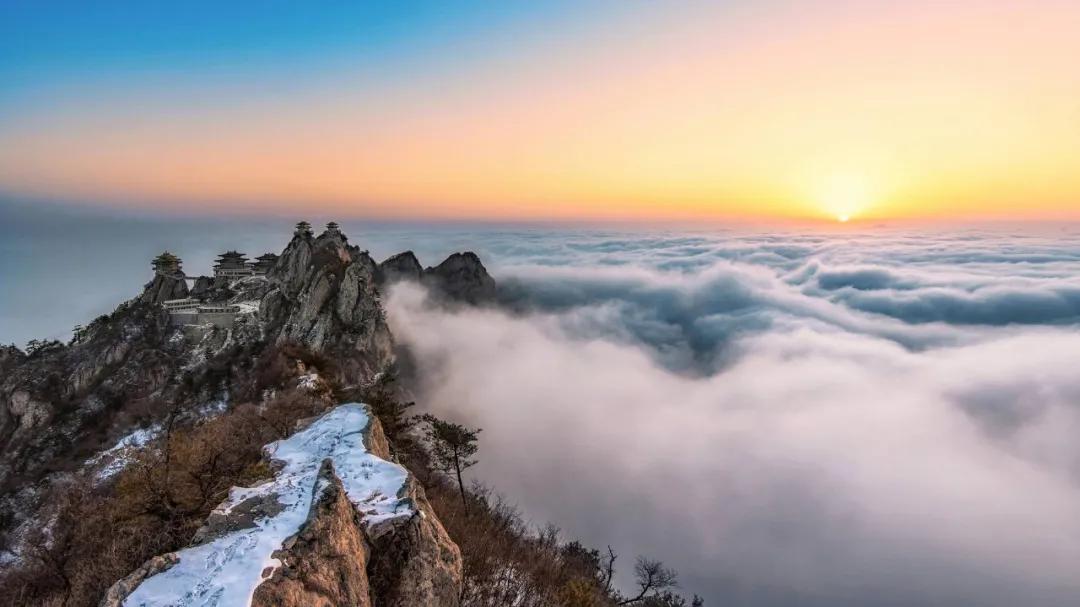
🪨 The Granite Peak Forest & Ropeway Ascent
- The Story: Sword-like granite walls reached by a two-stage cable car and a final stair climb.
- What to Look For: The natural ‘forest’ of spires, and the physical reality that the two ropeways plus stairs are the true cost of the view.
🏘️ Base in Luanchuan, Not Luoyang
Laojun is often sold as a Luoyang day trip; it is not. The mountain sits in Luanchuan county, a long drive south-west of the city, and the summit weather rewards an overnight. Sleeping in Luanchuan lets you take the first ropeway, check the cloud forecast, and still catch the same-day summit light.
Two nights is better than one if the sea of clouds is the reason you came. One morning is a coin flip; two gives a second window without redoing the whole transfer. On the way back, pair the mountain with the Longmen Grottoes — the high-speed station sits between the two, and the order matters less than starting early.
Coming from Luoyang, do not book a same-day return. The county road and the ropeway queues make the afternoon unpredictable, and a missed last cable car turns a scenic day into a long walk.
3. Cultural Contrast: Sacred Mountain as Spectacle
Laojun is a clean illustration of how China’s sacred mountains work: named for a sage, studded with temples, and revered long before tourism existed — then re-encountered today as photography. For a foreign visitor both layers are available at once. The Daoist history gives the summit temples their meaning; the sheer natural drama gives them their stage. Neither needs the other, and together they explain why a remote peak draws hundreds of thousands of pilgrim-tourists.
The honest counterweight is logistics and luck. Laojun is not a casual add-on to a Luoyang city day; it is a long haul into the Funiu backcountry whose entire payoff hangs on clear or cloud-perfect weather and open ropeways. Read correctly, it is a dedicated overnight-in-Luanchuan objective — best combined with nearby Jiguan Cave — rather than a checkbox. Travelers who accept the distance and chase good conditions are rewarded with one of China’s most theatrical mountain summits; those who squeeze it between city sights usually lose.
4. Practical Essentials: Tickets, Transit & Scam Alerts
Tickets & Passport Booking
- Price: Sold mainly via third-party platforms; scenic ticket typically bundles Laojun/Zhaigou/Zhuimeng Valley, with the two cable cars priced separately on top — no official figure is fixed here, confirm live prices for gate and ropeways on the day.
- Passport & booking: Book close to the date and verify ropeway status (weather closures are announced late); bring your passport for real-name ticketing where required.
How to Get There
- Where it is: Deep in Luanchuan county, west-southwest of Luoyang in the Funiu Mountains — a long drive, normally handled as a base-in-Luanchuan overnight rather than a city day-trip. There is no official drive time for this city; budget generously and plan a return.
- Show Your Driver: 师傅,请带我到老君山景区(洛阳栾川),谢谢!
Inside Tips & Scam Alerts
- Chase the weather, not a fixed plan — verify cloud/wind and ropeway openings, and allow several chances at the summit view. Cable cars cost extra beyond the gate ticket. Bring a layer even in summer; the summit is cool and exposed. Treat travel time seriously. Complaints / lost property: 12345, free from a local number.
Quick Answers
The 5 things visitors ask before setting out, answered from the same verified record used across this page.
- What are the opening hours at Laojun Mountain?
- There is no simple daily timetable to assume here: a high mountain park opens around daylight but its practical window is set by the cable-car operating hours and, decisively, by weather — the ropeways suspend in high wind, icing or poor visibility, and closures can be announced only shortly before. Given how far the mountain is, check the scenic area's and ropeway's current operating notice on the day before you set out, so you don't make a long journey into a shut-down ascent.
- Is Laojun Mountain wheelchair accessible?
- Not fully. A high mountain reached by cable car then long flights of stone stairs up to the summit temples; the core experience is inherently stair-based and not wheelchair- or stroller-accessible.
- How do I tell a taxi driver to take me to Laojun Mountain?
- Copy this line into DiDi or show it to the driver: 师傅,请带我到老君山景区(洛阳栾川),谢谢!
- Can I leave my luggage at Laojun Mountain?
- Storage is at the base/service area, not the summit — leave city luggage at your Luanchuan base or hotel; you'll ascend light.
- Is there anything to watch out for at Laojun Mountain?
- The risks are logistical, not a rip-off at the gate. First, pricing opacity: because entry is sold via OTA and the ropeways are separate add-ons, treat any single headline 'ticket' figure as partial — confirm exactly what it includes and what the cable cars cost on the day. Second, the far bigger cost is a wasted trip: Laojun is genuinely remote (deep in the Funiu Mountains in Luanchuan, a long drive from Luoyang), and its famous sea-of-clouds and gold-summit views are entirely weather-dependent, with ropeways closing in wind or ice. Book and verify conditions close to the day, allow a lot of transit time, and don't chain it onto the same day as the city sights.
Laojun Mountain Photo Wall
1 / 1414 views of Laojun Mountain from the visitor photo set: the sea of clouds, the name-inscribed stone, the peak boardwalk, the Golden Summit.
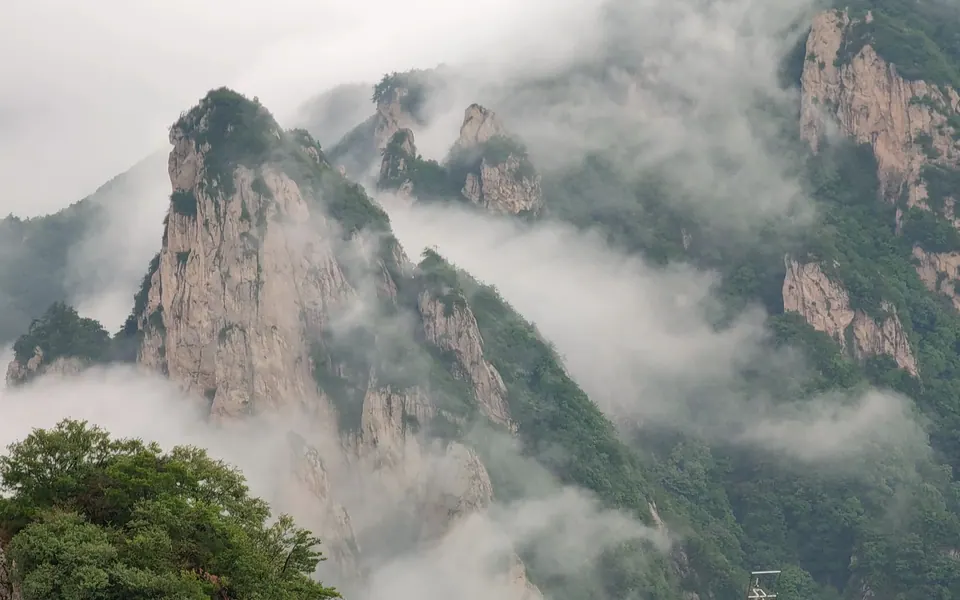
The sea of clouds.
Where to go next
Three short lists, recomputed at build time from the same coordinates and categories as the pages themselves — no paid placement, no hand-picked names. Every card is a published guide.
Next stop in Luoyang
Straight-line distance from this spot, so you can judge what is walkable and what needs a taxi.


More like this, elsewhere in China
If park or garden is what you came for, these are the closest equivalents you can reach in another city — ordered by distance, one city per card.


Change the subject
Deliberately a different category, for when one more temple or garden would blur into the last one.


Lists are derived from coordinates and category alone. Fix a wrong pin or re-tag a place and every list that mentions it moves with it.
Before you go · arrival essentials
Practical guides that pair with this kind of place — picked by category, not sponsored placement.