
Guanlin Temple

The main confusion is geography and ticketing: Guanlin sits between the city and Longmen, so it is easy to lump into a 'Longmen day', but the two sell completely separate admissions — buy Guanlin's own ticket at its own gate, not a vague combo. The site itself is honest and low-risk; the other watch-out is expectation — this is a temple-tomb dedicated to a deified general, rich in steles, cypresses and Guan Yu lore. If you don't know the Three Kingdoms story, read a paragraph beforehand or the exhibits lose much of their point.
Taxi & Street Navigation Help
师傅,请带我到关林(洛阳,洛龙区关林),谢谢!
Opening Hours & Best Time
A day visiting site with hours set by the temple's own operator; there is no single confirmed all-year timetable relied on here, so check the day's posted opening window before arriving, especially off-season. It is a compact walkable complex, so leave ample time for the axial halls and stele groves without needing to plan around a scheduled event.
💡 Pro Tip: Guanlin is where the head of Guan Yu — the sworn brother-warrior of the Three Kingdoms — is traditionally said to be buried, and its very name signals his exalted status: 'lin' (forest) was a term reserved for imperial tombs, like Confucius's burial grove. The site is unique in combining tomb (zhong), temple (miao) and memorial grove (lin) in one worship complex, and ranks with the Xiezhou Guan Di Temple and Dangyang Guan Ling as one of the three great Guan Yu sites. Guan Yu was deified as Guan Di, god of loyalty, righteousness and — importantly for shopkeepers and traders — wealth and protection, so you'll see plenty of business owners praying here. The axial Ming-Qing halls, ancient cypresses and stele groves reward a slow read.
Accessibility & Luggage Lockers
Accessibility: ⚠️ Step thresholds, limited access
A traditional temple-mausoleum of terraced halls, thresholds and courtyard groves; paths are paved but hall platforms are stepped, and step-free access through the whole complex is unverified.
🧳 Luggage Storage: No visitor lockers noted at the gate — carry light, or stop here en route to Longmen with bags at your hotel.
Nearby Landmarks
The 2 places within reach of this spot — each one opens straight into Apple Maps or Amap, with the Chinese name you can show a driver.
- Luoyang Longmen high-speed rail station, nearby to the north-westTransit HubNearby
Also worth pairing: Sui-Tang Luoyang City / Yingtian Gate, north toward the city — real picks, just left off the grid so the cards stay in pairs.
Chinese names and pins are matched against each city's own map data at build time; a place only gets Directions once its pin has been verified, otherwise the button searches by name.
About Guanlin Temple
1. Historical Origins: The Buried Head of a God of War
Guan Yu was a real general of the Shu Han kingdom in the Three Kingdoms period (late 2nd–early 3rd century), whose loyalty and martial virtue were gradually deified over the following centuries until he was worshipped as Guan Di, a god. Tradition holds that after his death his head was sent to Cao Cao and buried with princely honours here in Luoyang, while his body and limbs were interred elsewhere — giving rise to the split shrines that today mark the three great Guan Yu sites.
The name itself declares his rank. In imperial China the word ‘lin’ — literally ‘forest’ — was a designation reserved for the burial grounds of the highest figures, most famously Confucius’s tomb-grove at Qufu. To call Guan Yu’s resting place a ‘lin’ placed him in that exalted company. What grew around the burial mound became a combined tomb-temple-grove complex, a triple-worship layout rare in China, formalised largely in the Ming and Qing.
2. What to Spot: The Mound, the Axial Halls, the Steles and Cypresses
⚔️ The Burial Mound & Main Shrine
- The Story: The tomb of Guan Yu’s head at the heart of the combined tomb-temple-grove layout, and the halls where he is worshipped as Guan Di.
- What to Look For: The cult image and the incense of traders and shopkeepers praying to the god of loyalty and wealth.
🏛️ The Ming-Qing Axial Architecture
- The Story: A strict north-south sequence of gates and halls, the classical face of a state-honoured shrine.
- What to Look For: Bracketing, roof grade and the disciplined central axis that signals how lofty the honour was.
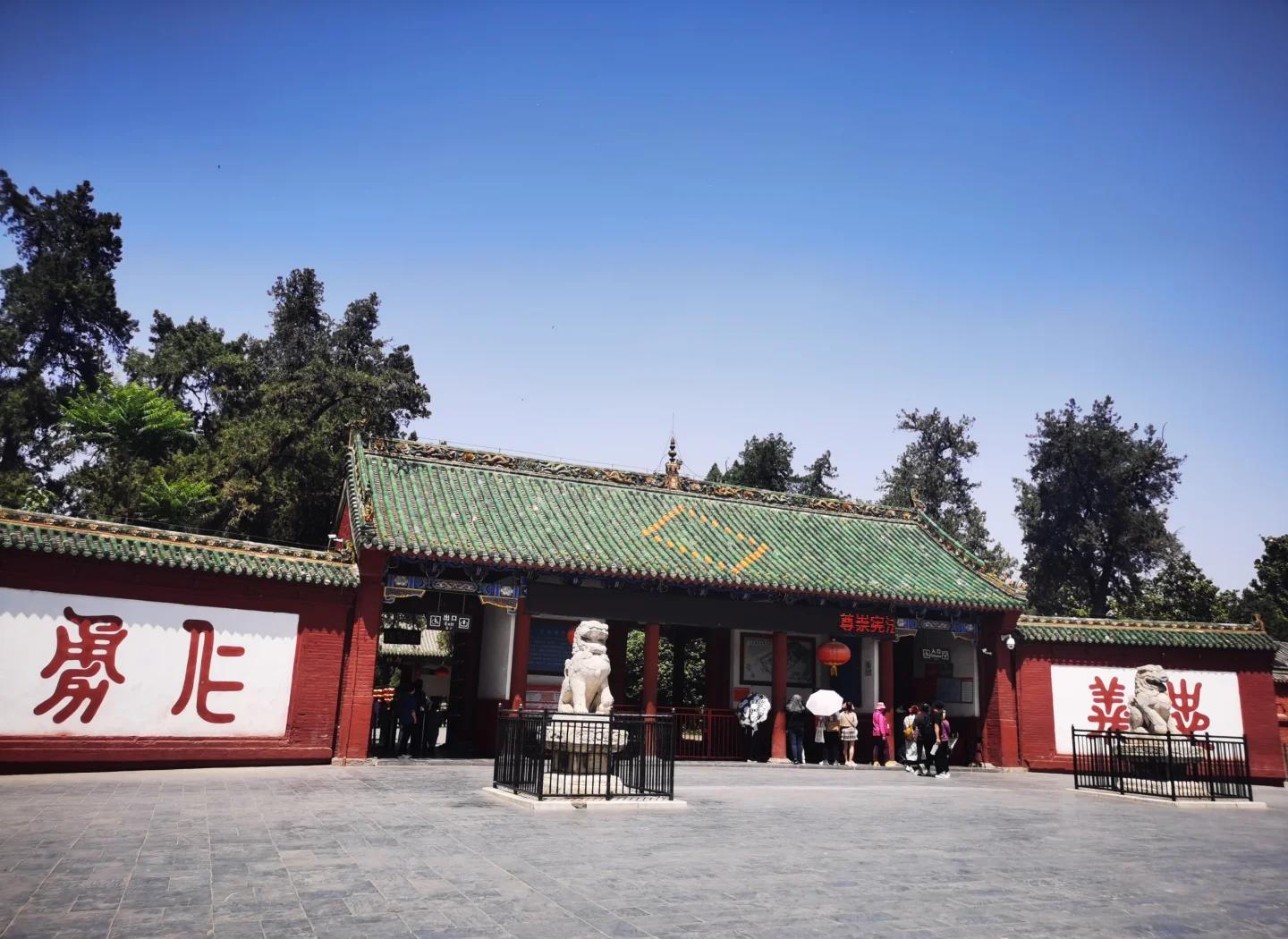
🪧 The Stele Groves & Ancient Cypresses
- The Story: Commemorative tablets and old trees crowding the courtyards.
- What to Look For: Inscriptions donated across the dynasties, and the solemn greenery that gives a ‘lin’ its feel.
3. Cultural Contrast: How a Man Becomes a God
For a foreign visitor Guanlin is the most concentrated lesson in Chinese popular religion available near Luoyang: here history, myth and commerce fuse in one man. Guan Yu’s earthly loyalty was elevated into a cosmic virtue, so he is simultaneously a Three Kingdoms general, a Confucian moral exemplar, a Buddhist and Daoist protector, and a god of fair dealing — which is why modern business owners still burn incense to him. That layered sanctification has no neat Western parallel.
The Three Kingdoms story that animates it — the oath in the peach garden, the journeys, the betrayal and death — is to Chinese culture something like Homer is to ours, and Guanlin is where its most beloved hero literally lies. Read a page of the saga before you come and the steles and shrines turn from decoration into narrative. Positioned between the city and Longmen, it slots easily into a grottoes day — just budget a separate admission and a slower pace.
4. Practical Essentials: Tickets, Transit & Scam Alerts
Tickets & Passport Booking
- Price: Standalone temple-mausoleum admission at its own gate; not bundled with Longmen, and no official figure is fixed here — third-party listings are non-official, confirm at the site.
- Passport & booking: Buy at the gate or the site’s own channel with your passport document; don’t assume online passport purchase works like a Chinese ID.
How to Get There
- Where it is: In Luolong district on Guanlin South Street, between Luoyang’s centre and the Longmen Grottoes — a convenient pairing with the grottoes (separate tickets). There is no official drive time quoted to the airport or high-speed station for this city — allow real time.
- Show Your Driver: 师傅,请带我到关林(洛阳,洛龙区关林),谢谢!
Inside Tips & Scam Alerts
- Know the Guan Yu story first — a paragraph on the Three Kingdoms transforms the visit. Buy its own ticket; don’t expect a Longmen combo. Respect active worship — it is a shrine, not just a museum. Complaints / lost property: 12345, free from a local number.
Quick Answers
The 5 things visitors ask before setting out, answered from the same verified record used across this page.
- What are the opening hours at Guanlin Temple?
- A day visiting site with hours set by the temple's own operator; there is no single confirmed all-year timetable relied on here, so check the day's posted opening window before arriving, especially off-season. It is a compact walkable complex, so leave ample time for the axial halls and stele groves without needing to plan around a scheduled event.
- Is Guanlin Temple wheelchair accessible?
- Not fully. A traditional temple-mausoleum of terraced halls, thresholds and courtyard groves; paths are paved but hall platforms are stepped, and step-free access through the whole complex is unverified.
- How do I tell a taxi driver to take me to Guanlin Temple?
- Copy this line into DiDi or show it to the driver: 师傅,请带我到关林(洛阳,洛龙区关林),谢谢!
- Can I leave my luggage at Guanlin Temple?
- No visitor lockers noted at the gate — carry light, or stop here en route to Longmen with bags at your hotel.
- Is there anything to watch out for at Guanlin Temple?
- The main confusion is geography and ticketing: Guanlin sits between the city and Longmen, so it is easy to lump into a 'Longmen day', but the two sell completely separate admissions — buy Guanlin's own ticket at its own gate, not a vague combo. The site itself is honest and low-risk; the other watch-out is expectation — this is a temple-tomb dedicated to a deified general, rich in steles, cypresses and Guan Yu lore. If you don't know the Three Kingdoms story, read a paragraph beforehand or the exhibits lose much of their point.
Where to go next
Three short lists, recomputed at build time from the same coordinates and categories as the pages themselves — no paid placement, no hand-picked names. Every card is a published guide.
Next stop in Luoyang
Straight-line distance from this spot, so you can judge what is walkable and what needs a taxi.


More like this, elsewhere in China
If landmark is what you came for, these are the closest equivalents you can reach in another city — ordered by distance, one city per card.


Change the subject
Deliberately a different category, for when one more temple or garden would blur into the last one.


Lists are derived from coordinates and category alone. Fix a wrong pin or re-tag a place and every list that mentions it moves with it.
Before you go · arrival essentials
Practical guides that pair with this kind of place — picked by category, not sponsored placement.