
Mount Songshan

The zone-ticket maze is the trap, not a rip-off: buy before you know which peaks you'll actually climb and you overpay for gates you never reach. If you only want the academy at the foot, a stand-alone ticket can beat a whole-zone combo. Also distrust the bus timing — a nominal short ride over 80 km of mountain road is really a good hour and a half; budget it. And the summit is 3–4°C cooler than the city, so carry a layer.
Taxi & Street Navigation Help
师傅,请带我到登封·嵩山(少室山/太室山景区),谢谢!
Opening Hours & Best Time
A broad daytime window (commonly quoted around 07:30–17:30) applies to the scenic areas, but with no official fixed timetable to reserve against and cable-car/mountain hours varying by season and weather — confirm on the day and allow real travel time.
💡 Pro Tip: Songshan is the 'Central Peak' of the Five Sacred Mountains and a UNESCO Global Geopark, but its distinction is a literary one — Confucian (Songyang Academy), Buddhist (Shaolin) and Taoist (Zhongyue Temple) heritage all crowd one valley. You don't do all of it in a day: pair Shaolin + Pagoda Forest + a Shaoshi cable-car climb as one day, or Songyang Academy + Taishi as a culture half-day. September–November turning leaves are the visual peak. The coordinates mark one Songshan scenic gate, not the 70 km range.
Accessibility & Luggage Lockers
Accessibility: ⚠️ Step thresholds, limited access
A mountain landscape of stone steps and cable cars — only the flat lower zones such as Zhongyue Temple are realistically wheeled; summit and gorge trails are not, and surfaces are uneven and slippery when wet.
🧳 Luggage Storage: Storage is only practical at each zone's visitor-centre counter on a case-by-case basis; on a day trip leave bags at a Dengfeng or Zhengzhou hotel.
Nearby Landmarks
The 2 places within reach of this spot — each one opens straight into Apple Maps or Amap, with the Chinese name you can show a driver.
Also worth pairing: Zhongyue Temple & Gaocheng Observatory, the Zhongyue zone — real picks, just left off the grid so the cards stay in pairs.
Chinese names and pins are matched against each city's own map data at build time; a place only gets Directions once its pin has been verified, otherwise the button searches by name.
About Mount Songshan
1. Historical Origins: The Mountain Where Three Teachings Met
Songshan is the ‘Central Peak’ of China’s Five Sacred Mountains, a system of two great ranges — Shaoshi and Taishi — whose seventy-two peaks run some seventy kilometres near Dengfeng. It is a UNESCO Global Geopark for its ancient geology, but its real signature is cultural: unlike the other sacred mountains, Songshan is a ‘mountain of letters’, where Confucian scholars lectured at Songyang Academy, Buddhists built Shaolin, and Taoists consecrated Zhongyue Temple, all in one valley, for two thousand years.
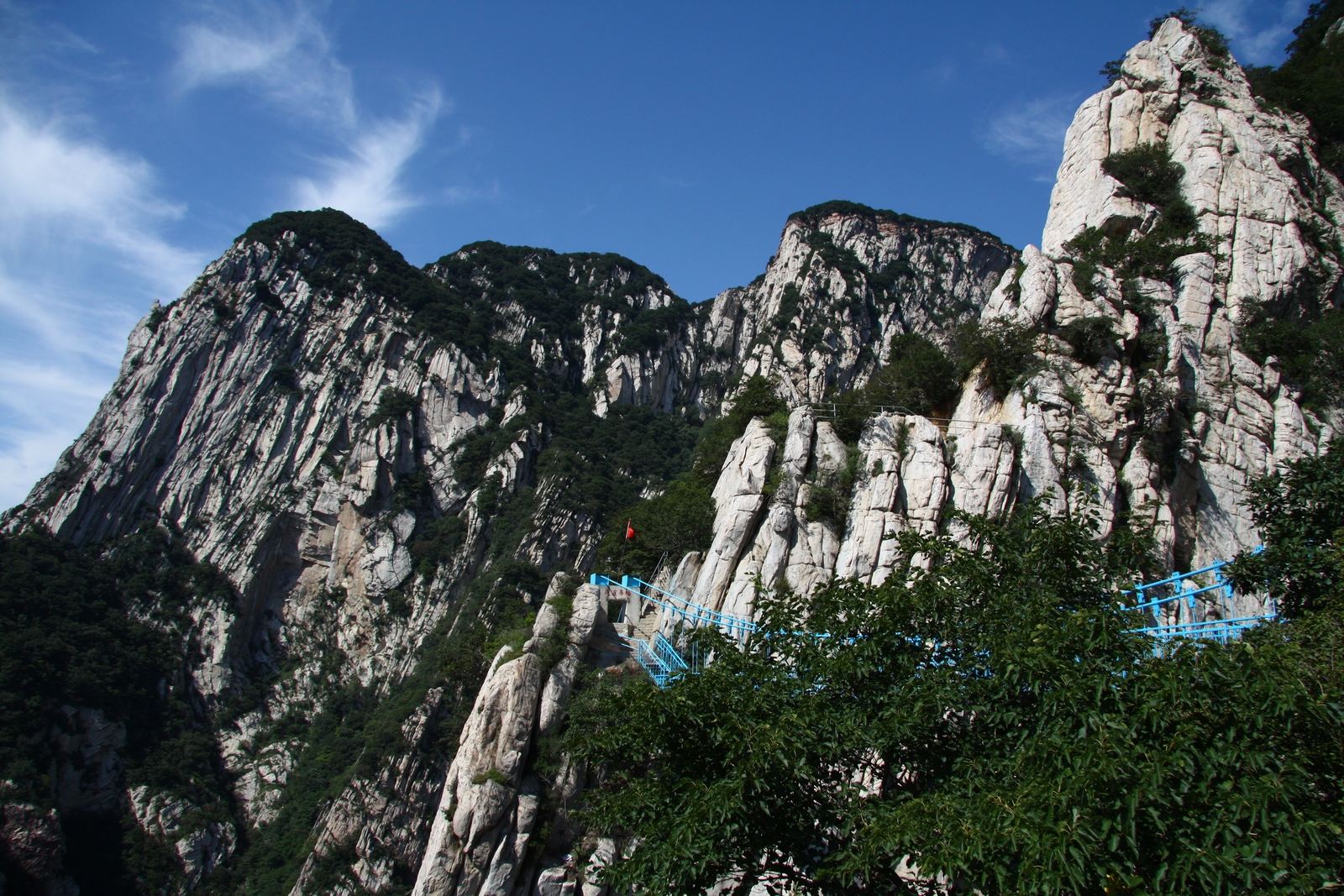
Because it sat beside old dynastic capitals, Songshan was a stage for imperial feng-and-shan sacrifices and for the birth of Song-dynasty Neo-Confucianism — the ideas of Cheng Yi and Cheng Hao were taught on its slopes. To climb Songshan is to walk through the physical layer-cake of Chinese thought.
2. What to Spot: The Ranges, the Zones, the Seasons
⛰️ Two Ranges, Seventy-Two Peaks
- The Story: Shaoshi (west, where Shaolin sits) and Taishi (east, where the academy and temple sit) are separate mountain systems with separate gates and tickets.
- What to Look For: Decide your range before you buy; they are kilometres apart and you cannot casually pop between them.
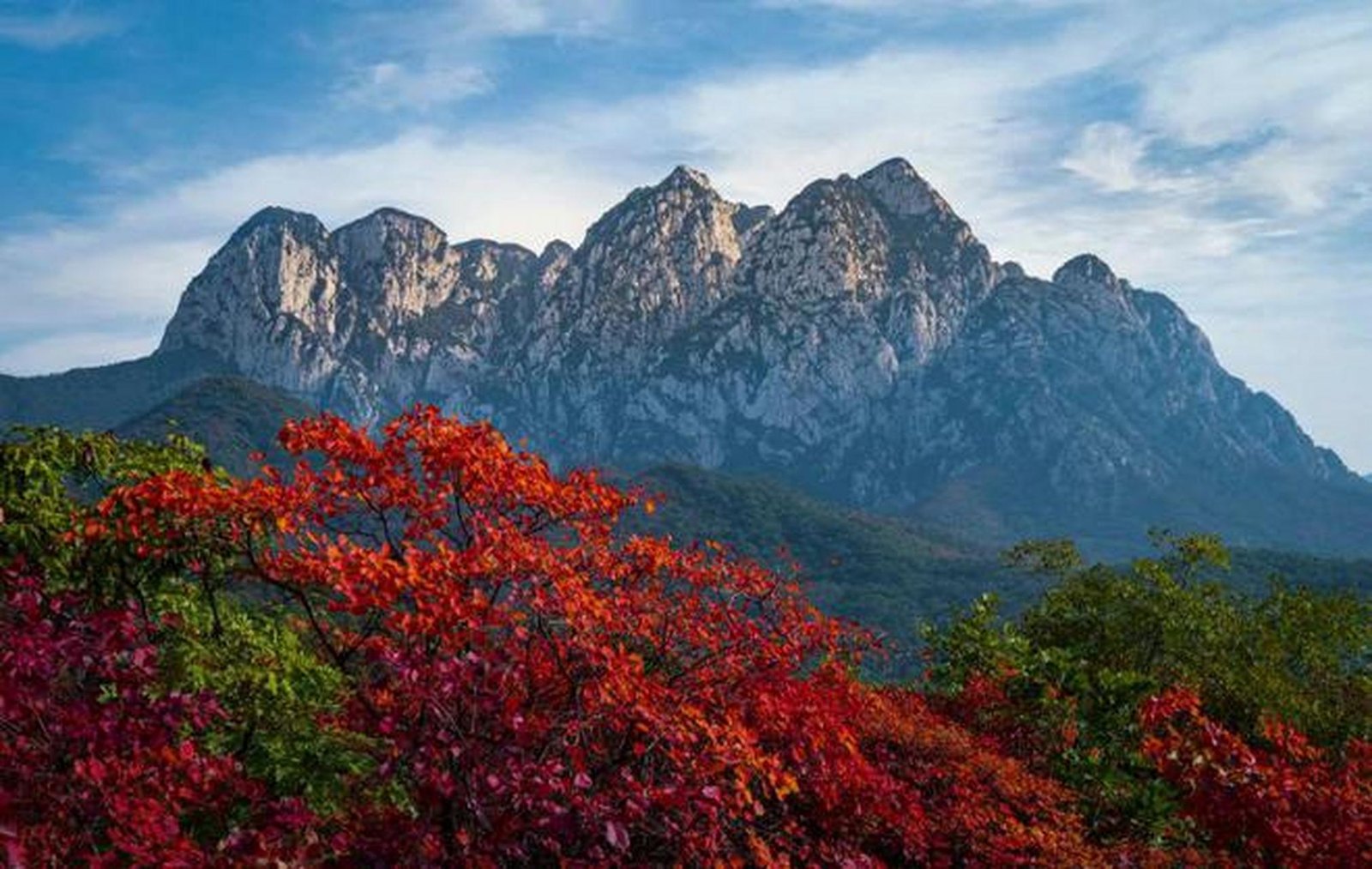
🍂 The Autumn Colours
- The Story: The region’s peak visual season is the turning of the leaves, roughly September to November, subject to the year.
- What to Look For: Reddened slopes against grey limestone; mornings are clearest and the summits run cold.
🏛️ The Three-Teaching Cluster
- The Story: Shaolin (Buddhist), Songyang Academy (Confucian) and Zhongyue Temple (Taoist) ring the mountain, each its own ticketed sight.
- What to Look For: The rare fact of all three of China’s traditions preserved within one small area — the mountain’s true ‘attraction’ is this density.
3. Cultural Contrast: A Sacred-Geography Day, Not a Summit Bag
Western hikers reach for a highest-point objective; Songshan rewards the opposite. Its significance is stratified culture — emperors sacrificing at the ‘world’s centre’, monks training, philosophers teaching, all below the same peaks — so the satisfying visit is a curated cultural day, not a gruelling ascent. Chasing all seventy-two peaks in one trip simply exhausts the budget and the legs.
That said, it is physically demanding if you let it be: real altitude, stone steps, cooler weather and a zone-ticket system that punishes impulse buying. The disciplined approach — pick two sights, buy only those tickets, ride a cable car for the view rather than the summit — is how foreign visitors leave satisfied. Do that and Songshan is the most intellectually concentrated mountain day in central China. If Shaolin is why you came, the genre-to-geography map on our wuxia places in China page explains what is real and what is film invention.
4. Practical Essentials: Tickets, Transit & Scam Alerts
Tickets & Passport Booking
- Price: Zone-based (Shaoshi / Songyang / Taishi / Zhongyue sold separately, some temples and the waterfall alone, cable cars extra); many conflicting figures, no fixed official rate, so none is quoted. Match the ticket to the zones you’ll enter and check the official page; passport purchase for foreigners.
- Hours: Approximate daytime window only; cable-car and mountain hours vary by season — confirm on the day.
How to Get There
- Where it is: Dengfeng, about 80 km southwest of Zhengzhou. A direct tourist bus runs, but mountain-road time is a real hour and a half despite shorter-sounding claims — budget it. The coordinates pin one scenic gate; the range itself is far larger.
- Show Your Driver: 师傅,请带我到登封·嵩山(少室山/太室山景区),谢谢!
Inside Tips & Scam Alerts
- Decide zones before paying; a single-foot-hill ticket can beat a combo. Carry a layer — the summit runs 3–4°C cooler. Complaints / lost property: 12345, free from a local number.
Quick Answers
The 5 things visitors ask before setting out, answered from the same verified record used across this page.
- What are the opening hours at Mount Songshan?
- A broad daytime window (commonly quoted around 07:30–17:30) applies to the scenic areas, but with no official fixed timetable to reserve against and cable-car/mountain hours varying by season and weather — confirm on the day and allow real travel time.
- Is Mount Songshan wheelchair accessible?
- Not fully. A mountain landscape of stone steps and cable cars — only the flat lower zones such as Zhongyue Temple are realistically wheeled; summit and gorge trails are not, and surfaces are uneven and slippery when wet.
- How do I tell a taxi driver to take me to Mount Songshan?
- Copy this line into DiDi or show it to the driver: 师傅,请带我到登封·嵩山(少室山/太室山景区),谢谢!
- Can I leave my luggage at Mount Songshan?
- Storage is only practical at each zone's visitor-centre counter on a case-by-case basis; on a day trip leave bags at a Dengfeng or Zhengzhou hotel.
- Is there anything to watch out for at Mount Songshan?
- The zone-ticket maze is the trap, not a rip-off: buy before you know which peaks you'll actually climb and you overpay for gates you never reach. If you only want the academy at the foot, a stand-alone ticket can beat a whole-zone combo. Also distrust the bus timing — a nominal short ride over 80 km of mountain road is really a good hour and a half; budget it. And the summit is 3–4°C cooler than the city, so carry a layer.
Where to go next
Three short lists, recomputed at build time from the same coordinates and categories as the pages themselves — no paid placement, no hand-picked names. Every card is a published guide.
Next stop in Zhengzhou
Straight-line distance from this spot, so you can judge what is walkable and what needs a taxi.


More like this, elsewhere in China
If park or garden is what you came for, these are the closest equivalents you can reach in another city — ordered by distance, one city per card.


Change the subject
Deliberately a different category, for when one more temple or garden would blur into the last one.


Lists are derived from coordinates and category alone. Fix a wrong pin or re-tag a place and every list that mentions it moves with it.
Before you go · arrival essentials
Practical guides that pair with this kind of place — picked by category, not sponsored placement.