
Erlitou Site Museum of the Xia Capital

With an unconfirmed ticket basis, the trap is assumption in both directions — don't arrive certain it's free, and don't buy a vague combo that quietly folds it into a 'Longmen/Luoyang' pass; Erlitou is separately run and separately booked. Confirm price, reservation and hours officially first. The bigger practical risk is transport: the museum sits well outside the city near Yanshi, so a taxi or self-drive with a return plan is essential, and there is no official drive-time figure to rely on — budget real time rather than trusting a mapping estimate.
Taxi & Street Navigation Help
师傅,请带我到二里头夏都遗址博物馆(洛阳偃师),谢谢!
Opening Hours & Best Time
No confirmed official timetable is relied on for this museum here. State and site museums commonly run a Tuesday-to-Sunday daytime schedule with Mondays closed, but treat that as a likely convention to check rather than a fact — confirm the day's opening hours and last-entry time on the official channel, especially given the site's distance from Luoyang, where a wrongly-assumed closed day costs a long, wasted trip.
💡 Pro Tip: Erlitou is the flagship of the 'earliest China' idea: the site is widely identified as a late-Xia-dynasty capital and has yielded China's earliest palatial city, its earliest axially-planned palace complex, its earliest cluster of bronze ritual vessels, and the turquoise-inlay dragon plaque dubbed the 'first dragon of Huaxia'. The museum's own architecture plays on that dragon motif, and the star relics to hunt are the turquoise dragon-and-inlay piece and the spudded bronze jue goblet called the 'first jue of Huaxia' — the physical evidence that a bronze-age royal court stood here around 3,800 years ago. It is remote, so pair it thoughtfully (some combine it with Luoyang city sights or Longmen across two days, not one).
Accessibility & Luggage Lockers
Accessibility: ⚠️ Step thresholds, limited access
A modern single-storey-dominant museum building with level galleries and lifts as a rule, so wheeled access inside is generally reasonable; the long approach and any outdoor site areas vary — confirm current access on site.
🧳 Luggage Storage: Cloakroom/storage is typical of museums of this class but unverified here — check on arrival, and travel light given the remote location.
Nearby Landmarks
The 2 places within reach of this spot — each one opens straight into Apple Maps or Amap, with the Chinese name you can show a driver.
- Luoyang city (Longmen, Luoyang Museum) far to the west — a separate legMuseumNearby
Chinese names and pins are matched against each city's own map data at build time; a place only gets Directions once its pin has been verified, otherwise the button searches by name.
About Erlitou Site Museum of the Xia Capital
1. Historical Origins: Searching for the Earliest China
The Erlitou site takes its name from a village in Yanshi, east of Luoyang, but its significance reaches to the beginning of Chinese civilisation itself. Excavations here uncovered a large Bronze Age settlement — a planned palatial city with axial palace complexes, foundry quarters and elite graves — that many scholars identify as a capital of the Xia dynasty, the semi-legendary first dynasty that tradition places before the Shang. If that reading holds, Erlitou is the strongest physical candidate for ‘the earliest China’.
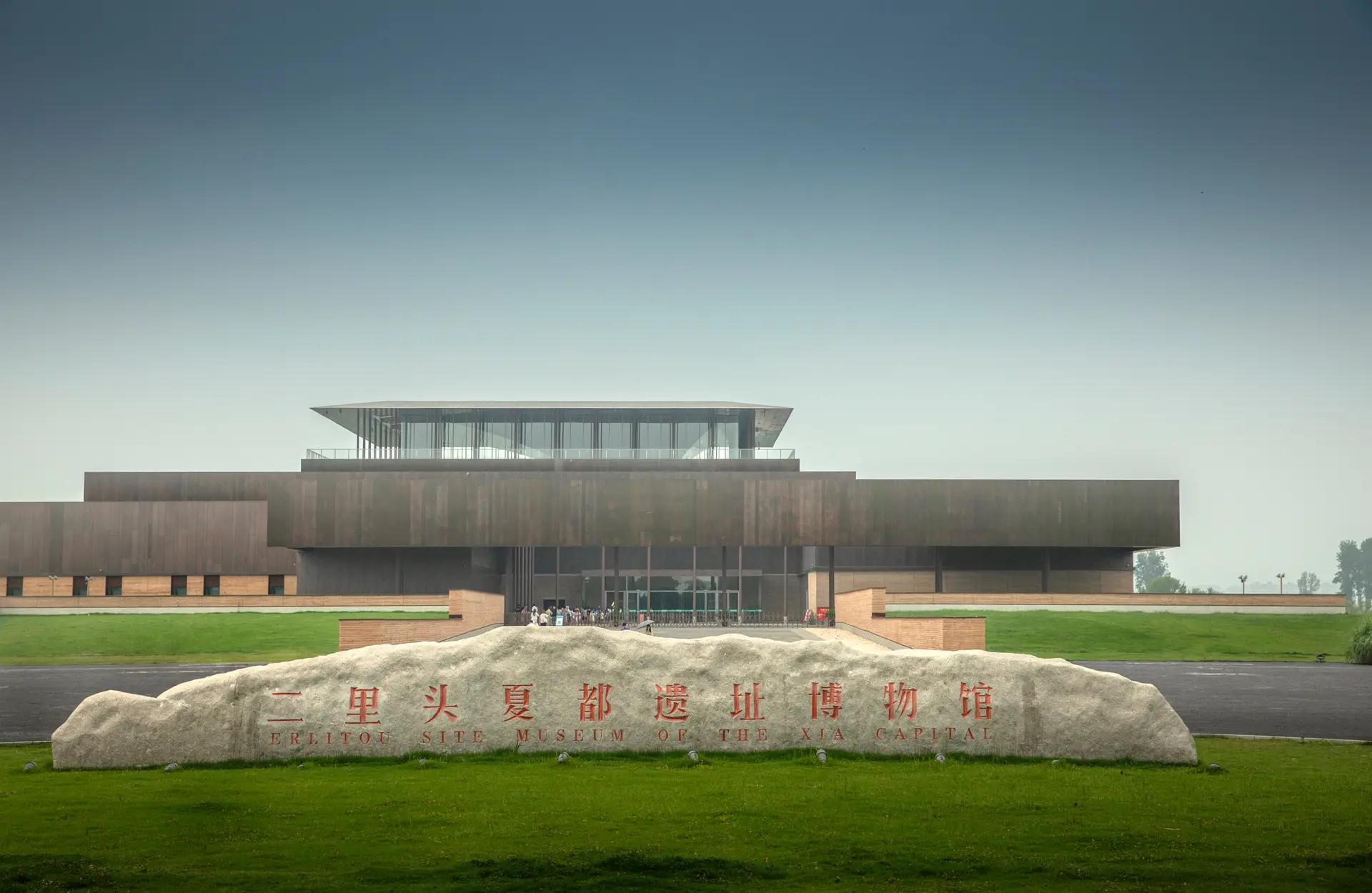
Dating to roughly 1900–1500 BCE, the site yields a string of ‘earliest’ records: China’s first palatial city layout, its earliest assemblage of cast bronze ritual vessels, and luxury crafts including a green-turquoise inlay dragon. The Erlitou Site Museum of the Xia Capital was built nearby to house and frame these finds, turning an archaeological park into a readable argument about where Chinese state civilisation began.
2. What to Spot: The Turquoise Dragon, the First Bronze Jue, the Palace Plan
🐉 The Turquoise Inlay Dragon
- The Story: A small dragon-form plaque built from thousands of turquoise pieces, the emblem of the site and nickname ‘first dragon of Huaxia’.
- What to Look For: The craftsmanship of the inlay and the dragon’s place in the genealogy of a creature that would come to symbolise China itself.
🍶 The Spudded Bronze Jue
- The Story: A cast bronze ritual wine vessel with rows of ‘nipple’ bosses, hailed as the ‘first jue of Huaxia’.
- What to Look For: The technology and authority implied by early bronze casting — ritual power made durable.

🏛️ The Palace-City Plan & Archaeology
- The Story: Models and remains of the earliest axial palatial city and its workshops.
- What to Look For: The grid of roads and foundations that shows a planned royal capital, not a village, at the dawn of the Bronze Age.
3. Cultural Contrast: Where the Chinese Origin Story Gets Evidence
Erlitou matters to foreign visitors because it is where China’s founding narrative moves from myth toward archaeology. Textbooks once treated the Xia as legendary; Erlitou offers the material that lets scholars argue it was a real early state. Standing before the turquoise dragon and the bronze jue, a visitor is seeing the earliest tangible claims in a national story about civilisation’s deep roots — a powerful, if scholarly, experience.
That scholarly weight is also the caveat: unlike a temple or the grottoes, Erlitou rewards curiosity about origins more than it dazzles casually, and much of the meaning comes through labels, models and (ideally) a guide, so some background pays off. Its remote Yanshi location and independent ticketing make it a deliberate add-on rather than a drop-in Luoyang sight. For anyone following the ‘how did China begin’ thread — especially combined with Luoyang Museum’s dynastic sweep — the detour is richly worth it; for a quick highlights tour it can be skipped.
4. Practical Essentials: Tickets, Transit & Scam Alerts
Tickets & Passport Booking
- Price: Unconfirmed from official sources here — site museums are often free-with-reservation but this one is independently run; no figure is fixed or assumed. Verify tariff and reservation status on the museum’s official channel.
- Passport & booking: Confirm hours and booking officially before the trip (Mondays commonly closed as a convention, not a guarantee); bring your passport and don’t expect a Longmen pass to cover it.
How to Get There
- Where it is: Near Erlitou village in Yanshi district, east of Luoyang and a significant drive from the city — arrange a taxi or self-drive with a return plan. There is no official drive time for this city; allow generous real time rather than trusting a mapping estimate.
- Show Your Driver: 师傅,请带我到二里头夏都遗址博物馆(洛阳偃师),谢谢!
Inside Tips & Scam Alerts
- Go with the origin-story in mind and use labels/a guide — the finds carry meaning, not just beauty. Check ticket + hours + reopening before driving out; a wasted long trip is the real cost. Budget it as its own half-day, not a footnote to Longmen. Complaints / lost property: 12345, free from a local number.
Quick Answers
The 5 things visitors ask before setting out, answered from the same verified record used across this page.
- What are the opening hours at Erlitou Site Museum of the Xia Capital?
- No confirmed official timetable is relied on for this museum here. State and site museums commonly run a Tuesday-to-Sunday daytime schedule with Mondays closed, but treat that as a likely convention to check rather than a fact — confirm the day's opening hours and last-entry time on the official channel, especially given the site's distance from Luoyang, where a wrongly-assumed closed day costs a long, wasted trip.
- Is Erlitou Site Museum of the Xia Capital wheelchair accessible?
- Not fully. A modern single-storey-dominant museum building with level galleries and lifts as a rule, so wheeled access inside is generally reasonable; the long approach and any outdoor site areas vary — confirm current access on site.
- How do I tell a taxi driver to take me to Erlitou Site Museum of the Xia Capital?
- Copy this line into DiDi or show it to the driver: 师傅,请带我到二里头夏都遗址博物馆(洛阳偃师),谢谢!
- Can I leave my luggage at Erlitou Site Museum of the Xia Capital?
- Cloakroom/storage is typical of museums of this class but unverified here — check on arrival, and travel light given the remote location.
- Is there anything to watch out for at Erlitou Site Museum of the Xia Capital?
- With an unconfirmed ticket basis, the trap is assumption in both directions — don't arrive certain it's free, and don't buy a vague combo that quietly folds it into a 'Longmen/Luoyang' pass; Erlitou is separately run and separately booked. Confirm price, reservation and hours officially first. The bigger practical risk is transport: the museum sits well outside the city near Yanshi, so a taxi or self-drive with a return plan is essential, and there is no official drive-time figure to rely on — budget real time rather than trusting a mapping estimate.
Where to go next
Three short lists, recomputed at build time from the same coordinates and categories as the pages themselves — no paid placement, no hand-picked names. Every card is a published guide.
Next stop in Luoyang
Straight-line distance from this spot, so you can judge what is walkable and what needs a taxi.


More like this, elsewhere in China
If landmark is what you came for, these are the closest equivalents you can reach in another city — ordered by distance, one city per card.


Change the subject
Deliberately a different category, for when one more temple or garden would blur into the last one.


Lists are derived from coordinates and category alone. Fix a wrong pin or re-tag a place and every list that mentions it moves with it.
Before you go · arrival essentials
Practical guides that pair with this kind of place — picked by category, not sponsored placement.