
Puguang Temple (White Sheep Monastery)

Volunteers inside will offer 'free' incense and a blessing, then present a donation book with suggested amounts of several hundred yuan — decline politely and walk on; nothing is compulsory. Fortune-tellers in the forecourt charge by 'whatever your heart says', which in practice means a hard number.
Taxi & Street Navigation Help
师傅,请带我到普光禅寺(人民路),谢谢!
Opening Hours & Best Time
08:00 - 17:30
💡 Pro Tip: Come at 08:30 when the courtyards are empty and the light comes in sideways through the main hall. Twenty minutes of quiet, then walk ten minutes to the city museum — the two together make a proper half-day of Zhangjiajie's non-mountain history.
Accessibility & Luggage Lockers
Accessibility: ⚠️ Step thresholds, limited access
Traditional temple layout with high thresholds and stone steps between courtyards; a wheelchair can reach the first courtyard but not the halls.
🧳 Luggage Storage: The gate office will hold a bag; no lockers.
Nearby Landmarks
The 2 places within reach of this spot — each one opens straight into Apple Maps or Amap, with the Chinese name you can show a driver.
 土家风情园·九重天吊脚楼Tujia Folk ParkHistoric districtShort ride away2.34 km2 km
Chinese names and pins are matched against each city's own map data at build time; a place only gets Directions once its pin has been verified, otherwise the button searches by name.
About Puguang Temple (White Sheep Monastery)
1. Historical Origins: Five Centuries Before the Tourists
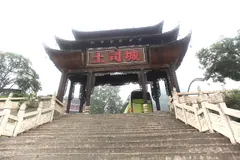
Puguang Temple is the oldest building in Zhangjiajie, and it predates the idea of Zhangjiajie as a destination by more than five hundred years. It was founded in 1414, the twelfth year of the Yongle reign of the Ming, and extended in the Qing; the alternative name, White Sheep Monastery, is older still in local usage.
The main hall is the reason to walk slowly: it is a beamless hall, built of brick vaulting with no timber span anywhere, which is unusual at this latitude and survives precisely because there is nothing in it to rot. Beneath the ridge there is a coffered ceiling; the columns are Ming stone. A bell tower and a drum tower face each other across the courtyard, and two ginkgo trees in that courtyard are about six hundred years old — roughly contemporary with the foundation.
This is not a museum piece. It is a working Chan Buddhist temple with resident monks, which changes how you should behave and what the tickets actually are.

2. What to Spot: A Beamless Hall and Six Hundred Years of Ginkgo
🏯 The Beamless Main Hall
- The Story: A hall of brick vaults and Ming stone columns, standing without a single wooden beam.
- What to Look For: Look up. The coffered ceiling under the ridge is the detail everyone misses; the vault geometry is why the building has survived earthquakes and fire.
🌳 The Ginkgo Courtyard
- The Story: Two trees of about six hundred years, planted around the time the temple was founded.
- What to Look For: Late November, when they turn. Otherwise, the shade is what makes the courtyard bearable at midday.
🔔 Bell and Drum Towers
- The Story: The paired towers that structure monastic time, facing each other across the yard.
- What to Look For: From the courtyard corner, both towers frame the hall at once — the composition the temple was designed around.


3. Cultural Contrast: A Religious Site, Not an Attraction
This is the distinction that matters most here, and it is where foreign visitors get caught out. Puguang is a religious and heritage-protected site rather than a scenic area, so its ticket is not governed by the development-reform price filings that cap the mountains, it can change without public notice, and a price complaint does not work the same way. Treat the window as the only authority.
The other difference is etiquette. Chinese visitors — especially older ones from the city — come to burn incense and leave, often in ten minutes. Foreign visitors tend to arrive expecting architecture and take an hour, which is fine as long as you remember the halls are in use: no photographs of the images, shoulders and knees covered, voices down. The monks are not exhibits, and the courtyard’s quiet is the actual attraction.

4. Practical Essentials: Tickets, Transit & Scam Alerts
Tickets & Passport Booking
- Price: ¥80 at the gate, the figure carried in the municipal opening notice of July 2019. It is the temple’s own ticket rather than a government-filed scenic-area tariff, so it can move without notice — confirm at the window and do not buy from touts.
- Concessions: half price for students and for visitors aged 60–65; free for serving military and over-65s; local residents with ID pay a reduced rate.
- How to Book: No passport registration and no advance booking — you buy at the gate.
How to Get There
- On Foot: Central Yongding District near People’s Square. Walkable from most downtown hotels, or about ¥10 by taxi.
- Combining It: The city museum is 3 km away and the Tianmen cableway station 4 km — the temple plus the museum is a proper half-day of non-mountain Zhangjiajie.
- Show Your Driver: 师傅,请带我到普光禅寺。谢谢!
Inside Tips & Scam Alerts
- Come at 08:30. The courtyards are empty, the light comes in sideways through the main hall, and you catch the ordinary monastic morning. No photography of the images inside the halls.
- Decline the volunteers offering ‘free’ incense and a blessing. Nine times out of ten a donation book follows, with suggested amounts in the hundreds. Nothing is compulsory; decline politely and walk on. Under Chinese law donations must be voluntary and monks may not demand money.
- Refuse the ‘guide’ who wants to introduce you to a master for a reading and a ¥300–2,000 blessing ritual. This is the standard script; do not follow anyone who approaches you first.
- The fortune-tellers in the forecourt charge ‘whatever your heart says’, which in practice means a hard number. Skip them.
- Buy incense from the small stalls outside for a few yuan rather than the blessing packages sold inside at several hundred.
- Dress properly: shoulders and knees covered inside the halls, and it is enforced.
- Accessibility: the courtyards are level with only two low thresholds; the halls themselves have steps. Bags can usually be left at the office by the gate — informal, but ask.
- Complaints: the national 12345 hotline is free to call from any local phone.
Quick Answers
The 6 things visitors ask before setting out, answered from the same verified record used across this page.
- How much does it cost to visit Puguang Temple (White Sheep Monastery)?
- ≈¥80 at the gate.
- What are the opening hours at Puguang Temple (White Sheep Monastery)?
- 08:00 - 17:30.
- Is Puguang Temple (White Sheep Monastery) wheelchair accessible?
- Not fully. Traditional temple layout with high thresholds and stone steps between courtyards; a wheelchair can reach the first courtyard but not the halls.
- How do I tell a taxi driver to take me to Puguang Temple (White Sheep Monastery)?
- Copy this line into DiDi or show it to the driver: 师傅,请带我到普光禅寺(人民路),谢谢!
- Can I leave my luggage at Puguang Temple (White Sheep Monastery)?
- The gate office will hold a bag; no lockers.
- Is there anything to watch out for at Puguang Temple (White Sheep Monastery)?
- Volunteers inside will offer 'free' incense and a blessing, then present a donation book with suggested amounts of several hundred yuan — decline politely and walk on; nothing is compulsory. Fortune-tellers in the forecourt charge by 'whatever your heart says', which in practice means a hard number.
Where to go next
Three short lists, recomputed at build time from the same coordinates and categories as the pages themselves — no paid placement, no hand-picked names. Every card is a published guide.
Next stop in Zhangjiajie
Straight-line distance from this spot, so you can judge what is walkable and what needs a taxi.


More like this, elsewhere in China
If temple is what you came for, these are the closest equivalents you can reach in another city — ordered by distance, one city per card.


Change the subject
Deliberately a different category, for when one more temple or garden would blur into the last one.


Lists are derived from coordinates and category alone. Fix a wrong pin or re-tag a place and every list that mentions it moves with it.
Before you go · arrival essentials
Practical guides that pair with this kind of place — picked by category, not sponsored placement.