
Wulong Karst (Three Natural Bridges)

The geography scam: '¥99 Wulong + Dazu day tour' is physically impossible — the two sites are 200 km apart on opposite sides of Chongqing. Any tour offering both in one day is selling you a bus ride and one site. Also: unlicensed drivers at Wulong county station quoting flat rates — use the official scenic-area shuttle; and the glass viewing platform inside is an optional ¥50 upsell, not a required ticket.
Taxi & Street Navigation Help
师傅,请带我到武隆天生三桥景区游客中心。谢谢!
Opening Hours & Best Time
08:00 - 16:00 (last entry); summer high season may extend
💡 Pro Tip: Take the 07:30 high-speed train from Chongqing North to Wulong (1.5 h), then the official shuttle bus to the scenic area (30 min). You'll be at the bridges by 10:00, ahead of the tour-bus wave from Chongqing that arrives after 11:00. The descent is by glass elevator + escalator; the walk back up is via a different canyon path — the full loop is 3-4 hours.
Accessibility & Luggage Lockers
Accessibility: ⚠️ Step thresholds, limited access
The glass elevator and escalators handle the initial descent, but the canyon floor loop involves 2-3 km of stepped and uneven path with stairs — not wheelchair viable. Not recommended for serious knee problems.
🧳 Luggage Storage: Lockers at the visitor center (large, fit backpacks).
Nearby Landmarks & A Short Train Ride
The 4 places worth pairing with this spot — each one opens straight into Apple Maps or Amap, with the Chinese name you can show a driver. One pick sits in Chengdu (HSR ~1 h 2 min) — a short high-speed ride, not a walk. Chongqing's own list came out one short of a pair, and this is the nearest pick that fills it.
Chinese names and pins are matched against each city's own map data at build time; a place only gets Directions once its pin has been verified, otherwise the button searches by name. Cards with an amber city tag are in another city — the ride time shown is the fastest train of the day.
About Wulong Karst (Three Natural Bridges)
1. Historical Origins: A River That Ate the Limestone
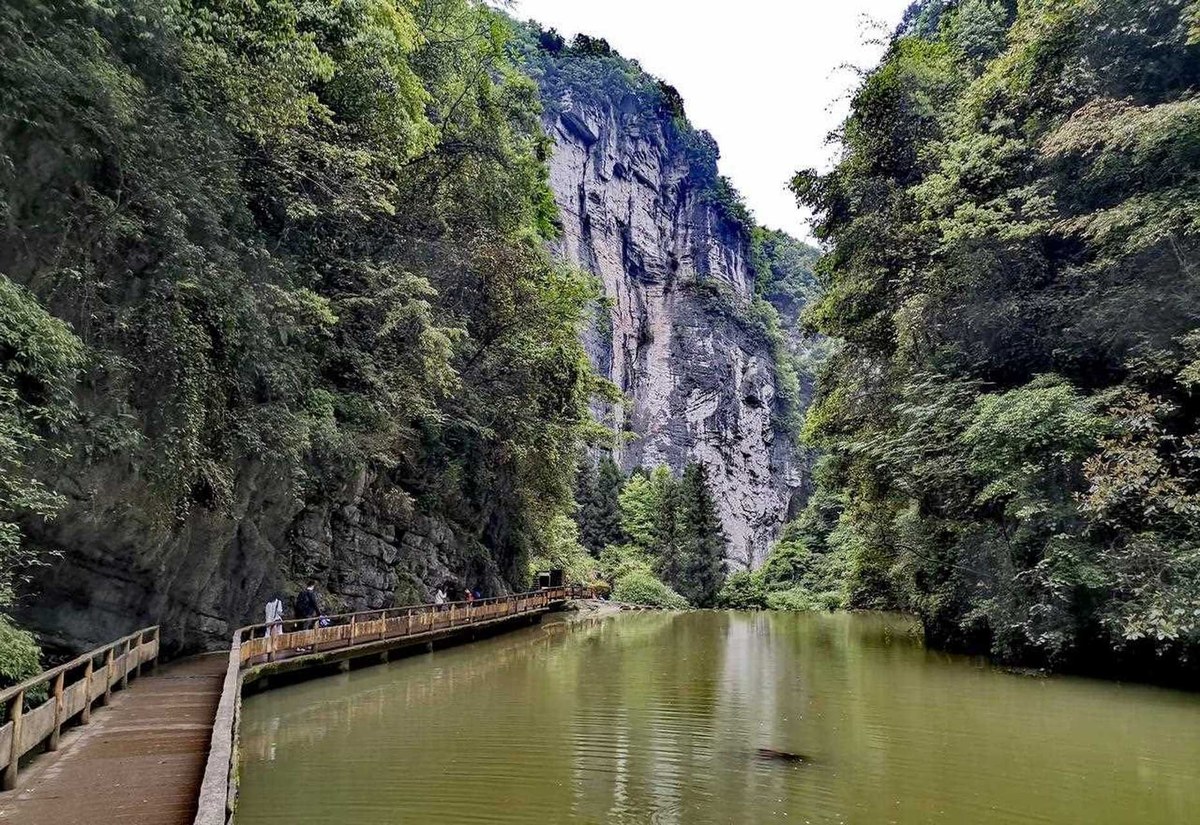
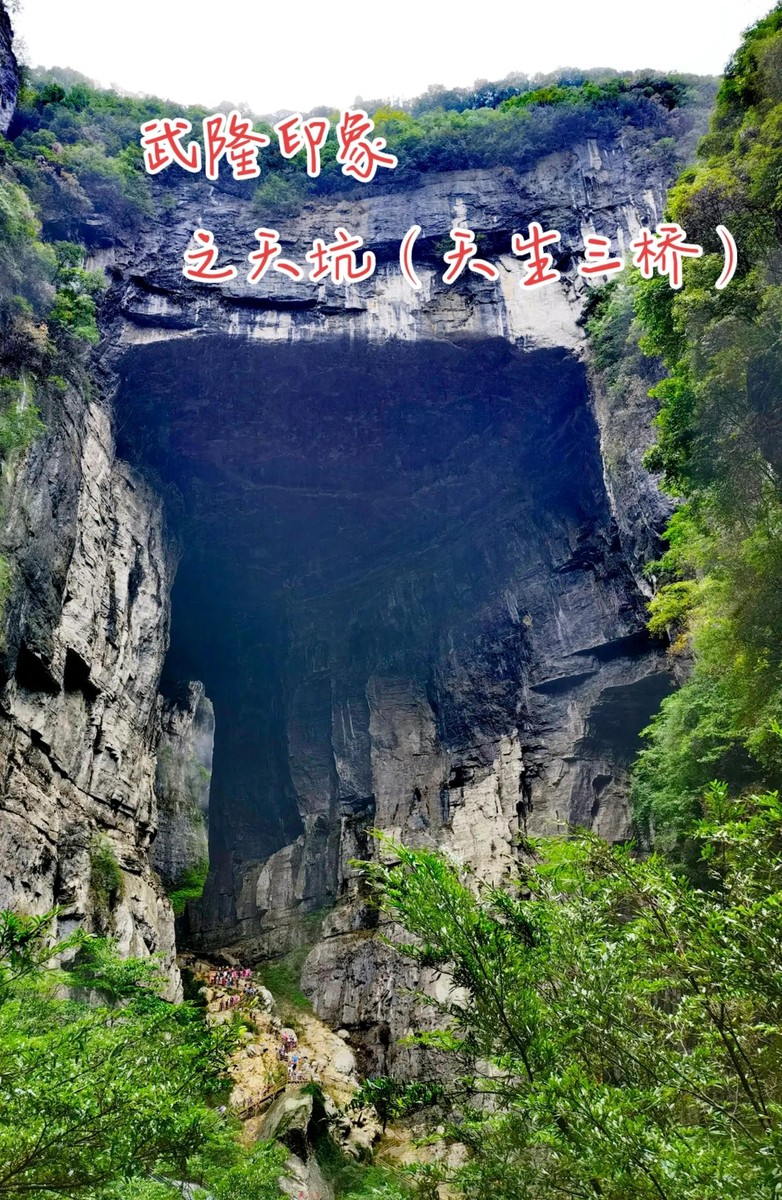
The bridges at Wulong are not bridges. They are the roofs of caves whose walls have collapsed — three natural limestone arches left standing across a gorge after the rock beneath them was dissolved and carried away by water over a period no human history can hold in view.
The scale is the thing nobody is prepared for. Each arch stands around two hundred metres high, and they come in sequence: you walk down into the gorge, pass under the first, follow the canyon, pass under the second, then the third, and come out at the far end. The site is part of the South China Karst, inscribed by UNESCO as a World Heritage property, and it is the best-known example in the country of what geologists call a tiankeng — a collapsed karst sinkhole.
Two films put it on the map for Chinese audiences, and one of them for everybody else: a period epic and a robot film both used the arches as locations. The old post station built into the rock under the first arch is now the most photographed structure in the landscape, which is ironic given that it was reconstructed for the cameras.
2. What to Spot: Three Arches and a Post Station
🌉 Tianlong Bridge
- The Story: The first and largest of the three, with the reconstructed post station built against the rock beneath it.
- What to Look For: The angle from the gorge floor looking up. The arch frames the sky, and the station gives the whole thing a human scale it would otherwise lack.
🪨 Qinglong Bridge
- The Story: The middle arch, on the canyon path between the other two, with a spring dripping from its underside.
- What to Look For: The water. The whole landscape was made by water dissolving limestone, and it is still doing it.
🕳️ Heilong Bridge
- The Story: The last of the three, opening onto the far end of the gorge where the path climbs out.
- What to Look For: Looking back once you are through. The alignment of all three arches in one line is visible only from the exit.
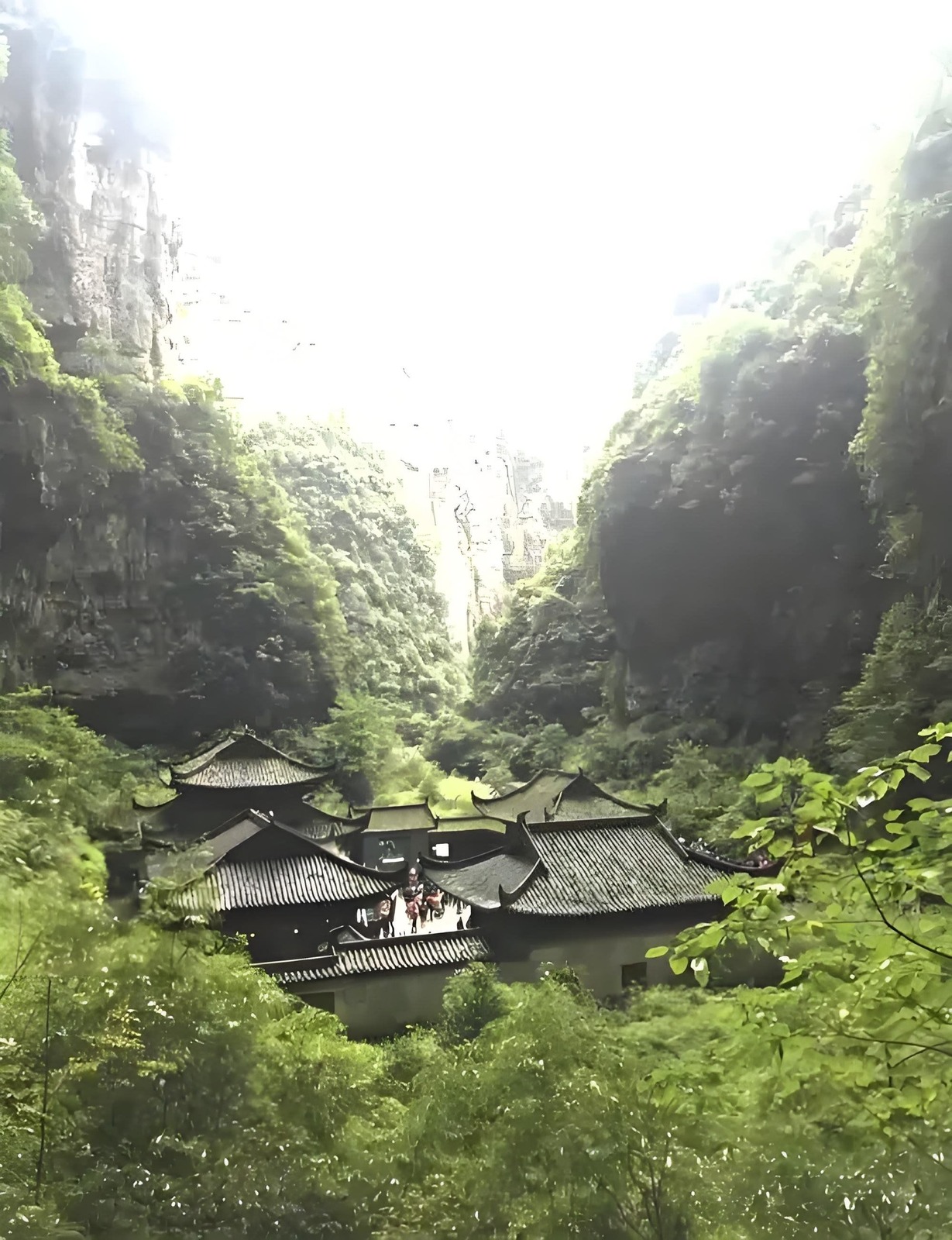
🏚️ The Post Station
- The Story: A timber building set into the cliff under the first arch: the relay station of the old courier routes, rebuilt for filming and kept as scenery.
- What to Look For: The way it sits against the rock — dark timber, deep eaves, and a roof dwarfed by the stone above it.
3. Cultural Contrast: Landscape That Does Not Need a Story
Chinese scenic areas are usually organised around a narrative: a poem, an immortal, a temple, a legend carved on a rock. Wulong has almost none of that, and it does not need it. The arches are impressive in a way that requires no explanation, and the experience is essentially geological — walk down, look up, walk on.
What the site has instead is infrastructure: an escalator descending into the gorge, a paved path along the floor, a lift back up, and a glass viewing platform cantilevered out over the drop as an optional extra. That combination is worth understanding before you go, because it means the scenery is accessible and also that you will not be alone in it.
The comparison is with the city. Chongqing’s urban attractions are all vertical problems solved with engineering; Wulong is a vertical landscape that no engineering was needed for. Seeing both in one trip is the reason the day out is worth the distance.
4. Practical Essentials: Tickets, Transit & Scam Alerts
Tickets & Passport Booking
- Price: Ticketing here is complicated — admission, shuttle, lift and the optional glass platform are priced separately or bundled in different combinations, and published figures conflict widely. Check the official Wulong scenic area channels on the day. Book a time slot in advance and bring your passport.
- Opening Hours: Daytime with a last-entry cut-off in the afternoon, extended in the summer high season. Confirm before you travel, because the gate closes well before dark.
- Note: This is a UNESCO World Heritage property and a national 5A scenic area; expect airport-style organisation, shuttle buses and timed entry.
How to Get There
- By High-Speed Train: Chongqing North to Wulong, roughly an hour, then the official shuttle bus from the station to the visitor centre.
- Alternatively: Long-distance coaches from the city, or a licensed day tour. Wulong is about 180 km from the centre and takes a full day either way.
- Show Your Driver: 师傅,去武隆游客中心(仙女山),我要去天生三桥,谢谢!
Inside Tips & Scam Alerts
- There is no such thing as a Wulong-and-Dazu day tour. The two sites are on opposite sides of Chongqing, hundreds of kilometres apart. Anyone selling both in one day is selling a bus ride and one stop.
- Use the official shuttle from Wulong station. Flat-rate drivers outside the station will take you the long way or add stops.
- The glass viewing platform is optional. It is an add-on ticket, and the gorge floor — where you actually walk under the arches — is the point of the visit.
- Start early. Tour coaches from the city arrive late in the morning; being in the gorge before them changes the experience completely.
- Weekend queues at the lift can run to an hour. Weekdays are calmer, and summer thunderstorms can close the glass platform without notice.
- Allow three to four hours in the gorge if you want the full loop rather than the shortest path out.
- Complaints or overcharging: the 12345 hotline is free from any local phone and has English-speaking operators.
Quick Answers
The 7 things visitors ask before setting out, answered from the same verified record used across this page.
- How much does it cost to visit Wulong Karst (Three Natural Bridges)?
- ¥125 (includes sightseeing bus + glass elevator).
- What are the opening hours at Wulong Karst (Three Natural Bridges)?
- 08:00 - 16:00 (last entry); summer high season may extend.
- How long should I spend at Wulong Karst (Three Natural Bridges)?
- Three to four hours in the gorge for the full loop.
- Is Wulong Karst (Three Natural Bridges) wheelchair accessible?
- Not fully. The glass elevator and escalators handle the initial descent, but the canyon floor loop involves 2-3 km of stepped and uneven path with stairs — not wheelchair viable. Not recommended for serious knee problems.
- How do I tell a taxi driver to take me to Wulong Karst (Three Natural Bridges)?
- Copy this line into DiDi or show it to the driver: 师傅,请带我到武隆天生三桥景区游客中心。谢谢!
- Can I leave my luggage at Wulong Karst (Three Natural Bridges)?
- Lockers at the visitor center (large, fit backpacks).
- Is there anything to watch out for at Wulong Karst (Three Natural Bridges)?
- The geography scam: '¥99 Wulong + Dazu day tour' is physically impossible — the two sites are 200 km apart on opposite sides of Chongqing. Any tour offering both in one day is selling you a bus ride and one site. Also: unlicensed drivers at Wulong county station quoting flat rates — use the official scenic-area shuttle; and the glass viewing platform inside is an optional ¥50 upsell, not a required ticket.
Where to go next
Three short lists, recomputed at build time from the same coordinates and categories as the pages themselves — no paid placement, no hand-picked names. Every card is a published guide.
Next stop in Chongqing
Straight-line distance from this spot, so you can judge what is walkable and what needs a taxi.


More like this, elsewhere in China
If park or garden is what you came for, these are the closest equivalents you can reach in another city — ordered by distance, one city per card.


Change the subject
Deliberately a different category, for when one more temple or garden would blur into the last one.


Lists are derived from coordinates and category alone. Fix a wrong pin or re-tag a place and every list that mentions it moves with it.
Before you go · arrival essentials
Practical guides that pair with this kind of place — picked by category, not sponsored placement.