
Qianling Mausoleum (Emperor Gaozong & Wu Zetian)
ℹ️ ¥100 combined ticket (includes Qianling Museum and the tomb sites)

Taxi & Street Navigation Help
师傅,请带我到乾陵景区入口。谢谢!
Opening Hours & Best Time
8:00 - 18:00
💡 Pro Tip: The two things to see: the Uncharactered Stele (无字碑) — the blank tablet Wu Zetian designed for herself, and the 61 headless stone statues of foreign envoys — and the Qianling Museum's Tang murals, which are as good as the Shaanxi History Museum's and require no lottery.
Accessibility & Luggage Lockers
Accessibility: ♿ Wheelchair & Stroller Friendly
The spirit way (the statue-lined approach) is a paved, gentle slope; the tomb mound itself requires a stair climb. The museum is step-free.
🧳 Luggage Storage: Lockers at the ticket office.
Nearby Landmarks
The 2 places within reach of this spot — each one opens straight into Apple Maps or Amap, with the Chinese name you can show a driver.
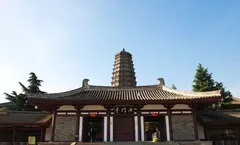
Also worth pairing: Yongtai Princess Tomb (included in ticket, has murals) — real picks, just left off the grid so the cards stay in pairs.
Chinese names and pins are matched against each city's own map data at build time; a place only gets Directions once its pin has been verified, otherwise the button searches by name.
About Qianling Mausoleum (Emperor Gaozong & Wu Zetian)
1. Historical Origins: A Whole Mountain, Never Opened
Qianling is the joint tomb of the Tang emperor Gaozong and Wu Zetian, the only woman in Chinese history to rule as emperor in her own name. She had been his concubine, then his empress, then the effective ruler during his illness, and finally sovereign of her own dynasty. When he died in 683 she buried him here, and when she died in 705 — after being deposed in a coup — she was buried in the same mountain.
The choice of site is why Qianling still exists. The tomb was cut into Liangshan itself rather than built under a mound, and the entrance shaft was sealed with iron and stone. Every other Tang imperial tomb was looted; this one has never been opened, and the archaeology suggests the chamber is intact. Walking the spirit road, you are looking at a sealed room rather than a ruin.

2. What to Spot: Blank Stele, Headless Envoys, Murals
🪨 The Wordless Stele
- The Story: A monumental tablet with a carved frame, dragons at the top and nothing at all inside it — left blank by Wu Zetian, and argued over for thirteen centuries.
- What to Look For: The empty surface. Every other imperial stele in China is a wall of self-praise; this one is a deliberate silence, and nobody knows whether it was modesty, confidence or a message to her successors.
🗿 The Sixty-One Envoys
- The Story: Sixty-one stone figures of foreign envoys and tribal leaders who attended Gaozong’s funeral, arranged along the spirit road — every one of them beheaded.
- What to Look For: The stumps and the robes. The heads were removed, probably centuries later, and the effect is the most atmospheric thing at any Tang site: a diplomatic reception that has been standing in a field for 1,300 years without faces.
🖼️ The Qianling Museum Murals
- The Story: Tang tomb murals from the satellite tombs, displayed indoors — comparable to the Shaanxi History Museum’s celebrated mural hall.
- What to Look For: You get these without a reservation lottery, which alone justifies the trip for anyone who failed to book the museum in Xi’an.
⛰️ The Mountain Itself
- The Story: Liangshan, three peaks with the tomb shaft driven into the middle one — the reason the tomb survived.
- What to Look For: The climb up the spirit road gives you the whole layout: two peaks like gate towers, the tomb in the centre.


3. Cultural Contrast: The Empress Nobody Can Categorise
Wu Zetian is the hook for every Chinese visitor. Her career — concubine, empress, regent, emperor, deposed, buried as an empress again — is the most politically interesting biography in Chinese history, and the blank stele is read as its summary. Domestic tour groups stop here longer than at the tomb mound.
Foreign visitors usually arrive for the Tang and leave thinking about her, which is the right order. Two practical points that shape the day: this is 80 km west of Xi’an and best combined with Famen Temple on a chartered car, and the site is spread out along a sloping spirit road with the museum separate — allow three hours rather than one.

4. Practical Essentials: Tickets, Transit & Scam Alerts
Tickets & Passport Booking
- Price: ¥100 for the combined ticket, covering the mausoleum, the museum and the satellite tomb sites.
- How to Book: Buy at the ticket office with a passport; international cards are usually accepted but carry cash as a backup. No advance reservation is required.
How to Get There
- By Metro: No rail connection to the site. Tourist coaches from Xi’an’s west bus station take about 1.5 hours, or take the high-speed train to Qianxian Station and a taxi for 15 minutes. The most efficient option is a chartered car combining Qianling with Famen Temple, around ¥500 for the day.
- Show Your Driver: 师傅,请带我到乾陵景区入口。谢谢!
Inside Tips & Scam Alerts
- The combined ticket already includes the main three sites. Ignore anyone selling a separate mural-hall ticket at the car park.
- The spirit road climbs. It is a gradual slope rather than stairs, but allow time in summer heat and carry water — there is little shade and few vendors.
- Opening hours are roughly 08:00-18:00. Late afternoon light on the stone figures is the best of the day.
- Bring the story with you. Without knowing who Wu Zetian was, the blank stele is just a blank stele; with it, it is the best object in Shaanxi.
- Complaints: the national 12345 hotline is free to call from any local phone.
Quick Answers
The 7 things visitors ask before setting out, answered from the same verified record used across this page.
- How much does it cost to visit Qianling Mausoleum?
- ¥100 combined ticket. ¥100 combined ticket (includes Qianling Museum and the tomb sites).
- What are the opening hours at Qianling Mausoleum?
- 8:00 - 18:00.
- How long should I spend at Qianling Mausoleum?
- About three hours — the site is spread along a sloping spirit road.
- Is Qianling Mausoleum wheelchair accessible?
- Yes. The spirit way (the statue-lined approach) is a paved, gentle slope; the tomb mound itself requires a stair climb. The museum is step-free.
- How do I tell a taxi driver to take me to Qianling Mausoleum?
- Copy this line into DiDi or show it to the driver: 师傅,请带我到乾陵景区入口。谢谢!
- Can I leave my luggage at Qianling Mausoleum?
- Lockers at the ticket office.
- Will English work at Qianling Mausoleum?
- Yes — staff used to foreign visitors handle English, and the site scores 3/5 on our foreign-friendliness scale.
Where to go next
Three short lists, recomputed at build time from the same coordinates and categories as the pages themselves — no paid placement, no hand-picked names. Every card is a published guide.
Next stop in Xi'an
Straight-line distance from this spot, so you can judge what is walkable and what needs a taxi.


More like this, elsewhere in China
If landmark is what you came for, these are the closest equivalents you can reach in another city — ordered by distance, one city per card.


Change the subject
Deliberately a different category, for when one more temple or garden would blur into the last one.


Lists are derived from coordinates and category alone. Fix a wrong pin or re-tag a place and every list that mentions it moves with it.
Before you go · arrival essentials
Practical guides that pair with this kind of place — picked by category, not sponsored placement.