
Dazu Rock Carvings (UNESCO)
ℹ️ ¥115 (Baodingshan, peak season Apr-Oct); combined Baodingshan + Beishan tickets available

Taxi & Street Navigation Help
师傅,请带我到大足石刻宝顶山景区(大足区)。谢谢!
Opening Hours & Best Time
08:30 - 18:00 (last entry 16:30)
💡 Pro Tip: Baodingshan is the essential site — the 800-year-old cliff frieze is a single continuous narrative carved over 70 years by one master's plan. Go with the QR audio guide (English available); the carvings read like a comic strip once you know the sequence. The 500-meter U-shaped cliff takes 90 minutes properly.
Accessibility & Luggage Lockers
Accessibility: ♿ Wheelchair & Stroller Friendly
Baodingshan's main cliff path is paved and mostly level with ramped sections; some stair detours. The shuttle from the gate to the cliff is wheelchair-capable.
🧳 Luggage Storage: Lockers at the visitor center.
Nearby Landmarks
The 2 places within reach of this spot — each one opens straight into Apple Maps or Amap, with the Chinese name you can show a driver.
Further out: Chongqing city (2-3 h by bus/car) — named but not carded: at more than two hours' travel, it is its own trip, not something you can reach on foot.
Chinese names and pins are matched against each city's own map data at build time; a place only gets Directions once its pin has been verified, otherwise the button searches by name.
About Dazu Rock Carvings (UNESCO)
1. Historical Origins: A Cliff Carved to One Man’s Plan
Eight hundred years ago, on a horseshoe-shaped cliff at Baodingshan, a single master’s plan was put into the rock. It took roughly seventy years to complete, and it was not built as a set of separate shrines — it was carved as one continuous sequence running along the wall, episode after episode, in order. That is why Dazu reads differently from every other major carving site in China: you do not walk up to a colossus and look at it, you walk along a story.
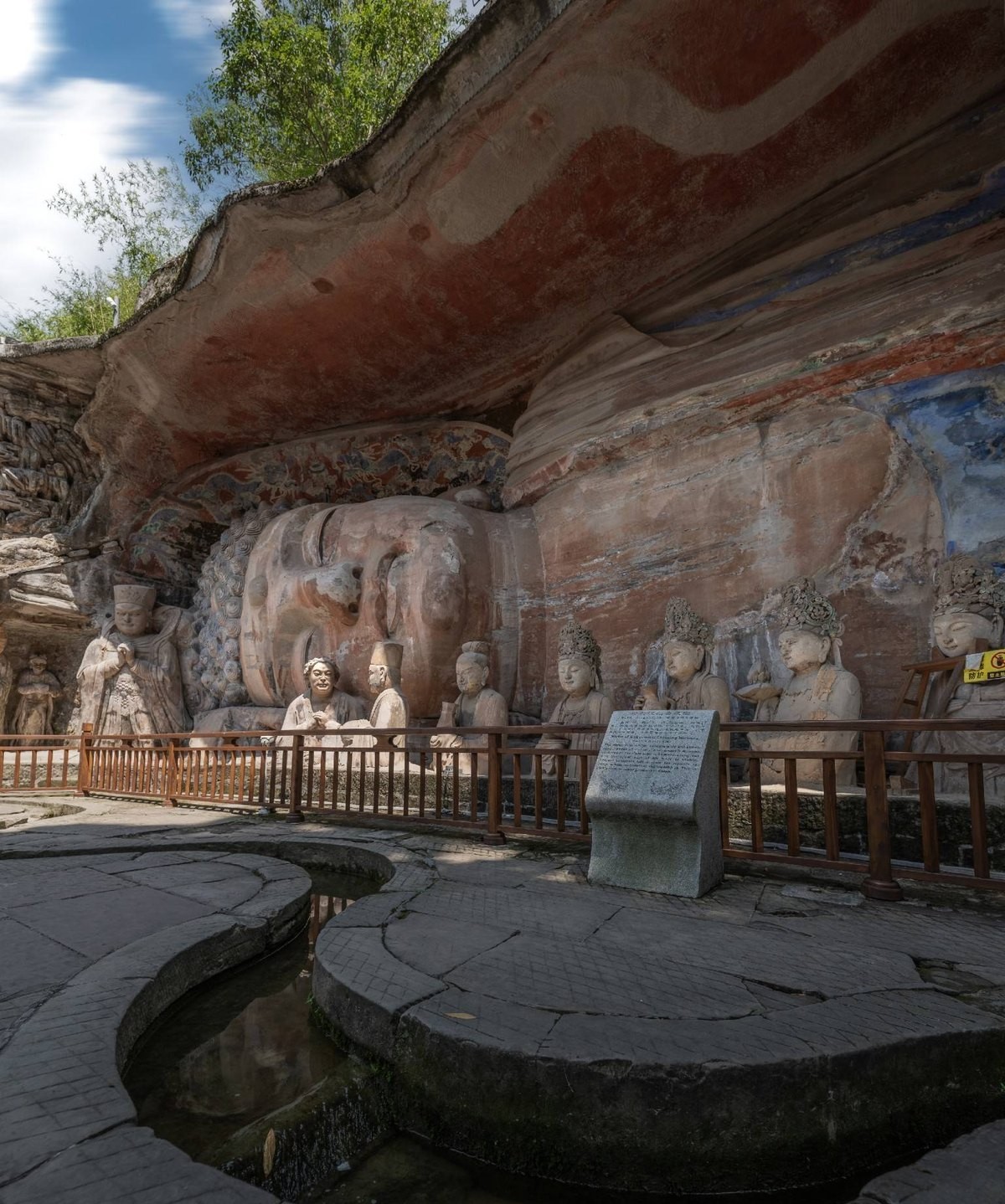
What survives is a five-hundred-metre U-shaped cliff, fully carved, with the narrative laid out in panels and groups. The reclining Buddha stretches thirty-one metres along the wall. The thousand-hand Guanyin is a wall of gilded arms, and it comes at the end of the route rather than the beginning, which is deliberate.
The site was inscribed by UNESCO in 1999, and it is the late peak of Chinese rock carving — several centuries after the great imperial projects at Yungang and Longmen, and doing something completely different with the form.
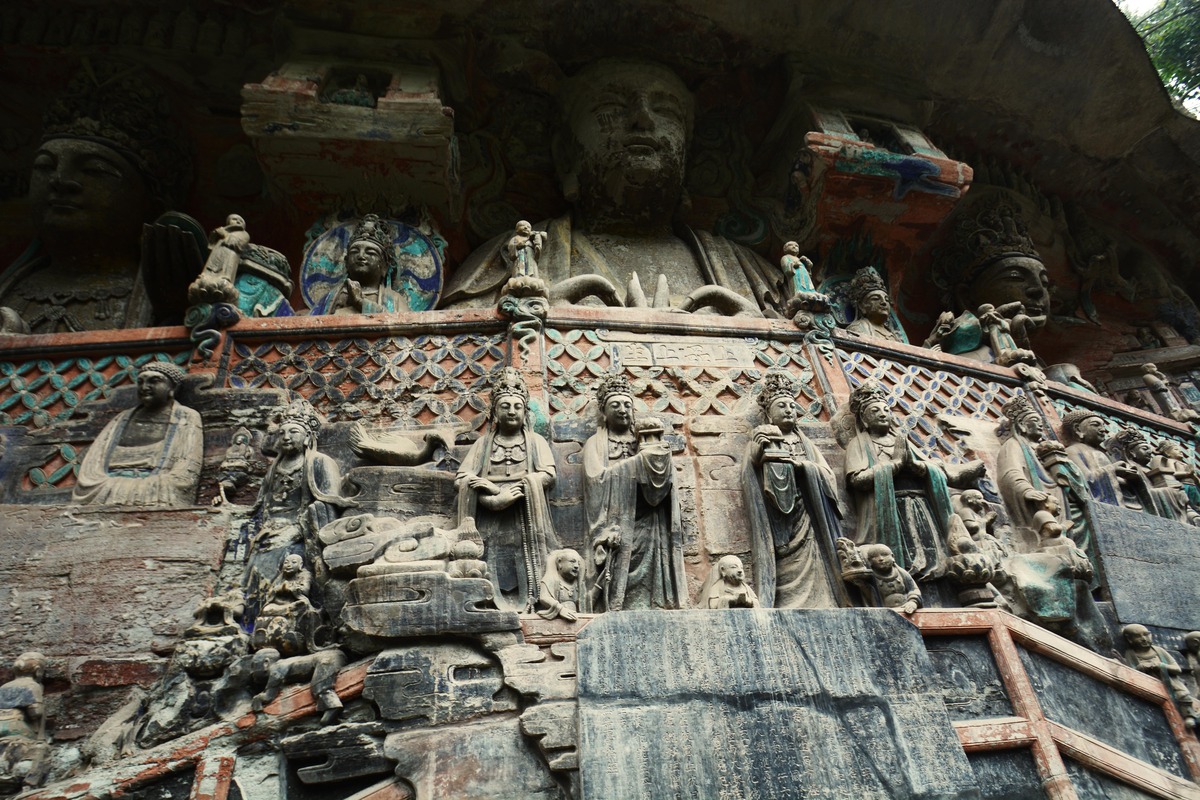
2. What to Spot: The U-Shaped Wall
🛕 The Continuous Frieze
- The Story: Panel after panel cut into the same cliff face, telling connected stories rather than displaying single deities. Because it was conceived as a whole, the joins between episodes are designed — the wall turns a corner and the next scene is already waiting.
- What to Look For: The corners. The two ends of the horseshoe are where the sequence changes register, and where most visitors stop reading and start photographing.
🌙 The Reclining Buddha
- The Story: A thirty-one-metre Buddha lying along the cliff, carved in the Song dynasty, with the mourners arranged behind him at a smaller scale. It is the largest single element at the site and the one every tour group stops at.
- What to Look For: The scale of the mourners’ faces relative to the body. Everything behind the Buddha is carved small so the figure reads as enormous, and it works from any distance.
🙏 The Thousand-Hand Guanyin
- The Story: A gilded wall of arms, arranged around a central figure and filling the rock face almost entirely. It sits at the end of the walk, which means you arrive at it after an hour of smaller scenes.
- What to Look For: The outermost arms — the ones reaching beyond the gilding into bare stone, which show how far the composition was planned before the carving began.
📖 Reading the Sequence
- The Story: The narratives are not obvious without help. They are scenes of everyday morality — parents, children, butchers, ferrymen — chosen to make points that a twelfth-century audience would have recognised instantly.
- What to Look For: Take the official audio guide, which has an English track. Without it you will see beautiful stonework and understand almost none of it.
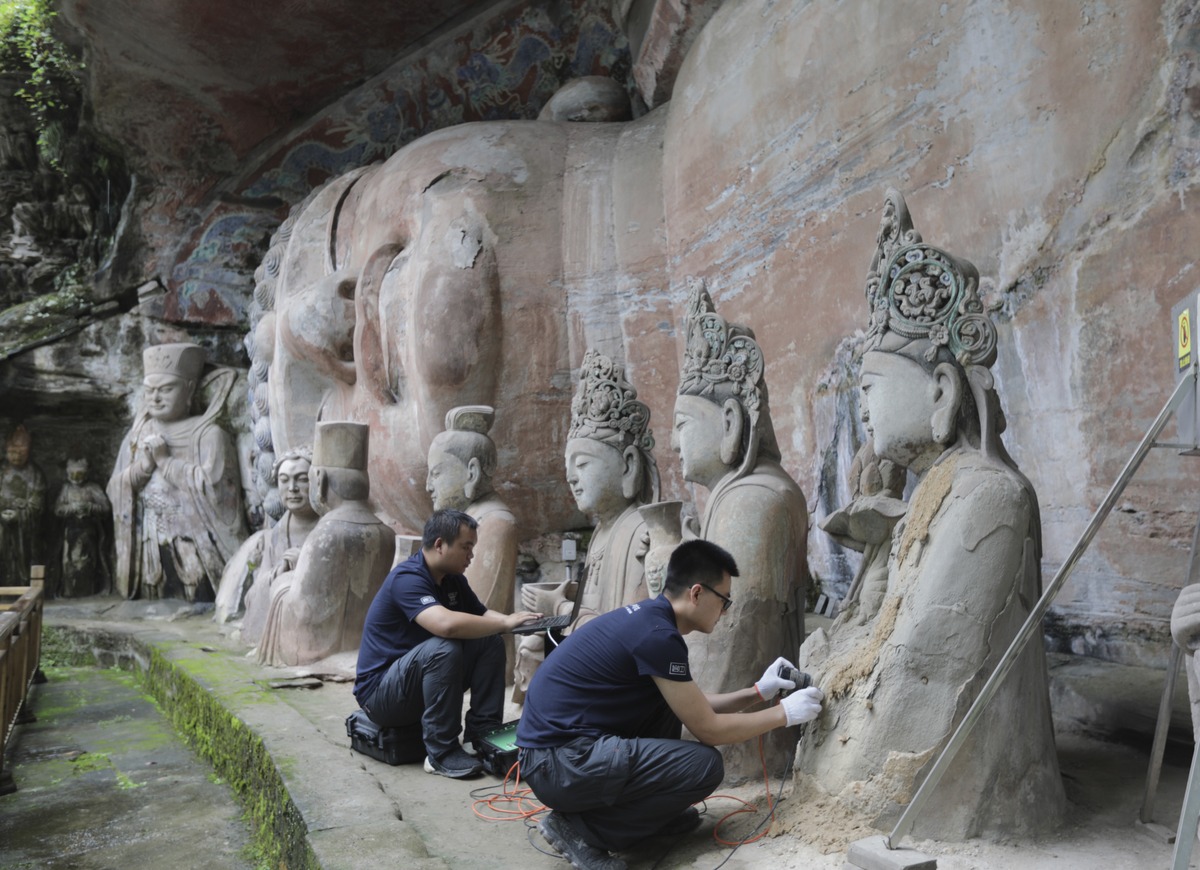
3. Cultural Contrast: Why Dazu Is Not Longmen
Longmen and Yungang were imperial projects: enormous single figures, carved to project state power, arranged in caves you enter one at a time. Dazu was funded by a mixture of clergy and local patrons, and it shows. The scenes are domestic, the figures are grouped, and the subject matter is ordinary life turned into teaching material.
The result is closer to a medieval mural cycle than to a monument. You read it left to right, you follow characters, and you notice details that were put there for a local audience — a butcher’s tools, a woman feeding a child, a boat being poled across water. Very little of it is trying to impress you.
Which is also the practical reason to give it a full day. Baodingshan alone covers ninety percent of what a first-time visitor needs, and doing it properly takes around ninety minutes on the cliff plus the approach. Adding Beishan in the same trip is possible, but it turns a good day into a rushed one.
4. Practical Essentials: Tickets, Transit & Scam Alerts
Tickets & Passport Booking
- Price: Paid. Baodingshan is the essential site and its ticket is priced by season — higher from spring to autumn — with a separate ticket for Beishan and a combined option for both. The gate also sells a shuttle within the site. Because the amounts change with season and package, check the Dazu Rock Carvings research institute’s official account on the day rather than relying on any figure in a guidebook.
- How to Book: Book through the institute’s official WeChat account or mini-program, which releases tickets several days ahead; in peak season book early. Your passport works as the ID at the window, and there is a staffed counter for visitors who cannot use the mini-program. Foreign cards are unreliable at the gate — carry cash or use mobile payment.
- Opening Hours: 08:30–18:00, last entry 16:30. Allow a full day from Chongqing: the site is about 100 km from the city.
How to Get There
- By High-Speed Rail: Chongqing West Station to Dazu South, about 30 minutes, then roughly 30 minutes by shuttle or taxi to Baodingshan. This is the fastest route and the one to plan around.
- By Bus: Direct coaches leave from Chenjiaping and Caiyuanba bus stations.
- Show Your Driver: 师傅,去大足石刻宝顶山景区(大足区宝顶镇),谢谢!
Inside Tips & Scam Alerts
- Take the official audio guide. The difference between seeing stones and seeing a story is the commentary, and the official version is cheaper and better paced than anything offered at the gate.
- The “discount guide” touts at the entrance are not licensed. They charge more than the audio guide for less information.
- Refuse the driver’s “wait and return” package. There are shared cars and shuttles at the high-speed station for the trip back, and committing to a day rate removes your flexibility.
- Do Baodingshan properly and skip Beishan if time is short. One site, done slowly, beats two sites at a run.
- The Thousand-Hand Guanyin hall is at the end of the route, so do not sprint the earlier panels to reach it.
- The Baodingshan path is a horseshoe with ramps and gentle slopes, making it the most accessible of the major carving areas here. Beishan involves more steps.
- Complaints or overcharging: the 12345 hotline is free to call from any local phone and has English operators.
Quick Answers
The 7 things visitors ask before setting out, answered from the same verified record used across this page.
- How much does it cost to visit Dazu Rock Carvings (UNESCO)?
- ¥115 Baodingshan (peak). ¥115 (Baodingshan, peak season Apr-Oct); combined Baodingshan + Beishan tickets available.
- What are the opening hours at Dazu Rock Carvings (UNESCO)?
- 08:30 - 18:00 (last entry 16:30).
- How long should I spend at Dazu Rock Carvings (UNESCO)?
- A full day from Chongqing.
- Is Dazu Rock Carvings (UNESCO) wheelchair accessible?
- Yes. Baodingshan's main cliff path is paved and mostly level with ramped sections; some stair detours. The shuttle from the gate to the cliff is wheelchair-capable.
- How do I tell a taxi driver to take me to Dazu Rock Carvings (UNESCO)?
- Copy this line into DiDi or show it to the driver: 师傅,请带我到大足石刻宝顶山景区(大足区)。谢谢!
- Can I leave my luggage at Dazu Rock Carvings (UNESCO)?
- Lockers at the visitor center.
- Will English work at Dazu Rock Carvings (UNESCO)?
- Yes — staff used to foreign visitors handle English, and the site scores 4/5 on our foreign-friendliness scale.
Where to go next
Three short lists, recomputed at build time from the same coordinates and categories as the pages themselves — no paid placement, no hand-picked names. Every card is a published guide.
Next stop in Chongqing
Straight-line distance from this spot, so you can judge what is walkable and what needs a taxi.


More like this, elsewhere in China
If museum is what you came for, these are the closest equivalents you can reach in another city — ordered by distance, one city per card.


Change the subject
Deliberately a different category, for when one more temple or garden would blur into the last one.


Lists are derived from coordinates and category alone. Fix a wrong pin or re-tag a place and every list that mentions it moves with it.
Before you go · arrival essentials
Practical guides that pair with this kind of place — picked by category, not sponsored placement.
- Pay with Alipay & WeChat PayPayment · Set up Alipay or WeChat Pay on a foreign card — needed at almost every counter.
- Get online with a China eSIMConnectivity · Maps and messaging that work without a VPN, the moment you land.
- Book China train tickets (12306)Trains · Buy high-speed rail tickets with a foreign passport, for getting here and back.