
Daci Monastery & Taikoo Li Block (Temple Inside the Mall)

Taxi & Street Navigation Help
师傅,请带我到大慈寺,太古里里面,谢谢!
Opening Hours & Best Time
Temple 8:00 - 18:00; Taikoo Li to 22:00+
💡 Pro Tip: Xuanzang — the monk who walked to India (the real Journey to the West) — was tonsured here. The temple survived; the city built a billion-dollar mall respectfully AROUND it. Photograph the main hall with the Apple logo floating behind it at dusk.
Accessibility & Luggage Lockers
Accessibility: ♿ Wheelchair & Stroller Friendly
Fully — mall-grade infrastructure around a flat temple.
🧳 Luggage Storage: Taikoo Li guest services hold bags free (passport deposit).
Nearby Landmarks & A Short Train Ride
The 4 places worth pairing with this spot — each one opens straight into Apple Maps or Amap, with the Chinese name you can show a driver. One pick sits in Chongqing (HSR ~1 h 2 min) — a short high-speed ride, not a walk. Chengdu's own list came out one short of a pair, and this is the nearest pick that fills it.
 春熙路·太古里·IFS爬墙熊猫IFS climbing pandaModern architectureAbout a 15-min walk0.31 kmacross the street
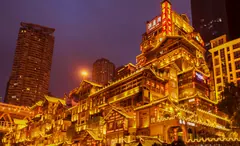
Chinese names and pins are matched against each city's own map data at build time; a place only gets Directions once its pin has been verified, otherwise the button searches by name. Cards with an amber city tag are in another city — the ride time shown is the fastest train of the day.
About Daci Monastery & Taikoo Li Block (Temple Inside the Mall)
1. Historical Origins: The Temple That Refused to Move
Daci Monastery dates to the Tang dynasty, and its foundation story is tied to a monk who became far more famous after he left. Xuanzang — the seventh-century pilgrim who walked to India and back and whose journey later became Journey to the West — was ordained here as a young man, before the trip that made him a legend.
The temple has been destroyed and rebuilt several times since; what stands today is largely Ming and Qing fabric on an ancient plan. What makes it unusual is what surrounds it. When the city sold this block for redevelopment in the 2000s, the plan that won kept the monastery in place and built a low-rise luxury retail village in a ring around it — not a mall with a temple attached, but a temple with a shopping district wrapped respectfully about its walls.
The result is the single clearest image of contemporary Chengdu: incense smoke, grey brick, tiled eaves, and a sheet-glass Apple store twenty metres away.

2. What to Spot: Halls, Eaves, and the Glass Behind Them
🏯 The Main Hall
- The Story: The Buddha hall is a working place of worship, not a museum room, and it is busiest in the early morning.
- What to Look For: Stand in the courtyard at dusk and frame the hall’s upturned eaves with the mall’s lighting behind — the juxtaposition is the whole point of the site.
🌿 The Tea Courtyard
- The Story: The temple runs a covered tea yard inside its walls, the kind of thing Chengdu does better than anywhere else in China.
- What to Look For: A seat in the shade, a covered cup, and an hour doing nothing. This is the cheapest luxury in the city.
🏮 The Taikoo Li Water Lanes
- The Story: The retail village’s pools and reflecting channels were cut to mirror the temple roofs.
- What to Look For: The reflection shots after dark, when the lanterns and the lit eaves double in the water.


3. Cultural Contrast: Incense and Retail, Unbothered
In most Chinese cities, a temple this central would have been cleared, relocated, or turned into a ticket office with a gift shop. Chengdu did something else, and the absence of conflict is the interesting part. Worshippers burn incense at the hall while shoppers walk past the wall with coffee; nobody finds this strange, and nobody is asked to choose.
That ease is very Chengdu, a city with a long habit of absorbing new things without dismantling old ones. For a visitor, it means the monastery is not a destination you schedule an hour for — it is a five-minute detour in the middle of an afternoon of wandering, and it works better that way. Come in, stand in the courtyard for a few minutes, look at what is behind the roof, and go back out to the shops. The contrast is the sight.

4. Practical Essentials: Tickets, Transit & Scam Alerts
Tickets & Passport Booking
- Price: Free, both the monastery and the Taikoo Li block. No reservation and no passport needed.
- How to Book: Nothing to book. The temple runs roughly 8:00 to 18:00; Taikoo Li stays open past 22:00. Guest services will hold bags against a passport deposit.
How to Get There
- By Metro: Line 2 or Line 3 to Chunxi Road Station, Exit D, then about five minutes on foot into the Taikoo Li block.
- Show Your Driver: 师傅,请带我到大慈寺,太古里里面。谢谢!
Inside Tips & Scam Alerts
- Treat it as a bonus, not a destination. Pair the temple with the shopping block and a meal; on its own it is a twenty-minute visit.
- Sequence it right. Temple first, mall second, starting an hour before dark — you get the golden light on the eaves and the neon on the water in one loop.
- The real rip-off is outside the block. Taikoo Li’s prices are honest because it is a mall. The “brand surplus” stalls on the neighbouring streets are selling counterfeit goods with a story attached.
- Complaints: the national 12345 hotline is free to call from any local phone.
Quick Answers
The 6 things visitors ask before setting out, answered from the same verified record used across this page.
- How much does it cost to visit Daci Monastery & Taikoo Li Block?
- Free.
- What are the opening hours at Daci Monastery & Taikoo Li Block?
- Temple 8:00 - 18:00; Taikoo Li to 22:00+.
- Is Daci Monastery & Taikoo Li Block wheelchair accessible?
- Yes. Fully — mall-grade infrastructure around a flat temple.
- How do I tell a taxi driver to take me to Daci Monastery & Taikoo Li Block?
- Copy this line into DiDi or show it to the driver: 师傅,请带我到大慈寺,太古里里面,谢谢!
- Can I leave my luggage at Daci Monastery & Taikoo Li Block?
- Taikoo Li guest services hold bags free (passport deposit).
- Will English work at Daci Monastery & Taikoo Li Block?
- Yes — staff used to foreign visitors handle English, and the site scores 5/5 on our foreign-friendliness scale.
Where to go next
Three short lists, recomputed at build time from the same coordinates and categories as the pages themselves — no paid placement, no hand-picked names. Every card is a published guide.
Next stop in Chengdu
Straight-line distance from this spot, so you can judge what is walkable and what needs a taxi.


More like this, elsewhere in China
If temple is what you came for, these are the closest equivalents you can reach in another city — ordered by distance, one city per card.


Change the subject
Deliberately a different category, for when one more temple or garden would blur into the last one.


Lists are derived from coordinates and category alone. Fix a wrong pin or re-tag a place and every list that mentions it moves with it.
Before you go · arrival essentials
Practical guides that pair with this kind of place — picked by category, not sponsored placement.