
Hongya Cave (The Spirited Away Skyline)

Three traps at the entrances: 1) 'Fast-track ¥20' touts — there is no fast lane into a free building; they walk you to a service elevator. 2) Bars and cafes INSIDE charge view-taxed prices — drink on the bridge side instead. 3) Holiday crowd controls run one-way routes with mandated exits — follow the arrows.
Taxi & Street Navigation Help
师傅,请带我到洪崖洞民俗风貌区(嘉陵江滨江路),在千厮门大桥附近停。谢谢!
Opening Hours & Best Time
Lights full-on 20:00 - 22:00 (stalls to 23:00; holidays later)
💡 Pro Tip: Enter from the 11th floor (Cangbai Rd) at 19:30, descend through the complex as the lights intensify, exit at the 1st-floor riverbank for the classic upstream view, then walk onto Qiansimen Bridge for the elevated shot. Doing it in reverse means fighting the crowd uphill.
Accessibility & Luggage Lockers
Accessibility: ♿ Wheelchair & Stroller Friendly
Elevators connect floors inside the complex; the riverbank promenade is flat. Street-level entries differ by 11 floors — enter at the TOP (11F, Cangbai Rd) and ride down if stairs are an issue.
🧳 Luggage Storage: Inside shops for customers; Jiefangbei malls (¥10-20) nearby.
Nearby Landmarks & A Short Train Ride
The 4 places worth pairing with this spot — each one opens straight into Apple Maps or Amap, with the Chinese name you can show a driver. One pick sits in Chengdu (HSR ~1 h 2 min) — a short high-speed ride, not a walk. Chongqing's own list came out one short of a pair, and this is the nearest pick that fills it.
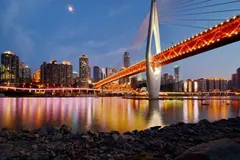 千厮门大桥洪崖洞观景Qiansimen Bridge viewpointLandmarkAbout a 15-min walk0.25 km100 m
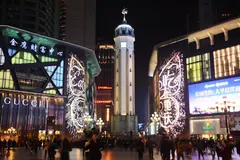 解放碑步行街Jiefangbei pedestrian streetLandmarkAbout a 15-min walk0.66 km700 m
Chinese names and pins are matched against each city's own map data at build time; a place only gets Directions once its pin has been verified, otherwise the button searches by name. Cards with an amber city tag are in another city — the ride time shown is the fastest train of the day.
About Hongya Cave (The Spirited Away Skyline)
1. Historical Origins: Eleven Storeys Against a Cliff
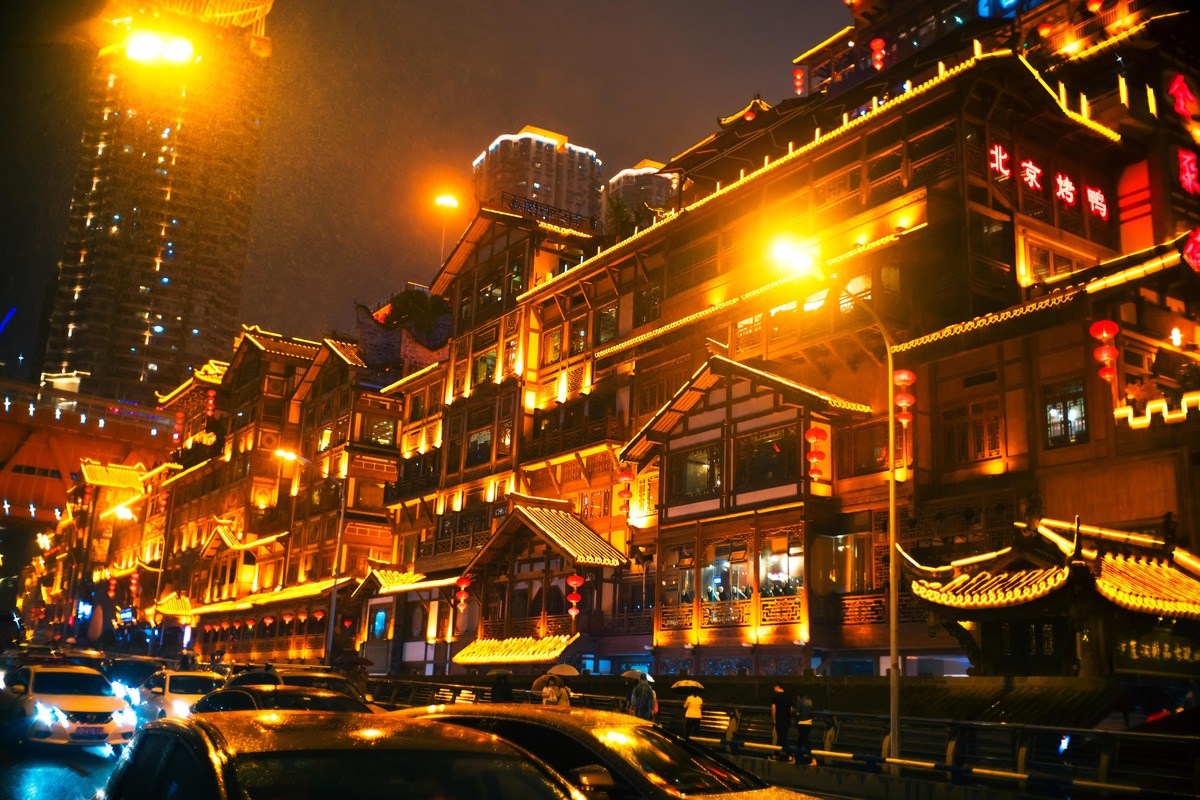
Chongqing’s older housing worked like this: where the ground was too steep for a courtyard, you built out over the drop on timber posts. The stilt house — diaojiaolou — is the vernacular of the upper Yangtze, and Hongyadong is that idiom rebuilt at civic scale.
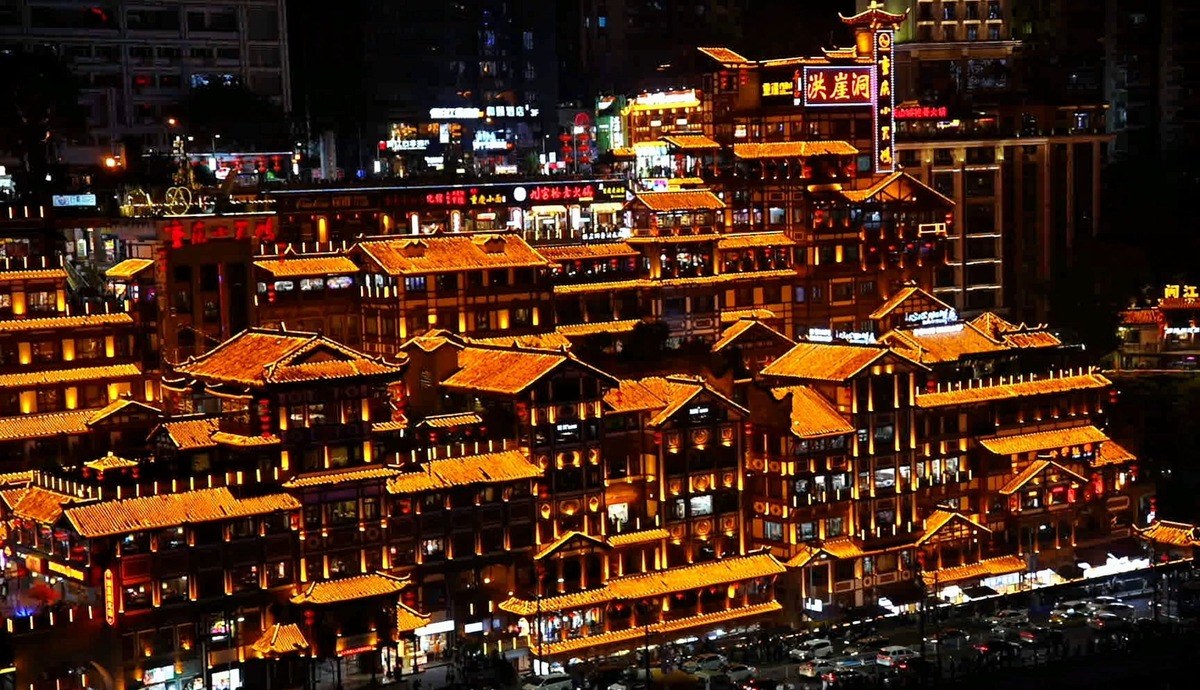
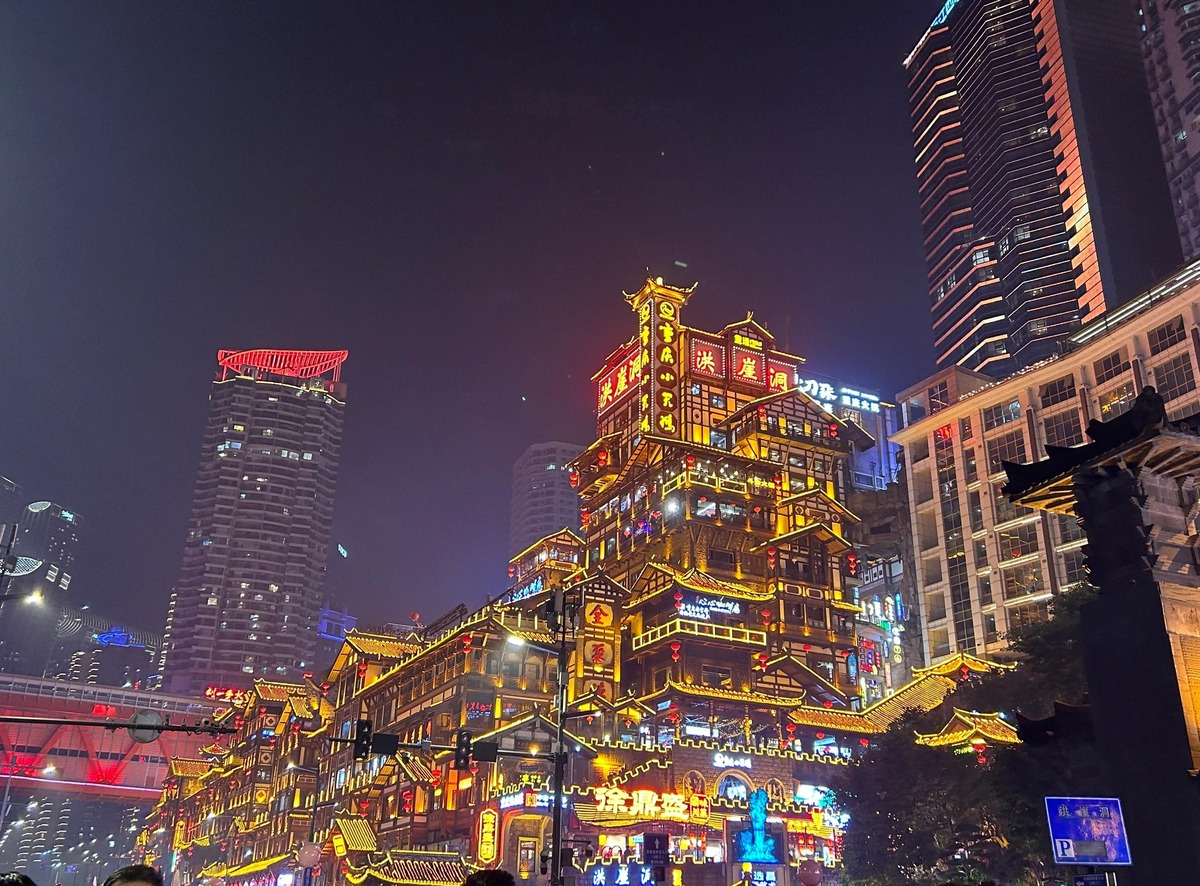
The complex standing today dates from 2006. It occupies the cliff between Cangbai Road on the ridge and the Jialing riverbank at the bottom, stacked eleven storeys deep, so that what looks from the water like a row of wooden houses is in fact a full commercial block climbing the slope. The building does not hide the trick once you are inside: the street you enter from on the ridge is the eleventh floor of the thing you were looking at from the river.
That inversion is the entire site. Hongyadong is not a monument and was never a palace; it is a piece of ordinary riverside architecture, repeated until it became a skyline.
2. What to Spot: Ladders, Eaves and the River Level
🏮 The Elevation
- The Story: The building is a set of terraces rather than a tower. Each level opens onto the slope at a different height, and the stair core beside the river is what holds the whole thing together.
- What to Look For: Where the exits land. Follow any corridor far enough and you come out on a different road at a different elevation, which is why people get lost here in a way they never do in a mall.
🪵 The Eaves and the Stilts
- The Story: The overhanging upper floors and the timber columns below them are the visual signature — deep eaves so the rain runs clear of the walls, posts so the structure sits lightly on ground it could never have levelled.
- What to Look For: How far the top floors project past the base. From the bridge, the whole block appears to lean out over the water.
💡 The Lights
- The Story: The building is lit at night, and the illumination is the reason it is famous. The switch-on time moves with the season and with the holiday calendar; it is a piece of landscape management rather than a fixed published schedule.
- What to Look For: The ten or fifteen minutes when the sky still has colour and the lamps are already on. That is the only window in which the building photographs the way it looks in other people’s pictures.
🌉 The Bridge
- The Story: Qiansimen Bridge carries a pedestrian deck across the Jialing a short walk upstream. From it you look down at the complex at an angle, which is the shot most people are actually after.
- What to Look For: The far end of the deck, where the bridge is high enough to clear the rooftops and low enough to keep the building in the frame.
3. Cultural Contrast: The Best View Is Not Inside
Inside Hongyadong you are in a commercial arcade: snack stalls, hotpot, souvenir shops, a lift queue. It is busy, it smells of chilli oil, and it is not remotely mysterious. Which is fine — but it means the famous image and the actual experience happen in different places.
The image is made from outside: the far bank, or the pedestrian deck of Qiansimen Bridge, or the riverside road below. That is where the building works as architecture rather than as a shopping centre. Visitors who arrive, ride up and down the lifts, and leave disappointed have usually done the correct thing in the wrong order.
The habit is worth naming because it applies all over Chongqing. This is a city where the interesting view of almost anything is from the other side of a river, and where the standard Chinese travel instinct — get to the attraction, go in — is often the least rewarding move. Arrive, look at it from across the water, and only then go inside for dinner.
4. Practical Essentials: Tickets, Transit & Scam Alerts
Tickets & Passport Booking
- Price: Free. Hongyadong is an open commercial district, not a ticketed attraction — there is nothing to buy at a gate, and no booking, passport or ID check to enter.
- Hours: The district is publicly accessible; individual shops and bars keep their own hours. The facade lighting is switched on in the evening and runs for a few hours, timed to the season and the holiday calendar rather than published as a fixed slot.
- What costs money: Food, drink and anything you carry out. The view is free from every public vantage point outside the building.
How to Get There
- By Metro: Lines 1 and 6 to Xiaoshizi (小什字), then follow the crowd downhill for about eight minutes. From Jiefangbei it is a ten-minute walk.
- The sensible route: Enter at the top, from Cangbai Road on the ridge, and work downwards — floor by floor, through the building, out at the riverbank. Walking it in reverse means climbing eleven storeys against the flow.
- Show Your Driver: 师傅,去洪崖洞民俗风貌区(嘉陵江滨江路、千厮门大桥附近),谢谢!
Inside Tips & Scam Alerts
- Ignore anyone selling fast-track entry. There is no fast lane into a free building. The “service” is usually a walk to a passenger lift you could have taken yourself.
- Bars with windows charge for the window. If you want a drink with the view, buy it on the far bank or from a shop and stand on the bridge instead. The markup inside is for the table, not the architecture.
- On public holidays the complex runs one-way routes with designated exits. Follow the arrows; the shortcuts you remember from a quiet Tuesday will be closed.
- Photo timing: the ridge entry at dusk, the riverbank an hour later, the bridge after that. Doing all three in one evening is entirely possible on foot.
- Rain does not ruin it. Half the complex is covered walkway, and wet stone at night is arguably the better picture.
- Complaints or overcharging: the 12345 hotline is free from any local phone and has English-speaking operators.
Quick Answers
The 6 things visitors ask before setting out, answered from the same verified record used across this page.
- How much does it cost to visit Hongya Cave?
- FREE.
- What are the opening hours at Hongya Cave?
- Lights full-on 20:00 - 22:00 (stalls to 23:00; holidays later).
- Is Hongya Cave wheelchair accessible?
- Yes. Elevators connect floors inside the complex; the riverbank promenade is flat. Street-level entries differ by 11 floors — enter at the TOP (11F, Cangbai Rd) and ride down if stairs are an issue.
- How do I tell a taxi driver to take me to Hongya Cave?
- Copy this line into DiDi or show it to the driver: 师傅,请带我到洪崖洞民俗风貌区(嘉陵江滨江路),在千厮门大桥附近停。谢谢!
- Can I leave my luggage at Hongya Cave?
- Inside shops for customers; Jiefangbei malls (¥10-20) nearby.
- Is there anything to watch out for at Hongya Cave?
- Three traps at the entrances: 1) 'Fast-track ¥20' touts — there is no fast lane into a free building; they walk you to a service elevator. 2) Bars and cafes INSIDE charge view-taxed prices — drink on the bridge side instead. 3) Holiday crowd controls run one-way routes with mandated exits — follow the arrows.
Where to go next
Three short lists, recomputed at build time from the same coordinates and categories as the pages themselves — no paid placement, no hand-picked names. Every card is a published guide.
Next stop in Chongqing
Straight-line distance from this spot, so you can judge what is walkable and what needs a taxi.


More like this, elsewhere in China
If landmark is what you came for, these are the closest equivalents you can reach in another city — ordered by distance, one city per card.


Change the subject
Deliberately a different category, for when one more temple or garden would blur into the last one.


Lists are derived from coordinates and category alone. Fix a wrong pin or re-tag a place and every list that mentions it moves with it.
Before you go · arrival essentials
Practical guides that pair with this kind of place — picked by category, not sponsored placement.