
Jiefangbei Pedestrian Street

Bayi Road's 'celebrity suanlafen stalls' with queues staged by staff — the honest version is 100 m away at any no-name stall where locals queue with bowls, not cameras. Bar promoters after 21:00: enter printed-price venues only.
Taxi & Street Navigation Help
师傅,请带我到解放碑步行街(民权路路口下)。谢谢!
Opening Hours & Best Time
Street 24/7; malls 10:00 - 22:00
💡 Pro Tip: The mall basements (Wanda / Global Harbor class) hide the city's best food courts at half the snack-street prices — eat underground, photograph at street level.
Accessibility & Luggage Lockers
Accessibility: ♿ Wheelchair & Stroller Friendly
Fully flat pedestrian streets with escalator-equipped malls — the easiest zone in town.
🧳 Luggage Storage: Bayi Road subway lockers; malls hold bags at service desks.
Nearby Landmarks
The 2 places within reach of this spot — each one opens straight into Apple Maps or Amap, with the Chinese name you can show a driver.

Chinese names and pins are matched against each city's own map data at build time; a place only gets Directions once its pin has been verified, otherwise the button searches by name.
About Jiefangbei Pedestrian Street
1. Historical Origins: A Monument That Ended Up in a Shopping District
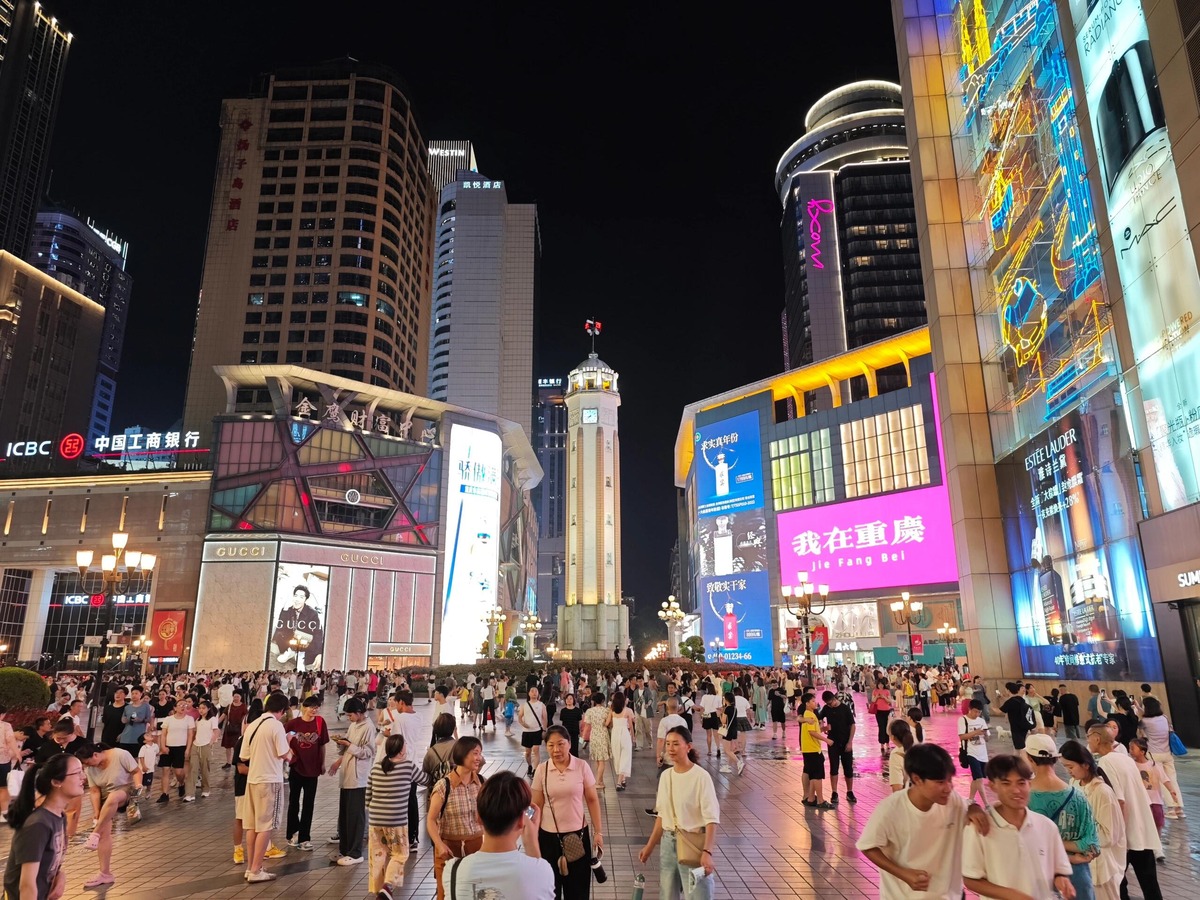
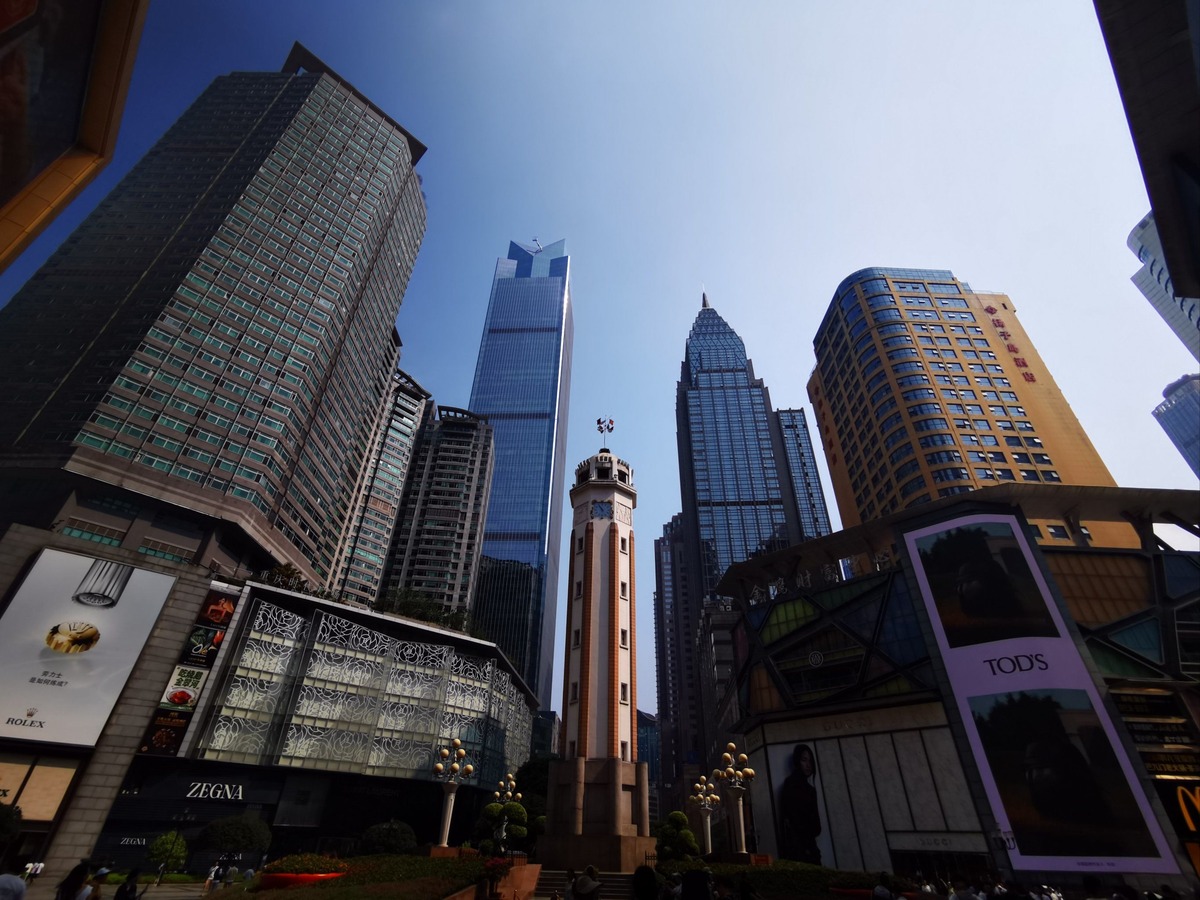
The obelisk in the middle of the square was raised to commemorate the victory in the War of Resistance against Japan, and the district around it takes its name from the monument. It is often described as the only monument of its kind in the country — a claim worth treating with the usual caution, but the intention behind it is clear enough: this is a national memorial that happens to stand in the middle of a retail zone.
That arrangement is the interesting part. Most war memorials in China are enclosed, landscaped and quiet. This one is at street level in the busiest commercial core of the city, with a pedestrian precinct running past it on all four sides and LED screens on the buildings behind. Nobody fences it off, because it would be pointless to try.
What the square is now is a shopping district with a memorial at its centre — department stores, malls, snack streets, and a great deal of neon. The monument did not become a relic; it became an address. Locals use it to meet, to navigate, and to describe where they live.
2. What to Spot: The Obelisk, the Screens, the Basements
🗿 The Monument
- The Story: A tapering stone obelisk on a stepped base, inscribed and faced with clock dials — the standard form for a mid-century civic memorial, and the reason the whole district is named after it.
- What to Look For: The base. It is the part people actually use: a raised platform to sit on, leave bags against, and photograph children in front of.
📺 The LED Walls
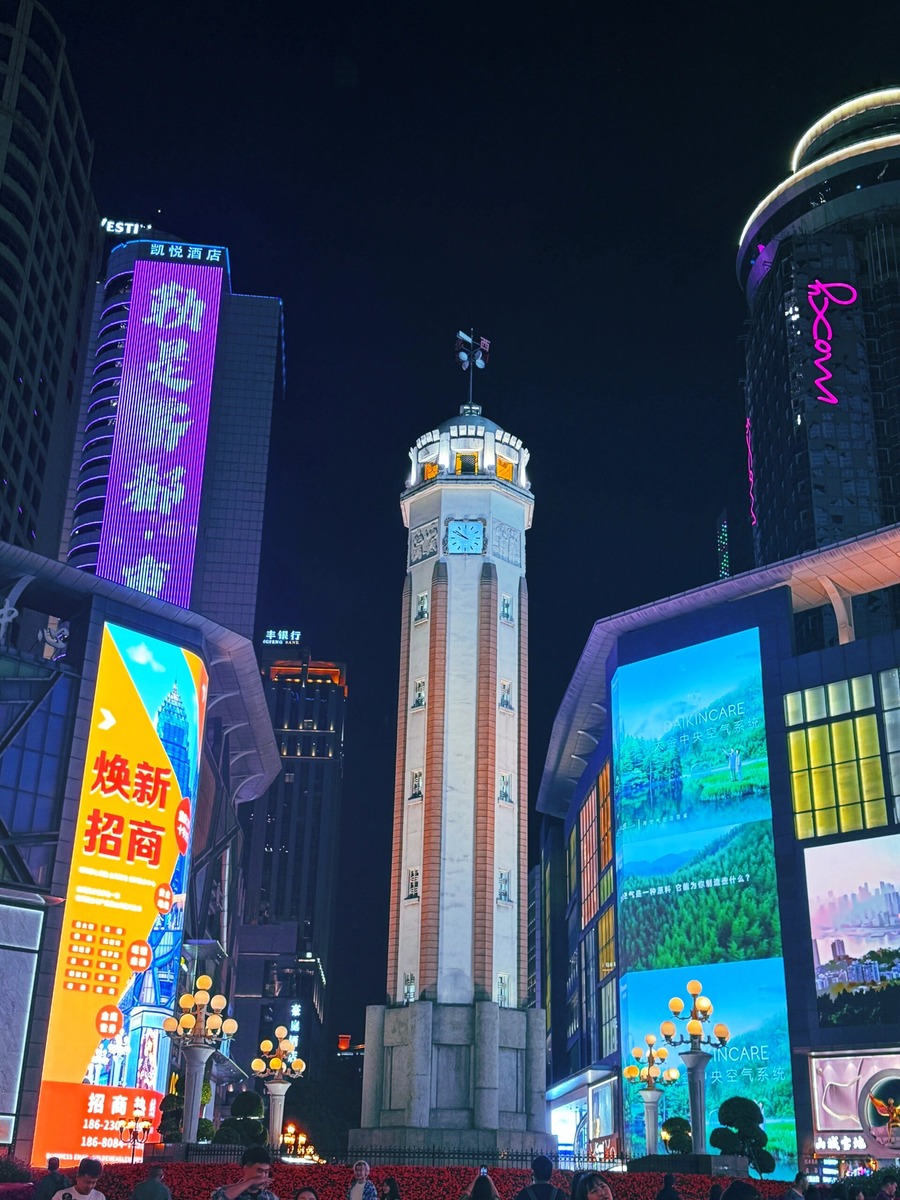
- The Story: The surrounding towers are clad in very large screens, and after dark the square becomes a canyon of moving light.
- What to Look For: The colour of the light on the stone. The monument photographs white in the afternoon and blue or magenta at nine in the evening, which is the whole visual argument of the place.
🍜 Bayi Road
- The Story: The snack street running off the square is the most heavily trafficked food strip in the city — noodles, hotpot skewers, cold jelly, and queues.
- What to Look For: Which queues are made of locals holding bowls rather than visitors holding phones. The difference is visible from ten metres away.
🛍️ The Basements
- The Story: Under the malls there is a second city of food courts, supermarkets, and cheap eating, connected to the metro and to each other.
- What to Look For: The price gap. The same dish is usually cheaper two floors down than at street level, and the air conditioning is better.
3. Cultural Contrast: A Landmark That Refuses to Be a Museum
Chinese heritage sites are usually separated from ordinary life: a wall, a ticket gate, a reconstructed street of shops outside the exit. Jiefangbei does the opposite. The memorial sits in the open, the shops run right up to it, and the two functions coexist without either one winning.
For a visitor this means you should not arrive expecting an experience. There is nothing to queue for and nothing to learn from a panel. What there is, is a piece of urban logic: a city that put its most solemn object where its busiest foot traffic already was, and then let the traffic keep flowing.
The comparison that makes it clear is with the riverside. Ten minutes downhill, the same city has a cliff of tourist shops and a bridge full of photographers. Jiefangbei is where people work and shop; Hongyadong is where they go to look. Chongqing keeps its civic memory and its spectacle in separate buildings, and locals use both without confusing them.
4. Practical Essentials: Tickets, Transit & Scam Alerts
Tickets & Passport Booking
- Price: Free. The precinct and the monument are public space — no ticket, no booking, no ID check. The malls open to anyone.
- Hours: The street is open around the clock. Shops and malls keep commercial hours and shift them with holidays, so treat any published time as indicative.
- Note: This is not a site you visit for two hours. It is a hub you pass through, eat in, and use to find your way between the river, the cableway and the metro.
How to Get There
- By Metro: Lines 1 and 2 to Jiaochangkou (较场口), or Line 2 to Linjiangmen (临江门), then about five minutes on foot to the monument.
- Show Your Driver: 师傅,去解放碑步行街(民权路路口),谢谢!
Inside Tips & Scam Alerts
- Eat underground. The mall food courts are consistently better value than the snack street at street level, and the queues move faster.
- Some queues on Bayi Road are staffed, not earned. If a stall has a camera crew and no local regulars, walk a hundred metres and find one that does.
- Bar promoters work the square after nine in the evening. Only go into venues with prices printed at the door; anyone offering a “free entry, minimum spend” deal is selling you the minimum spend.
- Rain is not a problem here. The malls and the underground concourses connect, so you can cross the district without going outside.
- Photo timing: late afternoon for the stone, after dark for the screens. The fifteen minutes between the two is the only window where the monument is still legible and the lights are already on.
- Complaints or overcharging: the 12345 hotline is free from any local phone and has English-speaking operators.
Quick Answers
The 6 things visitors ask before setting out, answered from the same verified record used across this page.
- How much does it cost to visit Jiefangbei Pedestrian Street?
- FREE.
- What are the opening hours at Jiefangbei Pedestrian Street?
- Street 24/7; malls 10:00 - 22:00.
- Is Jiefangbei Pedestrian Street wheelchair accessible?
- Yes. Fully flat pedestrian streets with escalator-equipped malls — the easiest zone in town.
- How do I tell a taxi driver to take me to Jiefangbei Pedestrian Street?
- Copy this line into DiDi or show it to the driver: 师傅,请带我到解放碑步行街(民权路路口下)。谢谢!
- Can I leave my luggage at Jiefangbei Pedestrian Street?
- Bayi Road subway lockers; malls hold bags at service desks.
- Is there anything to watch out for at Jiefangbei Pedestrian Street?
- Bayi Road's 'celebrity suanlafen stalls' with queues staged by staff — the honest version is 100 m away at any no-name stall where locals queue with bowls, not cameras. Bar promoters after 21:00: enter printed-price venues only.
Where to go next
Three short lists, recomputed at build time from the same coordinates and categories as the pages themselves — no paid placement, no hand-picked names. Every card is a published guide.
Next stop in Chongqing
Straight-line distance from this spot, so you can judge what is walkable and what needs a taxi.


More like this, elsewhere in China
If landmark is what you came for, these are the closest equivalents you can reach in another city — ordered by distance, one city per card.


Change the subject
Deliberately a different category, for when one more temple or garden would blur into the last one.


Lists are derived from coordinates and category alone. Fix a wrong pin or re-tag a place and every list that mentions it moves with it.
Before you go · arrival essentials
Practical guides that pair with this kind of place — picked by category, not sponsored placement.