
Yonghe Temple (Lama Temple)

Ignore anyone outside selling 'blessed' bracelets or offering paid 'opening the light' (开光) blessing rituals at inflated prices—blessings inside are free or donation-based. Buy incense only inside at posted prices.
Taxi & Street Navigation Help
师傅,请带我去雍和宫,雍和宫大街12号,谢谢!
Opening Hours & Best Time
09:00 - 16:30 (Nov-Mar) / 09:00 - 17:00 (Apr-Oct); closed some holidays—check official WeChat
💡 Pro Tip: Arrive at opening time to beat tour groups. Follow the incense smoke: locals give free incense sticks at the entrance (take 3), and the main halls' braziers are where you light them. The 18-meter sandalwood Maitreya Buddha in the rear hall is the sight you came for—photography is forbidden inside halls.
Accessibility & Luggage Lockers
Accessibility: ♿ Wheelchair & Stroller Friendly
The main axis is level and passable; some side halls have thresholds and steps. Wheelchair users can access the front courtyards and view the main halls.
🧳 Luggage Storage: Free lockers at the entrance; large bags must be stored.
Nearby Landmarks
The 2 places within reach of this spot — each one opens straight into Apple Maps or Amap, with the Chinese name you can show a driver.
Chinese names and pins are matched against each city's own map data at build time; a place only gets Directions once its pin has been verified, otherwise the button searches by name.
About Yonghe Temple (Lama Temple)
1. Historical Origins: A Prince’s House That Became a Monastery
Yonghe was built in 1694 as a residence for Prince Yong, who became the Yongzheng Emperor in 1722. Because a palace where an emperor had lived could not simply be sold or reused, it was converted into a Tibetan Buddhist monastery in 1744 under his son, the Qianlong Emperor — and given a political job at the same time. Qianlong kept a close relationship with the Mongol and Tibetan monastic hierarchies, and a grand imperial temple at the northern edge of the capital was part of managing that frontier.
That double origin explains the architecture: the roofs follow a Chinese imperial sequence from hall to hall, while the interiors are Tibetan in colour, iconography and ritual. Yonghe is the largest and best-preserved Tibetan Buddhist temple in Beijing, and it is still working — monks reside here, and the incense is not staged for visitors.

2. What to Spot: Halls, Incense, the Sandalwood Buddha
🕌 The Hall of Harmony and Peace
- The Story: The main hall, where three bronze Buddhas sit — past, present and future — flanked by eighteen arhats.
- What to Look For: The thangka hangings and the embroidered banners; the wall behind the images is often overlooked because everyone faces forward.
🪵 The 18-metre sandalwood Maitreya
- The Story: Wanfu Pavilion holds a single Maitreya carved from one white sandalwood trunk sent from Tibet — the reason most people come.
- What to Look For: Look up from the base of the statue. Photography inside the halls is forbidden and is enforced.
🕯️ The braziers
- The Story: Incense is given out free at the entrance — three sticks, which is the customary offering — and lit at the courtyard braziers.
- What to Look For: Watch how locals move: bow at the door, incense held level, then step in with the left foot.
🏷️ The multilingual plaque
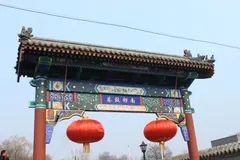
- The Story: The name board above the gate is written in Manchu, Chinese, Tibetan and Mongolian — a four-language statement of who this temple was for.
- What to Look For: Stand directly beneath it, not at an angle; the four scripts sit in a row and the light is better in the afternoon.


3. Cultural Contrast: A Working Temple in a Tourist City
For Chinese visitors Yonghe is a place to ask for something specific: exam results, a job, a child’s health. The queue at the halls is not idle — people come with a request, and on the first and fifteenth days of the lunar month, and on Tibetan festival dates, the courtyards are dense with it. Burning incense here is a transaction with a purpose, not a photo opportunity.
Foreign visitors arrive expecting architecture and get ritual, which is the better experience if you know the etiquette: hat off indoors, do not step on the threshold, walk clockwise around the halls, and keep the camera away inside. It is also worth walking five minutes east into the Wudaoying alley afterwards — the teahouses there are where people go to decompress after the smoke.

4. Practical Essentials: Tickets, Transit & Scam Alerts
Tickets & Passport Booking
- Price: ¥25.
- How to Book: Reserve through the official ‘Yonghegong’ WeChat account and enter with your passport; slots are tight in high season and around festival dates. Opening 09:00–16:30 from November to March and 09:00–17:00 from April to October — hours change on some holidays, so check the account.
How to Get There
- By Metro: Line 2 or Line 5 to Yonghegong (Lama Temple) station, Exit C. The temple is a two-minute walk south.
- Show Your Driver: 师傅,请带我去东城雍和宫(雍和宫大街12号),谢谢!
Inside Tips & Scam Alerts
- Do not buy ‘blessed’ bracelets or pay for ‘opening the light’ rituals from people outside the gate. Anything offered at a quoted price on the street is not the temple’s; inside, blessings are free or donation-based.
- Buy incense only inside, at posted prices — or simply take the three free sticks offered at the entrance.
- Come at opening time to beat the tour groups; the first half hour is the only quiet window.
- Dress and behave for a working temple: hats off indoors, no bare shoulders in the halls during festivals, no photographs inside.
- Accessibility: every hall has a high wooden threshold, so wheelchairs need a lift over each one; the courtyards between them are flat.
- Complaints: the national 12345 hotline is free to call from any local phone.
Quick Answers
The 6 things visitors ask before setting out, answered from the same verified record used across this page.
- How much does it cost to visit Yonghe Temple (Lama Temple)?
- ¥25.
- What are the opening hours at Yonghe Temple (Lama Temple)?
- 09:00 - 16:30 (Nov-Mar) / 09:00 - 17:00 (Apr-Oct); closed some holidays—check official WeChat.
- Is Yonghe Temple (Lama Temple) wheelchair accessible?
- Yes. The main axis is level and passable; some side halls have thresholds and steps. Wheelchair users can access the front courtyards and view the main halls.
- How do I tell a taxi driver to take me to Yonghe Temple (Lama Temple)?
- Copy this line into DiDi or show it to the driver: 师傅,请带我去雍和宫,雍和宫大街12号,谢谢!
- Can I leave my luggage at Yonghe Temple (Lama Temple)?
- Free lockers at the entrance; large bags must be stored.
- Is there anything to watch out for at Yonghe Temple (Lama Temple)?
- Ignore anyone outside selling 'blessed' bracelets or offering paid 'opening the light' (开光) blessing rituals at inflated prices—blessings inside are free or donation-based. Buy incense only inside at posted prices.
Where to go next
Three short lists, recomputed at build time from the same coordinates and categories as the pages themselves — no paid placement, no hand-picked names. Every card is a published guide.
Next stop in Beijing
Straight-line distance from this spot, so you can judge what is walkable and what needs a taxi.


More like this, elsewhere in China
If temple is what you came for, these are the closest equivalents you can reach in another city — ordered by distance, one city per card.


Change the subject
Deliberately a different category, for when one more temple or garden would blur into the last one.


Lists are derived from coordinates and category alone. Fix a wrong pin or re-tag a place and every list that mentions it moves with it.
Before you go · arrival essentials
Practical guides that pair with this kind of place — picked by category, not sponsored placement.