
Confucius Temple & Guozijian (Imperial Academy)

Taxi & Street Navigation Help
师傅,请带我去孔庙和国子监,国子监街13号,谢谢!
Opening Hours & Best Time
08:30 - 18:00 (peak) / 08:30 - 17:00 (off-peak), closed Mondays
💡 Pro Tip: The quietest major sight in central Beijing—pair with the Yonghe Temple, 5 minutes' walk away, for a perfect 'temple morning'. Don't miss the 198 steles of the Jinshi examination names in the Confucius Temple's courtyard.
Accessibility & Luggage Lockers
Accessibility: ♿ Wheelchair & Stroller Friendly
The main axis and courtyards are flat and passable; the Biyong hall platform has steps with a ramp alternative.
🧳 Luggage Storage: Storage at the visitor center at the entrance.
Nearby Landmarks
The 2 places within reach of this spot — each one opens straight into Apple Maps or Amap, with the Chinese name you can show a driver.
Chinese names and pins are matched against each city's own map data at build time; a place only gets Directions once its pin has been verified, otherwise the button searches by name.
About Confucius Temple & Guozijian (Imperial Academy)
1. Historical Origins: The Exam Factory Next Door
The Confucius Temple here was founded in 1302, under the Yuan, and rebuilt repeatedly in the Ming and Qing — the halls you walk through are eighteenth-century work. It is the second-largest Confucian temple in China after Qufu, but its real distinction is the courtyard, whose walls carry 198 stone tablets listing the names of jinshi graduates from the Yuan to the Qing: the examination results, carved in stone for six hundred years.
The Guozijian next door was the empire’s highest educational institution, the college where the sons of officials trained and where the emperor occasionally lectured. The two compounds are connected, which is why they share a ticket, and the academy’s hall called Biyong — a square pavilion on a round moat, water on all four sides — is the one building every photograph of this site is looking for.

2. What to Spot: The Steles, the Hall, the Biyong
🪨 The 198 examination steles
- The Story: Each tablet records the names, native places and ranks of one cohort of jinshi — the highest degree in the imperial examination system.
- What to Look For: Read a few lines rather than all of them. Names from the same cohort are ranked, which is why the order on the stone is the point.
🏛️ The Hall of Great Achievement
- The Story: The main hall, with a gilt statue of Confucius and the four assessors who wrote the classic commentaries.
- What to Look For: The roof and the stone terrace; the interior is dark and reverent rather than decorative.
💧 Biyong Hall
- The Story: The academy’s ceremonial lecture hall, square under a double roof, entirely surrounded by water and reached by four bridges.
- What to Look For: The reflection from the south bridge. It is a deliberately classical form — round moat, square building, the cosmos in miniature.
🌳 Guozijian Street
- The Story: The lane outside, lined with ancient locust trees and the only street in Beijing still fronted by the academy’s original gateways.
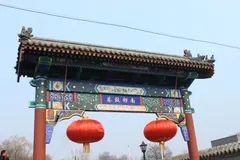
- What to Look For: The two paifang over the street and the shadows on the paving in late afternoon.


3. Cultural Contrast: The Quietest Sight in Central Beijing
For Chinese visitors this is a place of genuine respect: parents bring children about to sit the gaokao and rub the stone animals for luck, and the atmosphere is closer to a library than to a tourist site. The examination steles have a direct emotional charge — a wall of names that represents the ladder by which a village family could enter the state.
Foreign visitors usually find it by accident, five minutes from the far busier Yonghe Temple, and it is the calmest major sight in the centre of the city. The pairing is the best morning in Beijing: Yonghe at 09:00 when it opens, then walk five minutes west into the academy at about 10:30 when the tour groups have gone. Guozijian Street itself — locust trees, two stone arches, almost no traffic — is worth more time than the halls.

4. Practical Essentials: Tickets, Transit & Scam Alerts
Tickets & Passport Booking
- Price: ¥30 for the combined ticket covering both the temple and the academy.
- How to Book: Buy at the gate with your passport, or reserve through the official channel in high season. Open 08:30–18:00 in peak season and 08:30–17:00 off-peak, closed Mondays.
How to Get There
- By Metro: Line 2 or Line 5 to Yonghegong, then about ten minutes on foot west along Guozijian Street. The Yonghe Temple is five minutes back the other way.
- Show Your Driver: 师傅,请带我去东城孔庙国子监(国子监街),谢谢!
Inside Tips & Scam Alerts
- Closed Mondays — the most common wasted trip in this part of the city.
- Do not confuse the two entrances. The temple and the academy share a ticket but have separate gates on the same street; enter at either and walk through.
- Combine with Yonghe Temple for a half-day: the two are five minutes apart and the contrast between working temple and quiet academy is the point.
- Accessibility: the courtyards are flat and level, so wheelchairs manage the grounds; the halls have raised thresholds.
- Complaints: the national 12345 hotline is free to call from any local phone.
Quick Answers
The 6 things visitors ask before setting out, answered from the same verified record used across this page.
- How much does it cost to visit Confucius Temple & Guozijian (Imperial Academy)?
- ¥30.
- What are the opening hours at Confucius Temple & Guozijian (Imperial Academy)?
- 08:30 - 18:00 (peak) / 08:30 - 17:00 (off-peak), closed Mondays.
- Is Confucius Temple & Guozijian (Imperial Academy) wheelchair accessible?
- Yes. The main axis and courtyards are flat and passable; the Biyong hall platform has steps with a ramp alternative.
- How do I tell a taxi driver to take me to Confucius Temple & Guozijian (Imperial Academy)?
- Copy this line into DiDi or show it to the driver: 师傅,请带我去孔庙和国子监,国子监街13号,谢谢!
- Can I leave my luggage at Confucius Temple & Guozijian (Imperial Academy)?
- Storage at the visitor center at the entrance.
- Will English work at Confucius Temple & Guozijian (Imperial Academy)?
- Limited — ticketing and signage are mostly Chinese. Have a translation app with the offline Chinese pack ready, and keep the Chinese name (孔庙和国子监) on screen for staff.
Where to go next
Three short lists, recomputed at build time from the same coordinates and categories as the pages themselves — no paid placement, no hand-picked names. Every card is a published guide.
Next stop in Beijing
Straight-line distance from this spot, so you can judge what is walkable and what needs a taxi.


More like this, elsewhere in China
If temple is what you came for, these are the closest equivalents you can reach in another city — ordered by distance, one city per card.


Change the subject
Deliberately a different category, for when one more temple or garden would blur into the last one.


Lists are derived from coordinates and category alone. Fix a wrong pin or re-tag a place and every list that mentions it moves with it.
Before you go · arrival essentials
Practical guides that pair with this kind of place — picked by category, not sponsored placement.