
Pichaiyuan Alley

This is the most tourist-priced food alley in the city. Seafood is sold by weight and the scales are often the shop's own - ask the total before cooking. 海胆 and 鲍鱼 priced 'per head' at ¥30 are usually tiny.
Taxi & Street Navigation Help
师傅,请带我到劈柴院(江宁路),谢谢!
Opening Hours & Best Time
Alley about 09:00-21:30; individual stalls vary, busiest from 17:00.
💡 Pro Tip: Eat the cheap local things: 烤鱿鱼, 锅贴, 豆腐脑. Skip the lobster tanks. Go at 17:00 for the grill smoke and before the tour groups, and treat it as a snack stop rather than dinner - the real seafood is at 营口路 market.
Accessibility & Luggage Lockers
Accessibility: ⚠️ Step thresholds, limited access
A narrow 1930s lane of uneven stone with steps into most stalls; crowded enough after 18:00 that movement is slow. Not wheelchair friendly.
🧳 Luggage Storage: No storage.
Nearby Landmarks
The 2 places within reach of this spot — each one opens straight into Apple Maps or Amap, with the Chinese name you can show a driver.
Also worth pairing: Zhanqiao Pier (900 m west) — real picks, just left off the grid so the cards stay in pairs.
Chinese names and pins are matched against each city's own map data at build time; a place only gets Directions once its pin has been verified, otherwise the button searches by name.
About Pichaiyuan Alley
1. Historical Origins: Firewood, Then Food
The name gives away the origin: this courtyard block off Zhongshan Road was where the firewood for the surrounding houses was cut and sold. When the German-era commercial quarter grew up around it, the yard filled with cheap kitchens serving the shopkeepers and clerks of the busiest street in town, and it has been a food address ever since.
Zhongshan Road itself is the older story: a hundred-year-old commercial street lined with arcaded buildings, whose covered walkways are the concession’s answer to both rain and sun. Pichaiyuan (劈柴院) sits off it as a dense cluster of low lanes — the courtyard-block housing the city calls liyuan (里院) — packed with snack stalls under awnings.
2. What to Spot: Smoke, Signage and the Shape of the Block
🍢 The Food Lanes
The block is a warren of narrow lanes, lined with open kitchens. This is not a restaurant district with tables behind doors — the cooking happens at the front, on the street, and the smoke is the point. Grills, woks and steamers are all working at once from late afternoon.
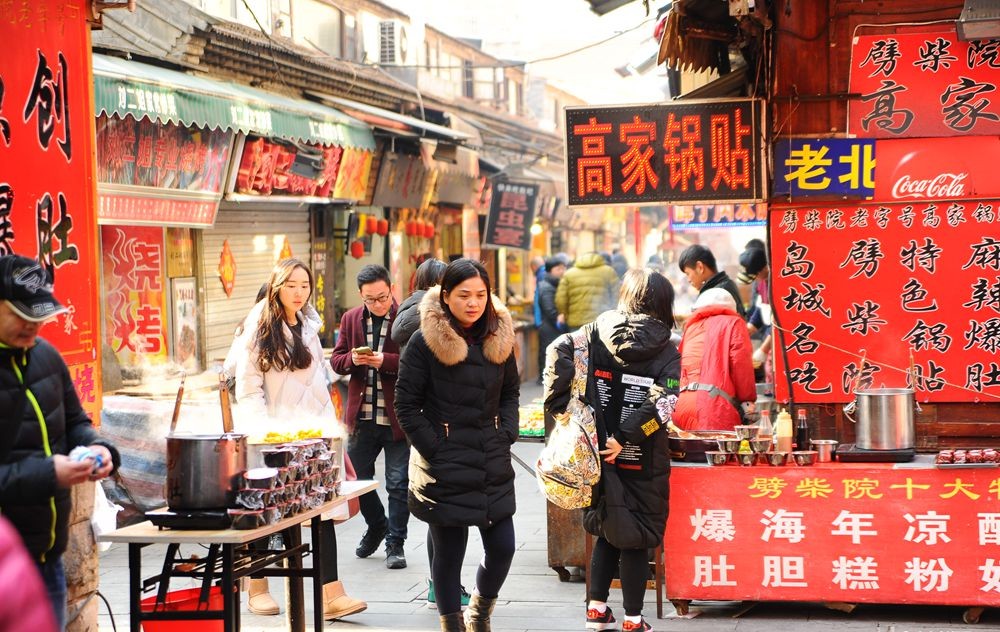
- The Story: The stalls grew out of feeding the commercial street, not out of feeding visitors; the format is old, the pricing is not.
- What to Look For: The old courtyard buildings above the shopfronts. The upper floors are the original housing stock and most of the commercial clutter is at eye level.
🦑 What Is Actually Worth Eating
The honest advice is to eat the cheap things. Grilled squid, potstickers (锅贴) and savoury tofu pudding are made well here and cost little. The lobster tanks and the sea urchins are for the photograph, not the meal.
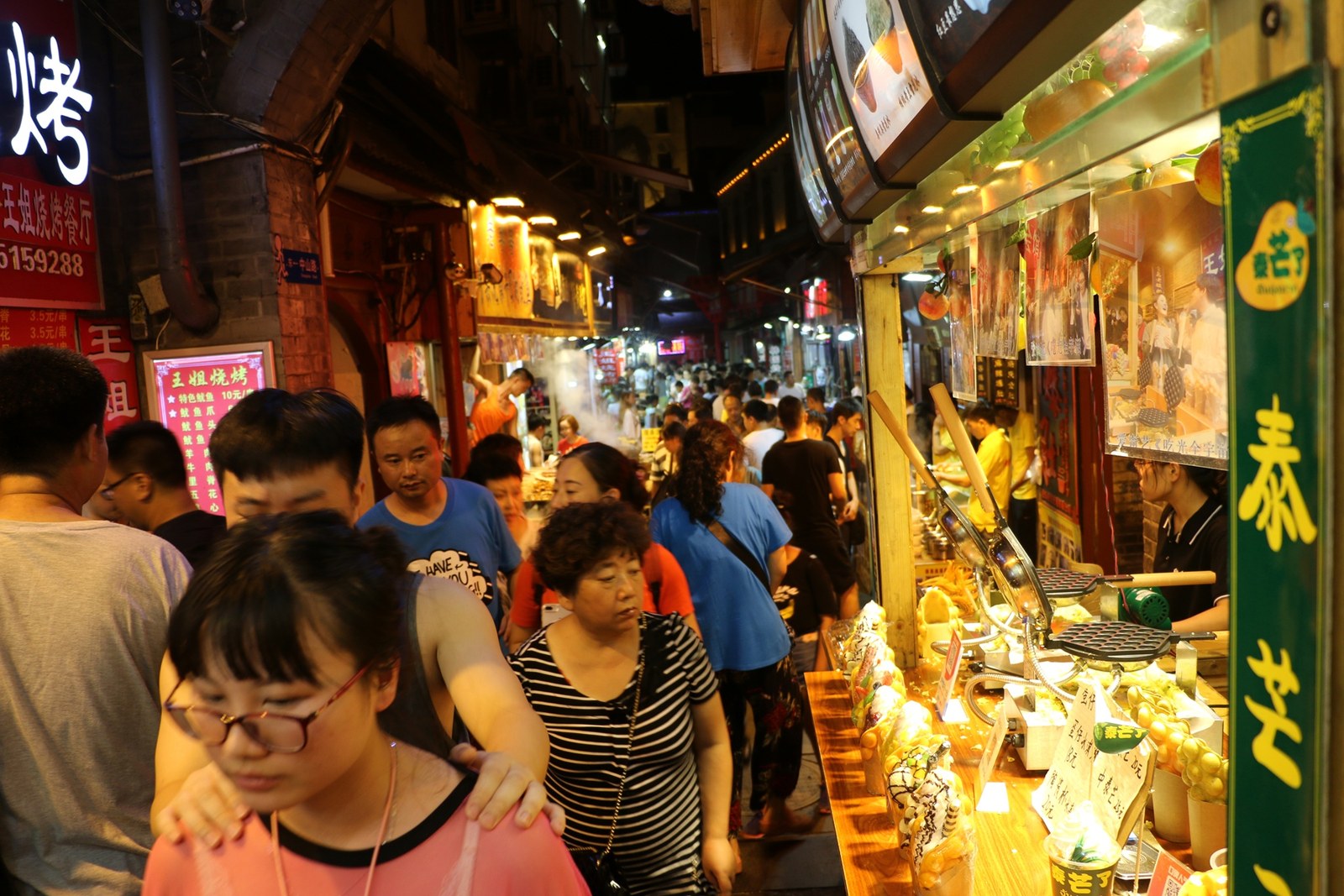
🏮 After Dark
Once the lanterns are lit the lanes look their best and the crowd thickens. It is a short visit either way — the block is small — and it works far better as a snack stop on the way to somewhere else than as a destination for dinner.
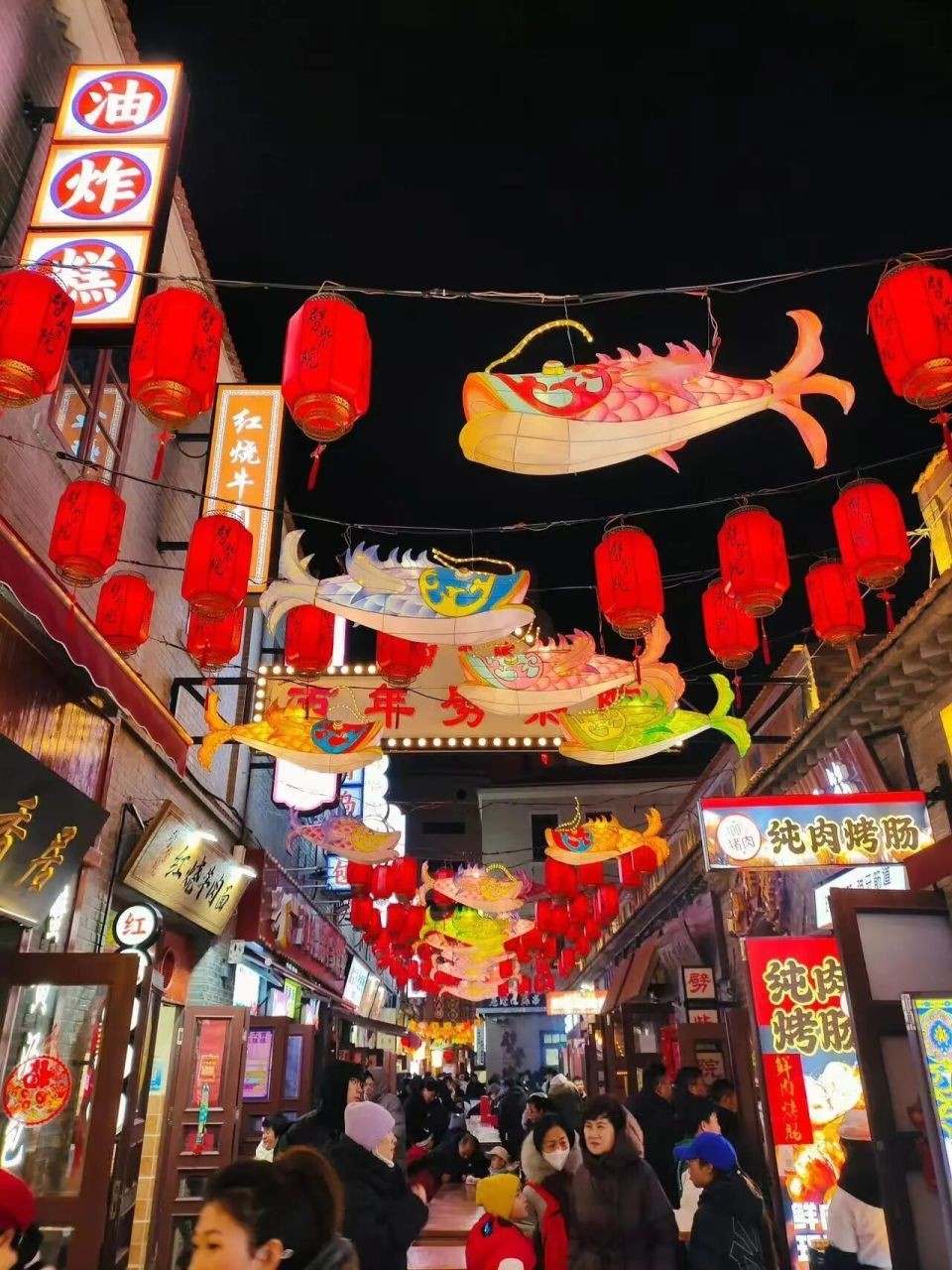
3. Cultural Contrast: A Courtyard Block That Became a Set
Pichaiyuan is the clearest example in Qingdao of a neighbourhood that has been converted into an atmosphere. The courtyard-block type the city calls liyuan (里院) — a block built round a shared yard — was the standard housing of the old commercial city, and most of it has gone. What survives here survives as a food court with a heritage frontage.
- Locals eat elsewhere. Taidong and Yingkou Road are where the city actually goes for seafood and beer; Pichaiyuan is where it takes visitors.
- Treat it as a snack stop, not dinner. An hour, two or three small things, and out.
- The real thing is ten minutes away. The Yingkou Road market, where you buy seafood and pay a kitchen to cook it, is a better use of an evening.
4. Practical Essentials: Tickets, Transit & Scam Alerts
Tickets & Passport Booking
- There is no ticket and no gate. Pichaiyuan is an open commercial block; you walk in from Zhongshan Road.
- Stalls keep their own hours and many shut in the middle of the afternoon. No schedule is quoted here because none exists — from late afternoon onward is when the lanes are fully open.
- Cash and mobile payment both work, but foreign cards are hit and miss at individual stalls; international cards are more reliably taken in the larger shops on Zhongshan Road.
How to Get There
- Location: off Zhongshan Road at Jiangning Road, Shinan District (市南区中山路/江宁路) — in the old town, ten minutes’ walk from the pier.
- Metro: Line 3 to Qingdao Railway Station or the old-town stations, then on foot; the lanes are inside the pedestrian quarter.
- Taxi: “师傅,去劈柴院” — the drop-off will be on Zhongshan Road at the nearest corner.
- Combine it: the pier, the cathedral and the old-town streets are all within a fifteen-minute walk.
Inside Tips & Scam Alerts
- This is the most tourist-priced food alley in the city. Seafood is often sold by weight on the shop’s own scale — ask for the total price before anything goes in the wok.
- “Per head” shellfish specials are usually tiny. A cheap sea urchin or abalone price generally buys a very small specimen.
- Never accept a fish that is already on the grill. Choose it live, watch it weighed, then agree the price.
- Crowds and narrow lanes: the paving is uneven and the lanes fill up after dark, so it is awkward with a pram or a wheelchair.
- Complaints or overcharging: the 12345 hotline is free from a local phone and takes calls in English — worth knowing in a food alley.
Quick Answers
The 6 things visitors ask before setting out, answered from the same verified record used across this page.
- How much does it cost to visit Pichaiyuan Alley?
- Free to walk in; food is ¥10-40 a dish.
- What are the opening hours at Pichaiyuan Alley?
- Alley about 09:00-21:30; individual stalls vary, busiest from 17:00.
- Is Pichaiyuan Alley wheelchair accessible?
- Not fully. A narrow 1930s lane of uneven stone with steps into most stalls; crowded enough after 18:00 that movement is slow. Not wheelchair friendly.
- How do I tell a taxi driver to take me to Pichaiyuan Alley?
- Copy this line into DiDi or show it to the driver: 师傅,请带我到劈柴院(江宁路),谢谢!
- Can I leave my luggage at Pichaiyuan Alley?
- No storage.
- Is there anything to watch out for at Pichaiyuan Alley?
- This is the most tourist-priced food alley in the city. Seafood is sold by weight and the scales are often the shop's own - ask the total before cooking. 海胆 and 鲍鱼 priced 'per head' at ¥30 are usually tiny.
Where to go next
Three short lists, recomputed at build time from the same coordinates and categories as the pages themselves — no paid placement, no hand-picked names. Every card is a published guide.
Next stop in Qingdao
Straight-line distance from this spot, so you can judge what is walkable and what needs a taxi.


More like this, elsewhere in China
If historic district is what you came for, these are the closest equivalents you can reach in another city — ordered by distance, one city per card.


Change the subject
Deliberately a different category, for when one more temple or garden would blur into the last one.


Lists are derived from coordinates and category alone. Fix a wrong pin or re-tag a place and every list that mentions it moves with it.
Before you go · arrival essentials
Practical guides that pair with this kind of place — picked by category, not sponsored placement.
- Pay with Alipay & WeChat PayPayment · Set up Alipay or WeChat Pay on a foreign card — needed at almost every counter.
- Claim your tourist tax refundTax refund · Get 11% VAT back on what you buy here, at the airport on departure.
- Book China train tickets (12306)Trains · Buy high-speed rail tickets with a foreign passport, for getting here and back.