
Small Wild Goose Pagoda & Xi'an Museum

Taxi & Street Navigation Help
师傅,请带我到小雁塔西安博物院入口,友谊西路。谢谢!
Opening Hours & Best Time
9:00 - 18:00 (closed Tuesdays)
💡 Pro Tip: This is the anti-crowd alternative to the Big Wild Goose Pagoda: same Tang dynasty, quieter gardens, and the free Xi'an Museum attached. The pagoda's top was sheared off by earthquakes centuries ago — the truncated silhouette is its signature.
Accessibility & Luggage Lockers
Accessibility: ♿ Wheelchair & Stroller Friendly
Flat garden paths and a step-free museum entrance; the pagoda interior is closed to climbing.
🧳 Luggage Storage: Free lockers at the museum entrance.
Nearby Landmarks
The 2 places within reach of this spot — each one opens straight into Apple Maps or Amap, with the Chinese name you can show a driver.
Chinese names and pins are matched against each city's own map data at build time; a place only gets Directions once its pin has been verified, otherwise the button searches by name.
About Small Wild Goose Pagoda & Xi'an Museum
1. Historical Origins: A Tang Pagoda That Survived by Shrugging
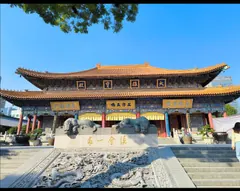
The Small Wild Goose Pagoda was built in 707, inside Jianfu Temple, one of the great translation monasteries of the Tang capital. It was originally fifteen storeys; earthquakes removed the top and left it at thirteen, about 43 metres, with a jagged open crown instead of a finial. That silhouette — flat-topped, slightly stubby, visibly broken — is how you know you are looking at the original rather than a restoration.
What makes the tower remarkable is not that it survived but how. Xi’an sits on a seismic belt, and this pagoda has been through more than seventy earthquakes in thirteen centuries. Cracks opened in the brickwork and then closed again, a behaviour engineers explain by the flexibility of the rammed-earth core and the absence of rigid internal framing. Locals describe it as self-healing, which is not far from what the record shows.
The grounds are the old Jianfu Temple, and the city museum was built into them in 2007 — which is why a Tang monument and a modern museum share one ticket, and one entrance.

2. What to Spot: The Truncated Top, the Bell, the City Museum
🛕 The Broken Crown
- The Story: The missing top is the whole point. Every other Tang pagoda in China was restored into a neat point; this one was left as the earthquakes made it.
- What to Look For: Get close to the base and look straight up the brick face — the taper is subtle, and the wall thickness at the bottom explains the stability.
🔔 The Morning Bell
- The Story: “Wild Goose Pagoda Morning Bell” is one of the eight classic scenes of the Guanzhong region, and the bell pavilion still stands in the courtyard.
- What to Look For: The bell itself — cast heavy, with the patina of centuries of hands. Mornings are when the gardens are quietest and the light comes in low through the cypresses.
🏛️ The Xi’an Museum
- The Story: Built into the temple grounds, free with the same reservation. Its collection is deliberately the opposite of the Shaanxi History Museum’s: everyday Tang life — pottery, figurines, tomb goods of ordinary officials — rather than imperial treasure.
- What to Look For: The Tang figurines of women, musicians and Central Asian traders. They are smaller, funnier and more human than anything in the big museum across town, and there is no queue.


3. Cultural Contrast: The Anti-Big-Wild-Goose
Xi’an has two wild goose pagodas and they are opposites. The Big Wild Goose is a plaza, a fountain show, a commercial district and a crowd at 8 p.m.; the Small Wild Goose is a walled garden with cypresses, birdsong and almost nobody, ten minutes away by metro. Chinese visitors know this and treat the small one as the connoisseur’s choice; foreign visitors often never hear of it.
The practical case for coming is the museum pairing. The Shaanxi History Museum is the best collection in the province and the hardest ticket in China — its free slots vanish days ahead. This museum is free, needs only a reservation, and shows you the same dynasty from the bottom of society. Doing both is better than doing either twice.
One scheduling trap: the museum closes on Tuesdays while the gardens stay open. A Tuesday visit gets you the pagoda and the trees but not the galleries.
4. Practical Essentials: Tickets & Passport Booking
Tickets & Passport Booking
- Price: Free, but a real-name reservation is required. Check the official site before you go in case the booking channel changes.
- How to Book: Reserve through the Xi’an Museum’s official WeChat account; foreign passports are accepted. Book a day or two ahead in peak season.
How to Get There
- By Metro: Line 2 to Nanshaomen Station, Exit F, then about eight minutes on foot south. The Forest of Steles and the South Gate are each about 1.5 km away.
- Show Your Driver: 师傅,请带我到小雁塔西安博物院入口,友谊西路。谢谢!
Inside Tips & Scam Alerts
- Closed Tuesdays — the museum, not the garden. If your only free day is Tuesday, still come for the pagoda and the grounds, but do not expect the galleries.
- Reserve before you travel, not on the day. Free tickets are capped and released in advance; walk-ups are often turned away.
- This is the answer to a sold-out Shaanxi History Museum. Same dynasty, different angle, no queue.
- A good rainy-day option. The gardens are sheltered by old trees and the museum is indoors.
- Complaints: the national 12345 hotline is free to call from any local phone.
Quick Answers
The 6 things visitors ask before setting out, answered from the same verified record used across this page.
- How much does it cost to visit Small Wild Goose Pagoda & Xi'an Museum?
- FREE (reservation required).
- What are the opening hours at Small Wild Goose Pagoda & Xi'an Museum?
- 9:00 - 18:00 (closed Tuesdays).
- Is Small Wild Goose Pagoda & Xi'an Museum wheelchair accessible?
- Yes. Flat garden paths and a step-free museum entrance; the pagoda interior is closed to climbing.
- How do I tell a taxi driver to take me to Small Wild Goose Pagoda & Xi'an Museum?
- Copy this line into DiDi or show it to the driver: 师傅,请带我到小雁塔西安博物院入口,友谊西路。谢谢!
- Can I leave my luggage at Small Wild Goose Pagoda & Xi'an Museum?
- Free lockers at the museum entrance.
- Will English work at Small Wild Goose Pagoda & Xi'an Museum?
- Yes — staff used to foreign visitors handle English, and the site scores 3/5 on our foreign-friendliness scale.
Where to go next
Three short lists, recomputed at build time from the same coordinates and categories as the pages themselves — no paid placement, no hand-picked names. Every card is a published guide.
Next stop in Xi'an
Straight-line distance from this spot, so you can judge what is walkable and what needs a taxi.


More like this, elsewhere in China
If museum is what you came for, these are the closest equivalents you can reach in another city — ordered by distance, one city per card.


Change the subject
Deliberately a different category, for when one more temple or garden would blur into the last one.


Lists are derived from coordinates and category alone. Fix a wrong pin or re-tag a place and every list that mentions it moves with it.
Before you go · arrival essentials
Practical guides that pair with this kind of place — picked by category, not sponsored placement.
- Pay with Alipay & WeChat PayPayment · Set up Alipay or WeChat Pay on a foreign card — needed at almost every counter.
- Get online with a China eSIMConnectivity · Maps and messaging that work without a VPN, the moment you land.
- Book China train tickets (12306)Trains · Buy high-speed rail tickets with a foreign passport, for getting here and back.