
Jimei School Village & Aoyuan
ℹ️ School village free to walk. Aoyuan ¥20 (¥10 for the adjacent Tan Kah-kee residence).

Taxi & Street Navigation Help
师傅,请带我到集美学村鳌园(集美街道银江路183号),谢谢!
Opening Hours & Best Time
Village lanes always open; Aoyuan about 08:00-17:30.
💡 Pro Tip: Ride Metro Line 1 from downtown and sit on the right-hand side heading north: the train runs on a causeway across the bay for one stop, which is the cheapest sea view in Xiamen.
Accessibility & Luggage Lockers
Accessibility: ♿ Wheelchair & Stroller Friendly
Aoyuan's corridors and the school village's main avenues are level and step-free; the seawall promenade is paved.
🧳 Luggage Storage: No lockers at the site; bag storage is available at the metro station nearby.
Nearby Landmarks
The 2 places within reach of this spot — each one opens straight into Apple Maps or Amap, with the Chinese name you can show a driver.
Chinese names and pins are matched against each city's own map data at build time; a place only gets Directions once its pin has been verified, otherwise the button searches by name.
About Jimei School Village & Aoyuan
1. Historical Origins: A Town Built Out of Schools
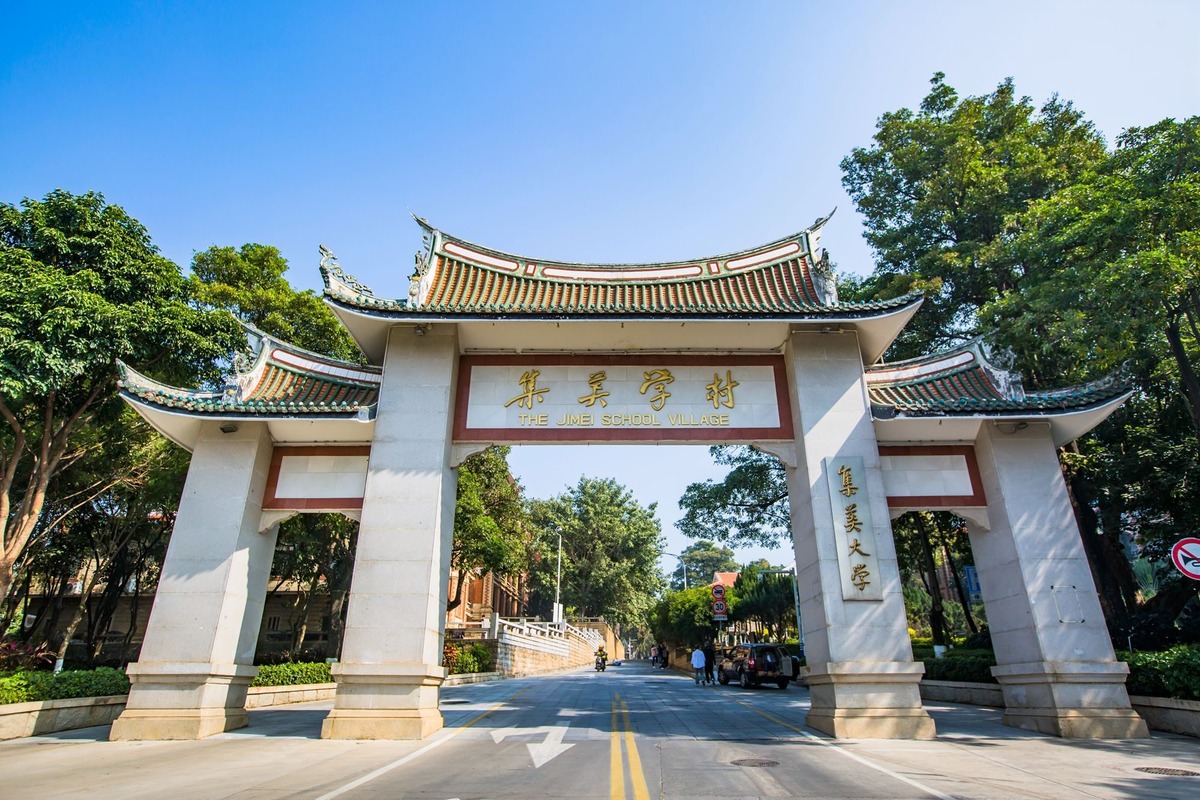
Jimei is the hometown of Tan Kah-kee, the overseas-Chinese businessman and philanthropist who spent his fortune building schools here, and the whole district is the result. Starting in the early twentieth century and continuing for decades, he financed a continuous run of institutions on this strip of coast — kindergarten, primary, secondary, normal school, vocational school, university — laid out along a man-made pool used for dragon-boat racing.
What makes it worth a half-day is the architecture, now called the Jiageng style after him: buildings whose plan and structure are Western — colonnades, arcades, concrete frames — but whose roofs are Chinese, with glazed tiles and upturned eaves. It was a deliberate choice at a moment when Chinese architects were being told that modernity meant Europe. The result is a coherent streetscape unlike anywhere else in the country, and it is still a working campus rather than a preserved set.
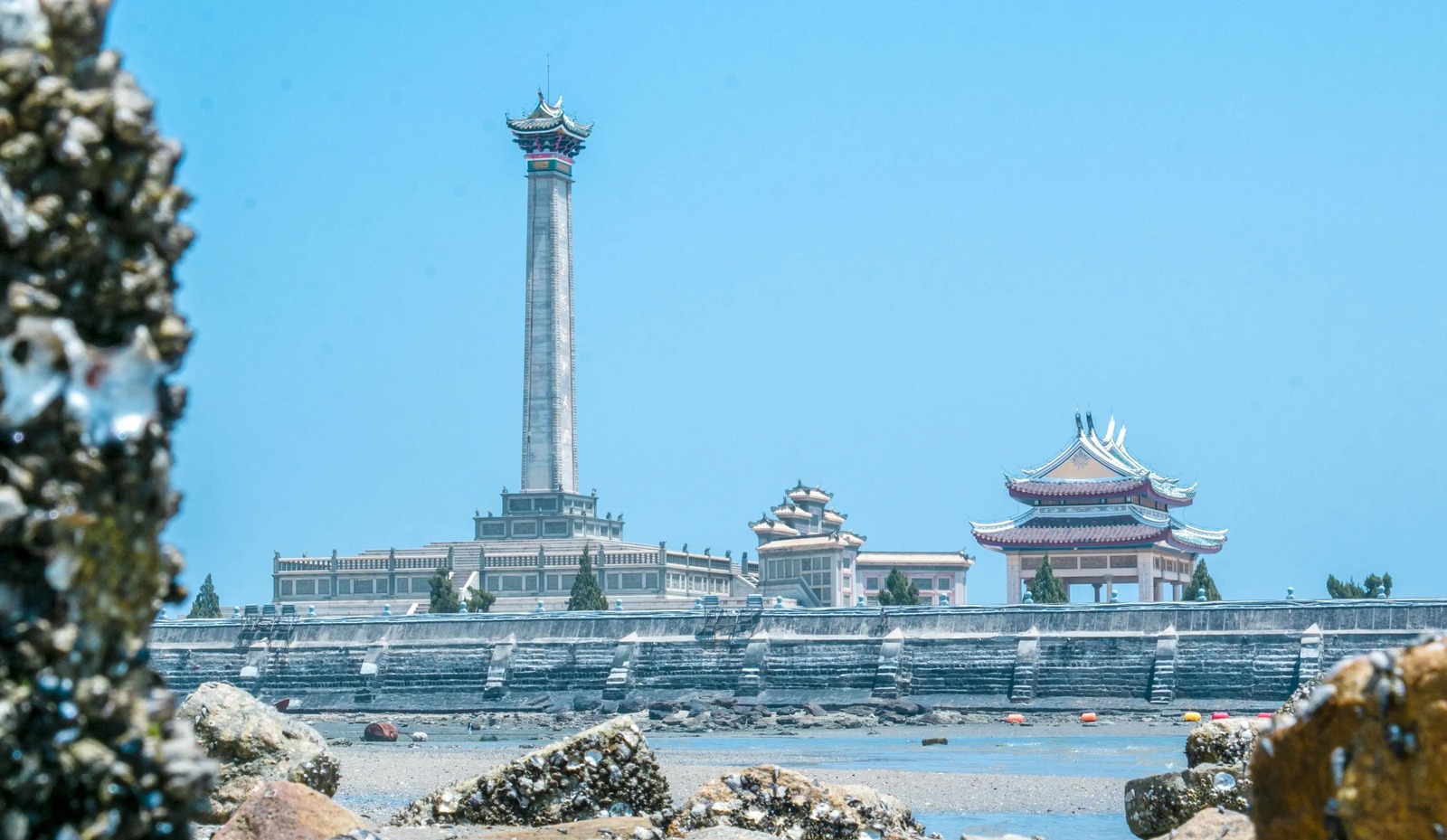
Aoyuan, in the south-east corner, is where the story closes: a memorial garden containing the Jimei Liberation Monument and Tan Kah-kee’s own tomb, faced and floored in carved bluestone.
2. What to Spot: Roofs, Reliefs and the Pool
🏛️ The Jiageng Roofs
Walk the edge of the dragon-boat pool and look up rather than ahead. The interest is entirely in the join: a concrete colonnade carrying a hipped roof with green glazed tiles, a Western window under a Chinese eave, a building that is neither one thing nor the other and knows it. The white-and-red palette is consistent across the whole district because it was built as one project rather than accreted.
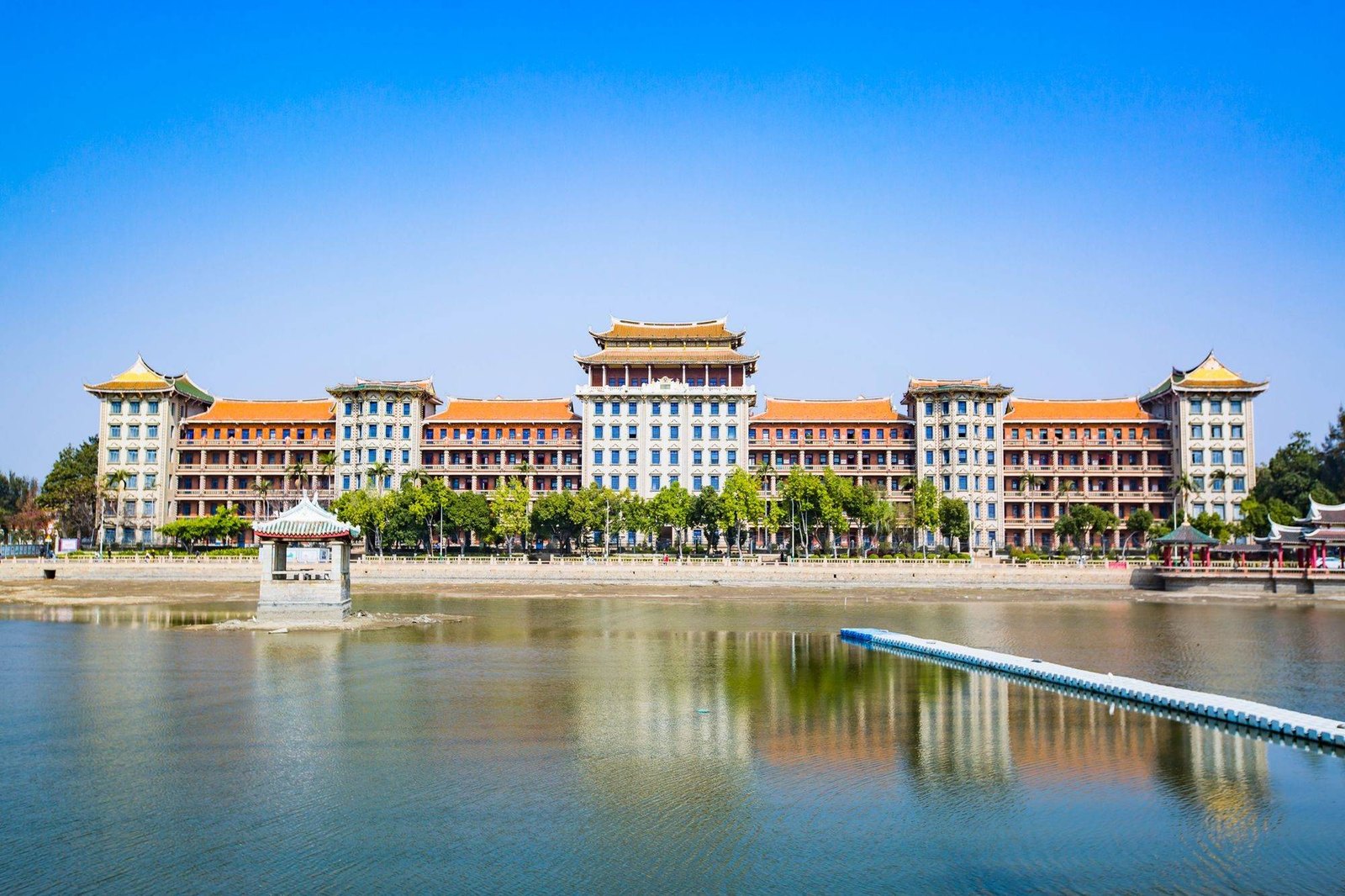
- The Story: The style was a statement about what a modern Chinese institution should look like — imported engineering, local identity.
- What to Look For: The eaves. Every one of the major buildings has a Chinese roof sitting on a structure that was designed in Europe.
🪨 The Aoyuan Reliefs
Inside Aoyuan the stonework is the reason to pay: corridors and walls faced in carved bluestone reliefs, figures and scenes cut in low relief across long panels, with the monument and the tomb beyond. It is dense, figurative carving of a kind that is rare at this scale, and it rewards slow walking rather than photography at arm’s length.
🚇 The Crossing
The journey is part of the visit. Metro Line 1 runs from the city centre onto a causeway across the bay for one stop on its way north, and the train is above the water rather than in a tunnel — the cheapest sea view in Xiamen, and the reason to take the metro rather than a taxi.
3. Cultural Contrast: A Campus With No Walls Around the Idea
European university towns grew around a cathedral or a market and were later formalised. Jimei was planned as a single educational estate by one man and built to a single architectural argument — which makes it read more like a manifesto than a town. It is also still in use: students cross the poolside roads between classes, and the ceremonial core sits next to ordinary school buildings.
That is what to expect. This is not a heritage park with turnstiles at the gate; it is a district where the visitor is a guest, and the school village itself costs nothing to walk through.
- Half a day covers the pool, the main facades and Aoyuan.
- Come around the Dragon Boat Festival if you can — the pool is used for races, which is what it was built for.
- Photograph the pool edge at an angle, not head-on: the roofs only read as a run of roofs from the side.
4. Practical Essentials: Tickets, Metro & Scam Alerts
Tickets & Passport Booking
- The school village and the dragon-boat pool are free and open at all hours. It is an open district and public square, not a ticketed sight; no booking and no gate.
- Aoyuan is ticketed, and no price is quoted here. The single-ticket price and a combined-ticket arrangement both circulate, and the figure at the gate is the only one that applies. Tan Kah-kee’s former residence and Jiageng Park are separately ticketed as well.
- Aoyuan keeps roughly 08:00 to 17:30. Two sources agree on that window, and it is early enough that you should not leave it to the end of the day.
- Foreign visitors buy with a passport at the Aoyuan window; the school village itself requires nothing.
How to Get There
- By metro: Line 1 to Jimei School Village station, exit 2, then on foot. Sit on the right-hand side heading north from the city centre — the causeway crossing is one stop long and it is the best view of the trip.
- By taxi: say 师傅,去集美学村龙舟池 — the pool is the centre of the district and a better destination than the station.
- On arrival: everything worth seeing is within a walk of the pool; Aoyuan is at the south-east corner, on Aoyuan Road.
Inside Tips & Scam Alerts
- Do the pool first, Aoyuan second. Aoyuan closes in the late afternoon and the school village does not, so the order matters.
- The school village is a working campus. Some buildings are closed to visitors during term; do not walk into teaching blocks, and ask before photographing students.
- Wheelchairs and prams are fine around the pool and the squares, but Aoyuan has steps and raised corridors, and the reliefs are viewed along a stepped route.
- There is no need for a guide. The district is free to walk and the architecture explains itself; anyone offering a paid tour is optional.
- Complaints, overcharging or a taxi that will not use the meter: call 12345, free from a local phone, with English-speaking operators.
Quick Answers
The 6 things visitors ask before setting out, answered from the same verified record used across this page.
- How much does it cost to visit Jimei School Village & Aoyuan?
- Village free; Aoyuan ¥20. School village free to walk. Aoyuan ¥20 (¥10 for the adjacent Tan Kah-kee residence).
- What are the opening hours at Jimei School Village & Aoyuan?
- Village lanes always open; Aoyuan about 08:00-17:30.
- Is Jimei School Village & Aoyuan wheelchair accessible?
- Yes. Aoyuan's corridors and the school village's main avenues are level and step-free; the seawall promenade is paved.
- How do I tell a taxi driver to take me to Jimei School Village & Aoyuan?
- Copy this line into DiDi or show it to the driver: 师傅,请带我到集美学村鳌园(集美街道银江路183号),谢谢!
- Can I leave my luggage at Jimei School Village & Aoyuan?
- No lockers at the site; bag storage is available at the metro station nearby.
- Will English work at Jimei School Village & Aoyuan?
- Limited — ticketing and signage are mostly Chinese. Have a translation app with the offline Chinese pack ready, and keep the Chinese name (集美学村与鳌园) on screen for staff.
Where to go next
Three short lists, recomputed at build time from the same coordinates and categories as the pages themselves — no paid placement, no hand-picked names. Every card is a published guide.
Next stop in Xiamen
Straight-line distance from this spot, so you can judge what is walkable and what needs a taxi.


More like this, elsewhere in China
If historic district is what you came for, these are the closest equivalents you can reach in another city — ordered by distance, one city per card.


Change the subject
Deliberately a different category, for when one more temple or garden would blur into the last one.


Lists are derived from coordinates and category alone. Fix a wrong pin or re-tag a place and every list that mentions it moves with it.
Before you go · arrival essentials
Practical guides that pair with this kind of place — picked by category, not sponsored placement.
- Pay with Alipay & WeChat PayPayment · Set up Alipay or WeChat Pay on a foreign card — needed at almost every counter.
- Claim your tourist tax refundTax refund · Get 11% VAT back on what you buy here, at the airport on departure.
- Book China train tickets (12306)Trains · Buy high-speed rail tickets with a foreign passport, for getting here and back.