
Longhua Temple & Longhua Pagoda

Taxi & Street Navigation Help
师傅,请带我去徐汇区龙华路【龙华寺】正门(龙华路2853号),谢谢!
Opening Hours & Best Time
08:00 - 16:30
💡 Pro Tip: Shanghai's oldest and largest religious complex (dating back to the Three Kingdoms period in 242 AD). Famous for striking the evening bell on New Year's Eve.
Accessibility & Luggage Lockers
Accessibility: ♿ Wheelchair & Stroller Friendly
Spacious flat stone courtyards surrounded by lush gardens.
🧳 Luggage Storage: Available near Longhua Metro Station Exit 2.
Nearby Landmarks & A Short Train Ride
The 4 places worth pairing with this spot — each one opens straight into Apple Maps or Amap, with the Chinese name you can show a driver. One pick sits in Hangzhou (HSR ~48 min) — a short high-speed ride, not a walk. Shanghai's own list came out one short of a pair, and this is the nearest pick that fills it.
Chinese names and pins are matched against each city's own map data at build time; a place only gets Directions once its pin has been verified, otherwise the button searches by name. Cards with an amber city tag are in another city — the ride time shown is the fastest train of the day.
About Longhua Temple & Longhua Pagoda
1. Historical Origins: Shanghai’s Oldest Temple, Rebuilt Many Times
Longhua is the oldest and largest religious complex in Shanghai. Tradition dates its founding to 242 AD, during the Three Kingdoms period, which makes it roughly seventeen centuries older than the skyline that now surrounds it. Almost nothing structural survives from that date — the temple has burned and been rebuilt repeatedly, and the halls you walk through today are later reconstructions in the classical layout.

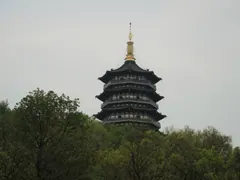
The pagoda in front of the temple is the exception. Longhua Pagoda was rebuilt during the Song dynasty, and it is the oldest standing structure of its kind in the city — a brick-and-timber tower of seven storeys that has outlasted everything built around it. That combination, a working temple behind a Song-dynasty tower, is why the site matters: it is the one place in Shanghai where you can see how far back the city’s built history actually goes.
2. What to Spot: The Pagoda, the Halls, the Bell
🗼 Longhua Pagoda
- The Story: The Song-era tower is the oldest structure in Shanghai, and it has been closed to climbing for years.
- What to Look For: The silhouette and the eaves against the sky, best from the temple courtyard side in late afternoon. Do not expect to go up.
🏯 The Hall Axis
- The Story: The temple follows the classical plan — gate, bell and drum towers, then halls of increasing sanctity.
- What to Look For: The sequence itself. Walk it in order and the architecture does the storytelling for you.


🔔 The New Year Bell
- The Story: Striking the bell on New Year’s Eve is the temple’s best-known ritual, and people queue for hours for a turn.
- What to Look For: The bell tower itself on any ordinary day — the queue is only worth joining once a year.
🥢 The Vegetarian Kitchen
- The Story: Longhua’s vegetarian noodles and mooncakes have a city-wide reputation that long predates the tourist trade.
- What to Look For: The canteen, not the souvenir counter. This is where locals actually eat.
3. Cultural Contrast: A Working Temple in a Modern District
Longhua is not a museum. It is an active temple with daily worship, and the people you see bowing in the halls are not performing for visitors. The etiquette is straightforward and locals follow it without thinking: keep to the side of the doorway rather than the centre, don’t photograph people while they pray, and don’t point at statues. The courtyard is also the neighbourhood’s park — retired residents sit in the shade in the morning, which is the quietest and best time to come. During the lunar March festival the temple fair fills the surrounding streets, a tradition that runs back centuries and is genuinely local rather than staged.

4. Practical Essentials: Tickets, Transit & Scam Alerts
Tickets & Passport Booking
- Price: About ¥10 for the incense ticket at the gate, which includes the incense you burn. Cash is easiest. The temple is an active one rather than a ticketed attraction, so the figure is small and can shift — treat ¥10 as the working number.
- How to Book: No advance booking. Buy at the gate; your passport works as ID if asked. The pagoda itself is not open for climbing, whatever you may be told outside.
How to Get There
- By Metro: Line 11 to Longhua Station, then about five minutes on foot to 2853 Longhua Road.
- Show Your Driver: 师傅,请带我去龙华寺,徐汇区龙华路 2853 号,谢谢!
Inside Tips & Scam Alerts
- Hours: 08:00 to 16:30. Because the temple is active rather than commercial, it closes early and does not stay open for evening visits.
- Morning Is Better: The halls are quiet, the courtyard is shaded, and the resident worshippers set the tone. Afternoons bring tour groups.
- Do Not Climb the Pagoda: There is no ticket and no access to the upper storeys. Anyone outside offering to take you up is not connected to the temple.
- Incense Selling: Buy incense inside the compound if you want it. Vendors on the approach road sell bundles at inflated prices and sometimes imply they are mandatory; they are not.
- Add the Cemetery: The Longhua Martyrs’ Cemetery next door is a separate site, free and quietly worth an hour.
- Complaints: the national 12345 hotline is free to call from any local phone.
Quick Answers
The 6 things visitors ask before setting out, answered from the same verified record used across this page.
- How much does it cost to visit Longhua Temple & Longhua Pagoda?
- ≈¥10 incense ticket at the gate (cash).
- What are the opening hours at Longhua Temple & Longhua Pagoda?
- 08:00 - 16:30.
- Is Longhua Temple & Longhua Pagoda wheelchair accessible?
- Yes. Spacious flat stone courtyards surrounded by lush gardens.
- How do I tell a taxi driver to take me to Longhua Temple & Longhua Pagoda?
- Copy this line into DiDi or show it to the driver: 师傅,请带我去徐汇区龙华路【龙华寺】正门(龙华路2853号),谢谢!
- Can I leave my luggage at Longhua Temple & Longhua Pagoda?
- Available near Longhua Metro Station Exit 2.
- Will English work at Longhua Temple & Longhua Pagoda?
- Limited — ticketing and signage are mostly Chinese. Have a translation app with the offline Chinese pack ready, and keep the Chinese name (龙华寺与龙华塔) on screen for staff.
Where to go next
Three short lists, recomputed at build time from the same coordinates and categories as the pages themselves — no paid placement, no hand-picked names. Every card is a published guide.
Next stop in Shanghai
Straight-line distance from this spot, so you can judge what is walkable and what needs a taxi.


More like this, elsewhere in China
If temple is what you came for, these are the closest equivalents you can reach in another city — ordered by distance, one city per card.


Change the subject
Deliberately a different category, for when one more temple or garden would blur into the last one.


Lists are derived from coordinates and category alone. Fix a wrong pin or re-tag a place and every list that mentions it moves with it.
Before you go · arrival essentials
Practical guides that pair with this kind of place — picked by category, not sponsored placement.