
Stone Forest (Shilin Karst)
ℹ️ About ¥130 in the main 大小石林 area (⚠️ confirm current price); the 乃古石林 and 长湖 sub-areas are separate and cheaper.

The gate is 3 km from the rock itself - the ¥25 shuttle inside is worth it. Sani women in embroidered dress will pose for photos and then ask ¥20-50; agree first. Guides at the gate ask ¥150-200 for a walk that is fully signposted. 'Ethnic minority village' shows near the exit are commercial photo sets, not villages.
Taxi & Street Navigation Help
师傅,请带我到石林风景区,谢谢!
Opening Hours & Best Time
About 08:00-18:00.
💡 Pro Tip: Stone Forest is 270 million years of limestone dissolved into a forest of blades 20-30 m high, and it is a UNESCO World Heritage karst site. Go early - by 10:00 the tour buses from Kunming arrive. The single best view is from 望峰亭 in the middle of the 大小石林. If you want the same rock without the crowd, 乃古石林 12 km away is nearly empty.
Accessibility & Luggage Lockers
Accessibility: ♿ Wheelchair & Stroller Friendly
The main 大小石林 circuit is on paved paths with gentle gradients and handrails; the outer 李子园 and 步哨山 sections involve stairs and narrow gaps between rock. Wheelchairs can do the core loop.
🧳 Luggage Storage: Left-luggage at the visitor centre; free.
Nearby Landmarks
The 2 places within reach of this spot — each one opens straight into Apple Maps or Amap, with the Chinese name you can show a driver.
Also worth pairing: Jiuxiang caves (40 km north-east) — real picks, just left off the grid so the cards stay in pairs.
Chinese names and pins are matched against each city's own map data at build time; a place only gets Directions once its pin has been verified, otherwise the button searches by name.
About Stone Forest (Shilin Karst)
1. Historical Origins: A Sea Floor That Stood Up
Two hundred and seventy million years ago this was limestone on the floor of a shallow sea. The sea went; rain and groundwater stayed, working down the vertical joints in the rock and dissolving it from the inside. What is left standing is a field of blades twenty to thirty metres high, packed close enough that the Chinese name needs no metaphor: stone forest.
It is part of the South China Karst World Heritage listing, and it is the reason geologists come here rather than to a canyon: the dissolution is still going on, and the shapes are the process made visible.
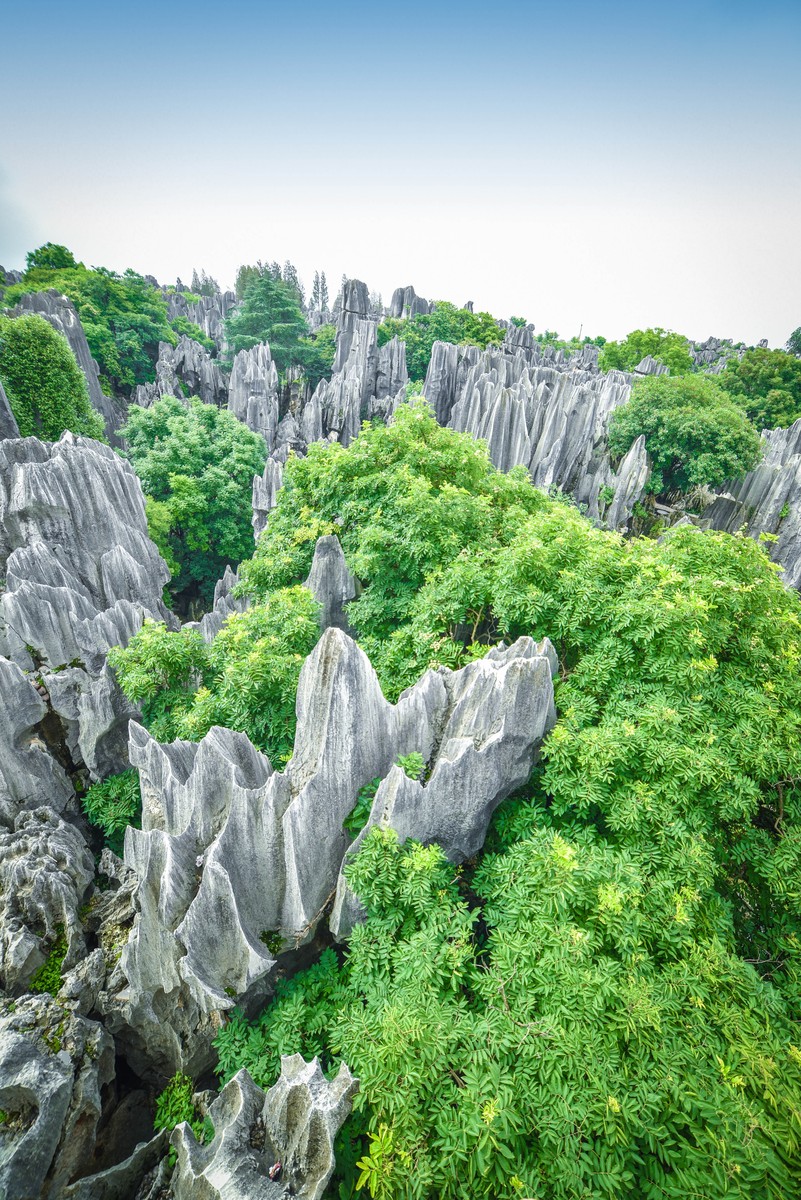
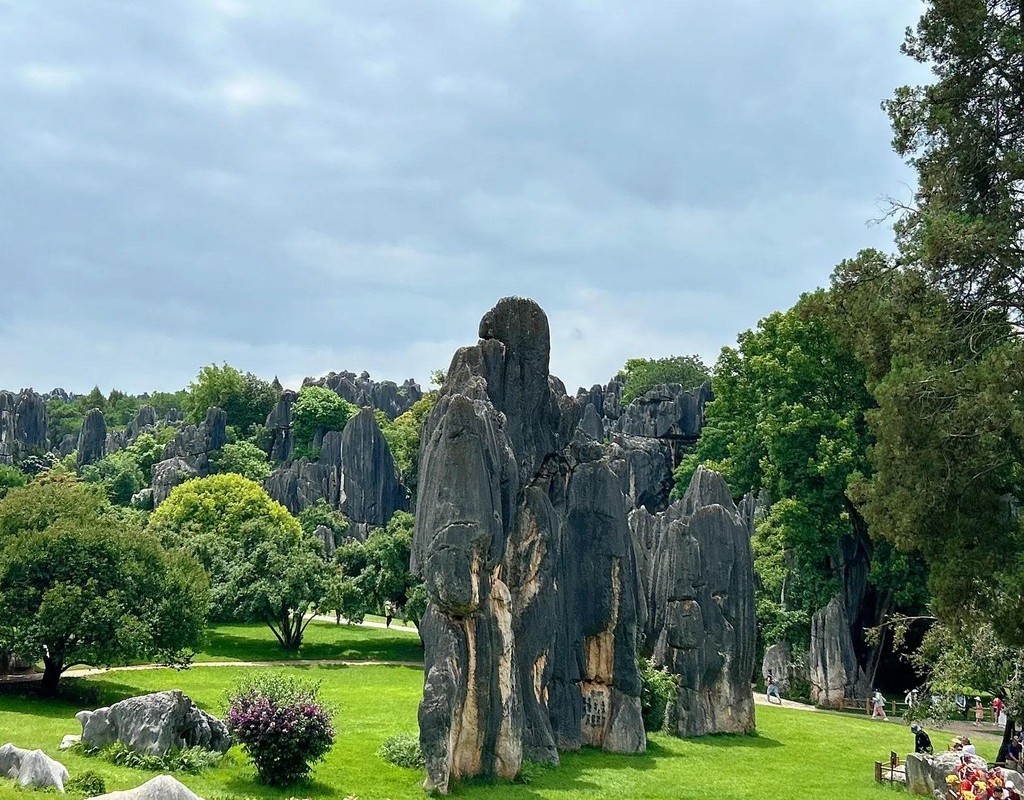
The rock is also literature. This is Sani country — the Sani are a branch of the Yi — and the formations carry names from the Ashima cycle, the long narrative poem that is the Sani’s own founding story. The tall stone in the Lesser Stone Forest is Ashima herself, turned to rock in the version everyone tells.
2. What to Spot: Two Forests, One Name
🗿 The Greater and Lesser Stone Forest
The main area is split into two adjoining fields. The Greater Stone Forest is the taller and more crowded; the Lesser is lower, greener and easier walking, with a lake in the middle of it. Both are on the same ticket and connected by paths, and most visitors see only the first.
- The Story: The two fields are the same limestone under different amounts of erosion — the Greater is further along, which is why its blades stand free and the Lesser still has soil and plants holding on between them.
- What to Look For: Cross-beds and fossil fragments in the rock face. This is a sedimentary rock; the layers run at an angle, and the sea that laid them down is legible in them.
🪨 The Pavilion on the Summit
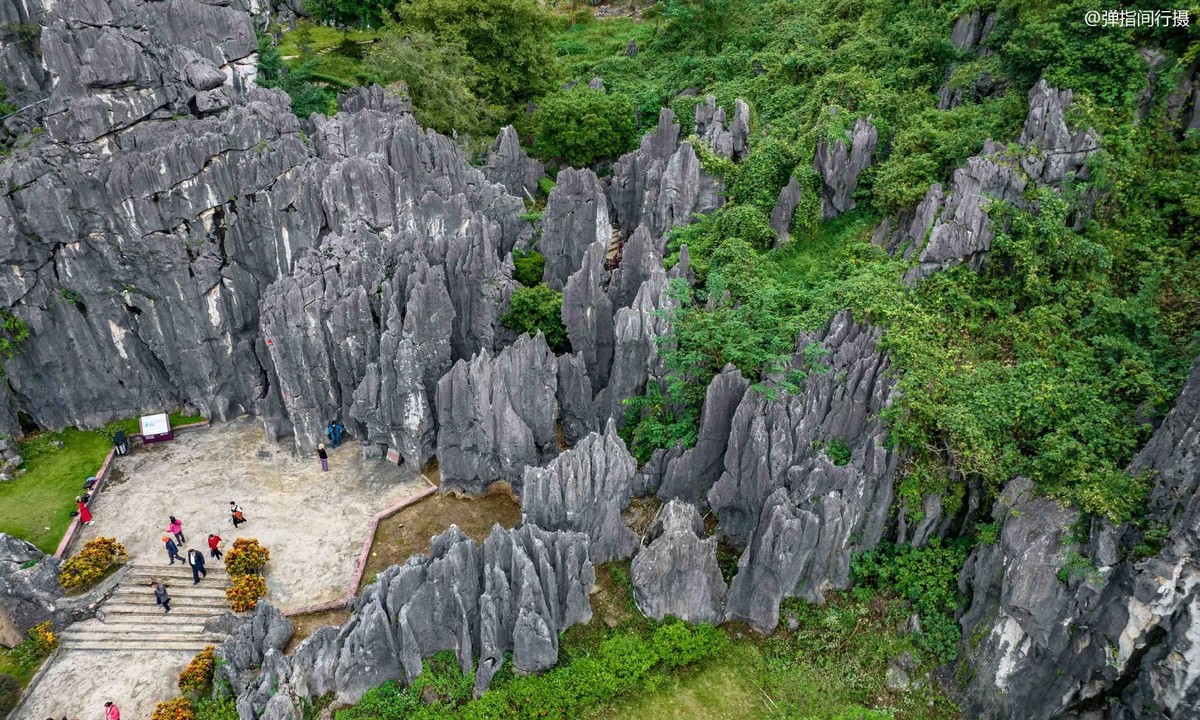
The single best view is from the pavilion on the high point in the middle of the main field. It is a short, steep climb on stone steps, and it is the only place where you see the forest as a forest instead of as a corridor.
💃 The Sani
Sani women in embroidered dress work the main paths and will pose for photographs. They are not staff and they are not free: agree a price before anyone stands next to you. The embroidery itself — headwrap, apron, cross-stitch in strong colour against dark cloth — is the reason to look twice.
3. Cultural Contrast: Landscape With a Plot
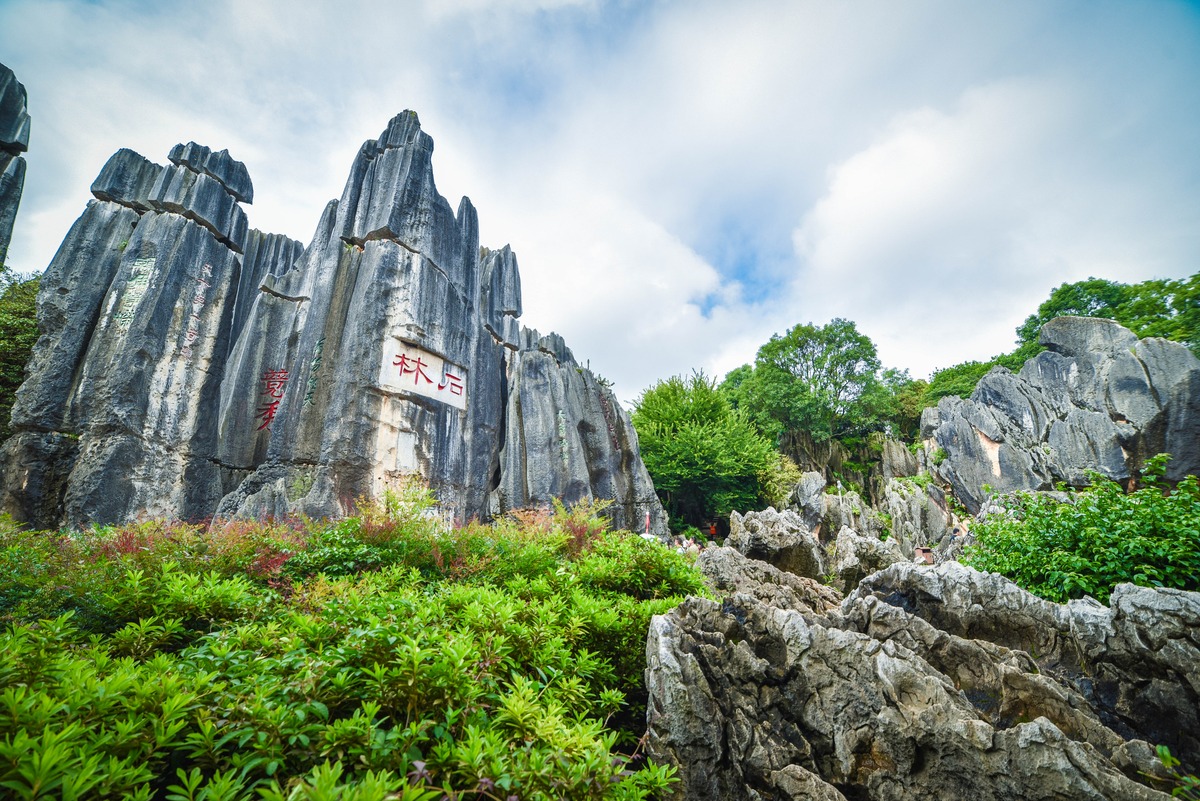
Western visitors read a karst field as geology and move on in twenty minutes. Chinese visitors arrive already knowing the story, because Ashima is taught in school and filmed in 1964 — the rock is a character, and the visit is partly a literary pilgrimage. That is the difference between a national park and a scenic area, and it is worth knowing before you decide the crowds are only there for the photograph.
- It is a managed landscape, not a wilderness. Paved paths, signposted routes, an internal shuttle and a named viewpoint at the top.
- The signage is bilingual, which is unusual at this level of Chinese scenic area and makes the geology readable without a guide.
- The commercial ring is at the gate, not inside: ethnic-minority song-and-dance shows and photo sets near the exit are staged, not villages.
4. Practical Essentials: Tickets, Transit & Scam Alerts
Tickets & Passport Booking
- Book ahead, by real name. Entry is booked through the provincial tourism mini-programme (游云南) roughly a day in advance, and it sells out in peak weeks. Foreign visitors book on a passport — the same document has to be shown at the gate.
- No prices are quoted on this page. The ticket has been repriced in recent years and old and new figures circulate online; check the official booking page for the day you travel.
- Sub-areas and the internal shuttle cost extra. The neighbouring rock fields and the long lake are separate admissions, and the shuttle from the gate to the formations is charged on top.
- Opening hours are not quoted either — sources disagree, so check the day’s notice at the gate or in the booking app.
How to Get There
- Location: Shilin Yi Autonomous County, about 80 km east of Kunming, on Shilin Avenue.
- High-speed rail: Kunming South to Shilin West takes roughly twenty-five minutes; from the station it is a shuttle or a short taxi ride to the gate.
- Taxi or car: “师傅,去【石林风景区】(石林县石林大道),谢谢!”
- Inside: the gate is about three kilometres from the rock. The shuttle is worth the small extra charge in both directions.
- Luggage: the visitor centre handles storage; confirm the desk and the charge on arrival.
Inside Tips & Scam Alerts
- Cheap “Stone Forest day tours” sold in central Kunming are shopping trips with a jewellery and tea stop attached. Book through the official channel or hire a car.
- Guides at the gate sell a walk that is already fully signposted. Take one only if you want the Ashima stories, and fix the fee in advance.
- Sani photographs are a paid transaction. Agree the price before the pose, not after.
- Stone steps are wet and polished in the shaded corridors between the blades. Wear grip; the main route is not wheelchair-friendly beyond the first section, which is why the shuttle matters.
- Go early. The coaches from Kunming arrive from mid-morning and the narrow paths between the blades become single file.
- Complaints or overcharging: call 12345. It is free from any local phone and has English-speaking operators.
Quick Answers
The 6 things visitors ask before setting out, answered from the same verified record used across this page.
- How much does it cost to visit Stone Forest (Shilin Karst)?
- About ¥130 (main area). About ¥130 in the main 大小石林 area (⚠️ confirm current price); the 乃古石林 and 长湖 sub-areas are separate and cheaper.
- What are the opening hours at Stone Forest (Shilin Karst)?
- About 08:00-18:00.
- Is Stone Forest (Shilin Karst) wheelchair accessible?
- Yes. The main 大小石林 circuit is on paved paths with gentle gradients and handrails; the outer 李子园 and 步哨山 sections involve stairs and narrow gaps between rock. Wheelchairs can do the core loop.
- How do I tell a taxi driver to take me to Stone Forest (Shilin Karst)?
- Copy this line into DiDi or show it to the driver: 师傅,请带我到石林风景区,谢谢!
- Can I leave my luggage at Stone Forest (Shilin Karst)?
- Left-luggage at the visitor centre; free.
- Is there anything to watch out for at Stone Forest (Shilin Karst)?
- The gate is 3 km from the rock itself - the ¥25 shuttle inside is worth it. Sani women in embroidered dress will pose for photos and then ask ¥20-50; agree first. Guides at the gate ask ¥150-200 for a walk that is fully signposted. 'Ethnic minority village' shows near the exit are commercial photo sets, not villages.
Where to go next
Three short lists, recomputed at build time from the same coordinates and categories as the pages themselves — no paid placement, no hand-picked names. Every card is a published guide.
Next stop in Kunming
Straight-line distance from this spot, so you can judge what is walkable and what needs a taxi.


More like this, elsewhere in China
If park or garden is what you came for, these are the closest equivalents you can reach in another city — ordered by distance, one city per card.


Change the subject
Deliberately a different category, for when one more temple or garden would blur into the last one.


Lists are derived from coordinates and category alone. Fix a wrong pin or re-tag a place and every list that mentions it moves with it.
Before you go · arrival essentials
Practical guides that pair with this kind of place — picked by category, not sponsored placement.