
People's Assembly Hall

Taxi & Street Navigation Help
师傅,请带我到人民大礼堂(人民广场),我在广场拍照。谢谢!
Opening Hours & Best Time
Square 24/7; interior 08:30 - 17:00
💡 Pro Tip: The classic shot is from the museum side of Renmin Square at dusk — the hall's dome lit gold with the modern skyline behind it. The ¥10 interior ticket is worth it only if the main auditorium is open (event setups sometimes close it).
Accessibility & Luggage Lockers
Accessibility: ♿ Wheelchair & Stroller Friendly
The square is fully flat and ramped; the interior has elevator access to the main hall level.
🧳 Luggage Storage: Museum lockers across the square.
Nearby Landmarks & A Short Train Ride
The 4 places worth pairing with this spot — each one opens straight into Apple Maps or Amap, with the Chinese name you can show a driver. One pick sits in Chengdu (HSR ~1 h 2 min) — a short high-speed ride, not a walk. Chongqing's own list came out one short of a pair, and this is the nearest pick that fills it.
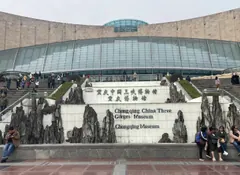 三峡博物馆Three Gorges MuseumMuseumAbout a 15-min walk0.27 kmacross the square
Chinese names and pins are matched against each city's own map data at build time; a place only gets Directions once its pin has been verified, otherwise the button searches by name. Cards with an amber city tag are in another city — the ride time shown is the fastest train of the day.
About People's Assembly Hall
1. Historical Origins: A Dome Built in 1954
The hall went up in the early 1950s, on the new civic axis the city was laying out north of the old peninsula: a square, a museum opposite, and the assembly building closing the composition. It was finished in 1954.
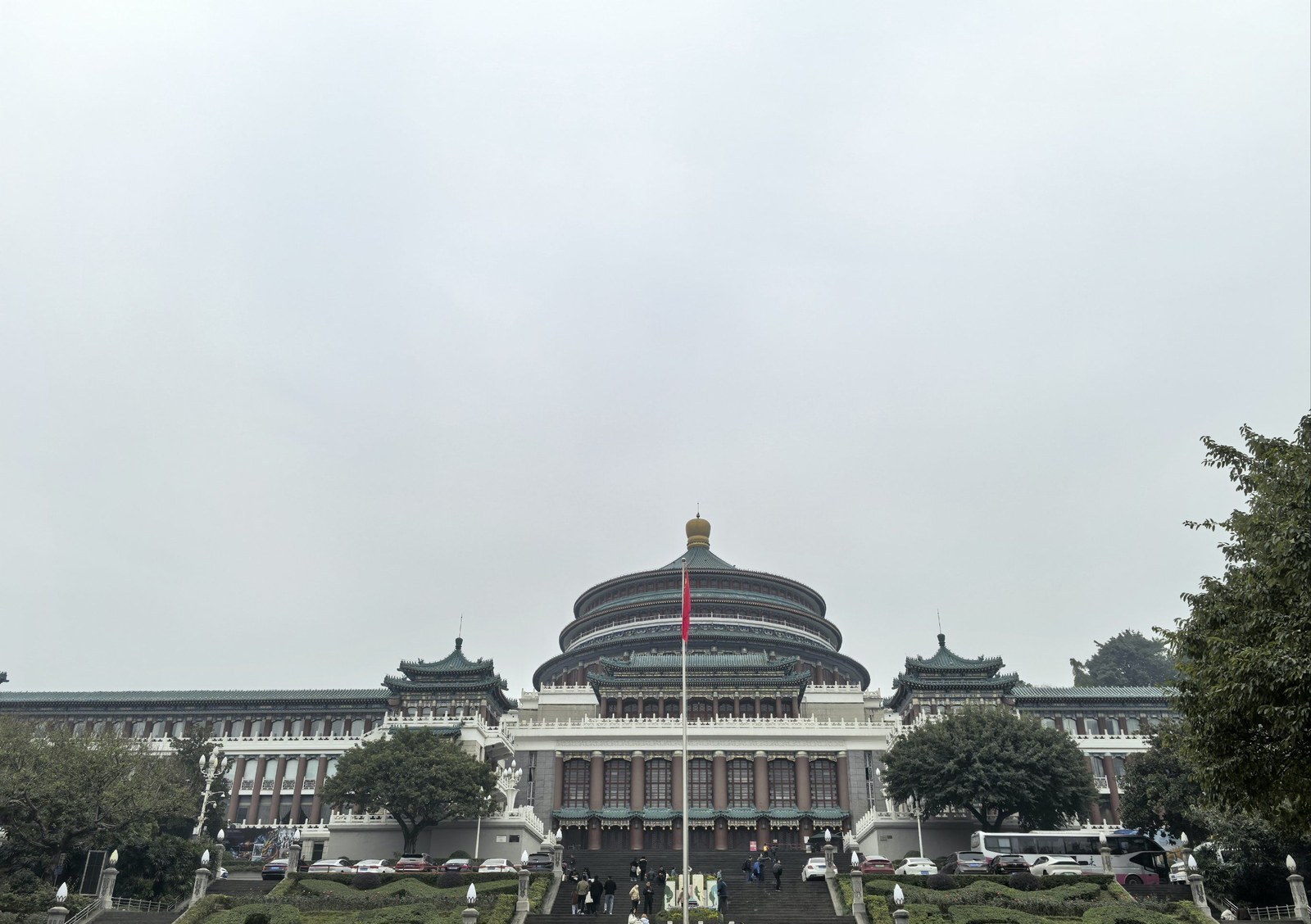
The design is a deliberate quotation. The great circular hall is capped by a dome in the idiom of the Temple of Heaven in Beijing — the same tiered roof form, gold on green, on a symmetrical plan — which makes it a piece of Ming-and-Qing vocabulary rendered in twentieth-century structure. It is not an ancient building pretending to be one; the quotation is the point.
What that produces is a building with no close relatives. Beijing’s temple is timber and ritual; this one is a modern assembly hall in period dress, sized for several thousand people and built to hold meetings. Both things are true at once when you look at it, and the effect is oddly confident rather than nostalgic.
2. What to Spot: Dome, Axis, Square
🏛️ The Dome
- The Story: A stepped circular roof stacked in tiers, capped and gilded, sitting on a colonnaded drum. The silhouette is the whole building; everything below it is a base.
- What to Look For: The vertical stacking. Each tier is smaller than the one below, which is what gives the roof its pyramid-like lift from the square.
📐 The Axis
- The Story: The hall, the square and the museum opposite are laid out on one line. This is a planned civic composition, not an accretion, and it is one of the few places in Chongqing where the ground is flat enough to see it.
- What to Look For: Stand on the museum steps and look straight across. That is the photograph — full square, full dome, nothing clipped.
🎎 The Square
- The Story: Renmin Square is public ground and used as such: dancing groups in the evening, kite sellers, families, and a great deal of amplified music.
- What to Look For: The change of population between five in the afternoon and eight at night. The same paving holds two entirely different events.
🖼️ The Interior
- The Story: Inside there is a large auditorium under the dome, with the ceiling coffering and the period decoration of the 1950s.
- What to Look For: The ceiling. It is the reason to pay the small admission, and it is visible only if the auditorium is not set up for an event.
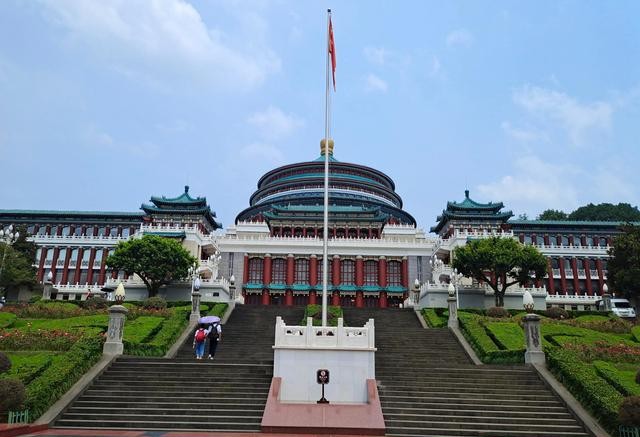
3. Cultural Contrast: A 1950s Building That Quoted the Fifteenth Century
Most twentieth-century civic architecture in China either rejected the past outright or copied it without conviction. This building does something more interesting: it takes a religious roof form, empties it of ritual, and uses it to cap a meeting hall. The result is political architecture that is also genuinely beautiful, which is a harder combination than it sounds.
The contrast is with the skyline behind it. The modern towers of the Jiangbei side are glass and height; the hall is stone, symmetry and a roof. When it is lit at night, the two sit in the same frame and neither looks embarrassed — which is more than most cities manage.
The practical consequence for a visitor is that this is a five-minute stop with a long tail. You can see it properly from the square in five minutes, and then you will stay an hour because the light changes, the dancing starts, and the museum opposite is right there.
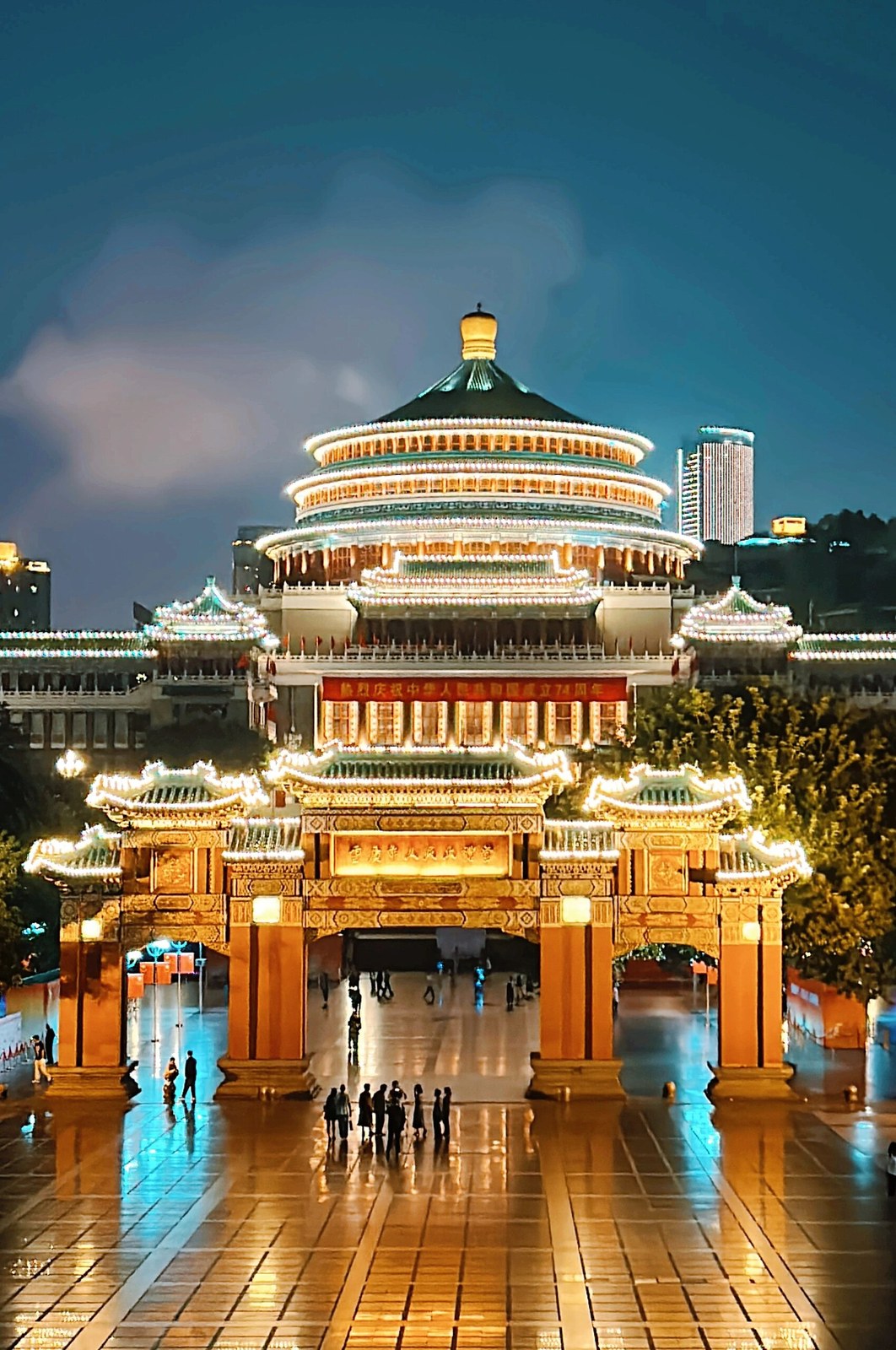
4. Practical Essentials: Tickets, Transit & Scam Alerts
Tickets & Passport Booking
- Price: The square is free and open to anyone at any hour. Going inside is a small paid admission; rates and concession categories change, so check the hall’s official mini-program or WeChat account on the day rather than trusting a figure from a blog.
- Opening Hours: The square is always open. The interior keeps daytime hours with last entry in the late afternoon, and it closes to visitors whenever a meeting or performance is being set up — so check the notice at the door before buying.
- Concessions: Seniors above a certain age and small children normally enter free; the thresholds are posted at the ticket desk.
How to Get There
- By Metro: Line 2 to Zengjiayan (曾家岩) — the square is effectively at the exit.
- Pair it with the museum: The Three Gorges Museum faces the hall across Renmin Square, and it is free. Doing both takes half a day and involves no transport at all.
- Show Your Driver: 师傅,去人民大礼堂(人民广场),谢谢!
Inside Tips & Scam Alerts
- Photograph it from the museum side. The axis, the square and the dome fit in one frame from there, which is not true from any other direction.
- There is no such thing as a “higher balcony ticket”. One interior admission is everything on offer; anyone selling more is inventing a product.
- The interior is worth it mainly for the ceiling. If the auditorium is closed for an event, skip it without regret and spend the money on coffee instead.
- Dusk is the best hour. The hall lights up while the sky still has colour, and the dancing starts on the square at the same time.
- Complaints or overcharging: the 12345 hotline is free from any local phone and has English-speaking operators.
Quick Answers
The 6 things visitors ask before setting out, answered from the same verified record used across this page.
- How much does it cost to visit People's Assembly Hall?
- FREE (exterior/square); interior ¥10.
- What are the opening hours at People's Assembly Hall?
- Square 24/7; interior 08:30 - 17:00.
- Is People's Assembly Hall wheelchair accessible?
- Yes. The square is fully flat and ramped; the interior has elevator access to the main hall level.
- How do I tell a taxi driver to take me to People's Assembly Hall?
- Copy this line into DiDi or show it to the driver: 师傅,请带我到人民大礼堂(人民广场),我在广场拍照。谢谢!
- Can I leave my luggage at People's Assembly Hall?
- Museum lockers across the square.
- Will English work at People's Assembly Hall?
- Yes — staff used to foreign visitors handle English, and the site scores 4/5 on our foreign-friendliness scale.
Where to go next
Three short lists, recomputed at build time from the same coordinates and categories as the pages themselves — no paid placement, no hand-picked names. Every card is a published guide.
Next stop in Chongqing
Straight-line distance from this spot, so you can judge what is walkable and what needs a taxi.


More like this, elsewhere in China
If landmark is what you came for, these are the closest equivalents you can reach in another city — ordered by distance, one city per card.


Change the subject
Deliberately a different category, for when one more temple or garden would blur into the last one.


Lists are derived from coordinates and category alone. Fix a wrong pin or re-tag a place and every list that mentions it moves with it.
Before you go · arrival essentials
Practical guides that pair with this kind of place — picked by category, not sponsored placement.