
Liziba: The Monorail Through the Building

Taxi & Street Navigation Help
师傅,请带我到李子坝轻轨站(2号线),看穿楼轻轨。谢谢!
Opening Hours & Best Time
Line 2 runs ~06:30 - 23:00; viewing platform 24/7
💡 Pro Tip: The dedicated viewing platform under the building is the classic angle, but the better shot is from the platform's far corner at train-arrival moment — pan with the train as it exits. Trains pass every 2-3 minutes; wait for a clean one (no ads on the flank).
Accessibility & Luggage Lockers
Accessibility: ♿ Wheelchair & Stroller Friendly
The street-level viewing platform is flat and ramped; Liziba station itself has elevators.
🧳 Luggage Storage: Station lockers.
Nearby Landmarks
The 2 places within reach of this spot — each one opens straight into Apple Maps or Amap, with the Chinese name you can show a driver.
Chinese names and pins are matched against each city's own map data at build time; a place only gets Directions once its pin has been verified, otherwise the button searches by name.
About Liziba: The Monorail Through the Building
1. Historical Origins: A Railway With Nowhere to Go
Chongqing’s terrain does not leave room for conventional infrastructure. The old city sits on a ridge with a river on each side, and the streets between them climb at angles that defeat ordinary rail. Line 2 was built as a monorail partly for that reason: a monorail can take gradients and curves a metro cannot.
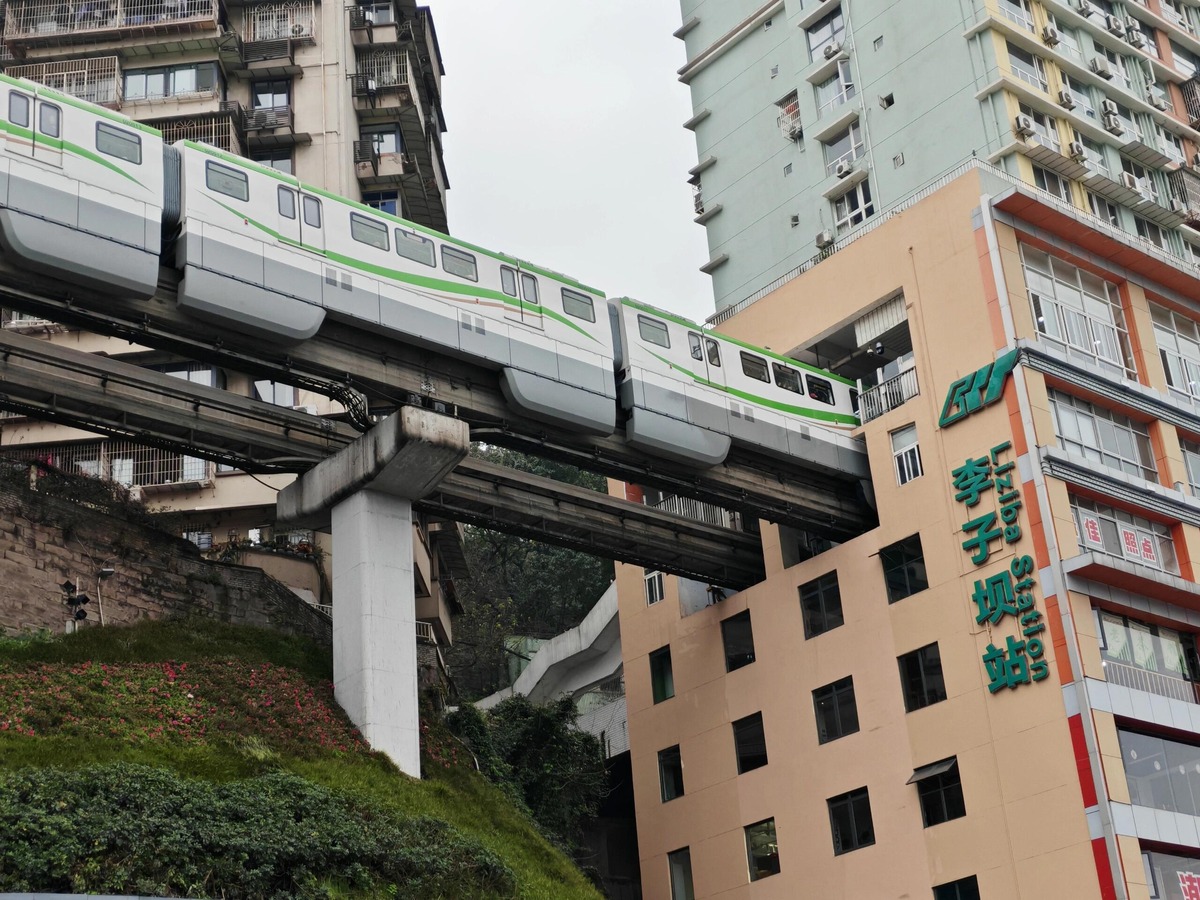
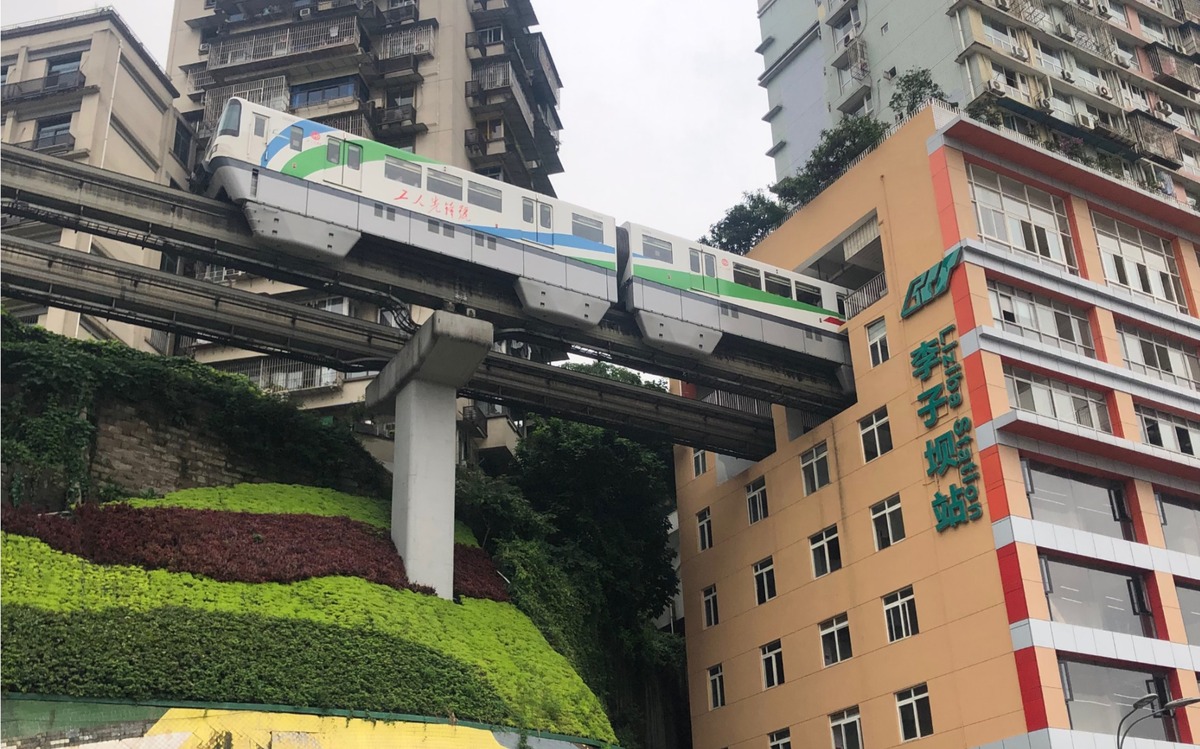
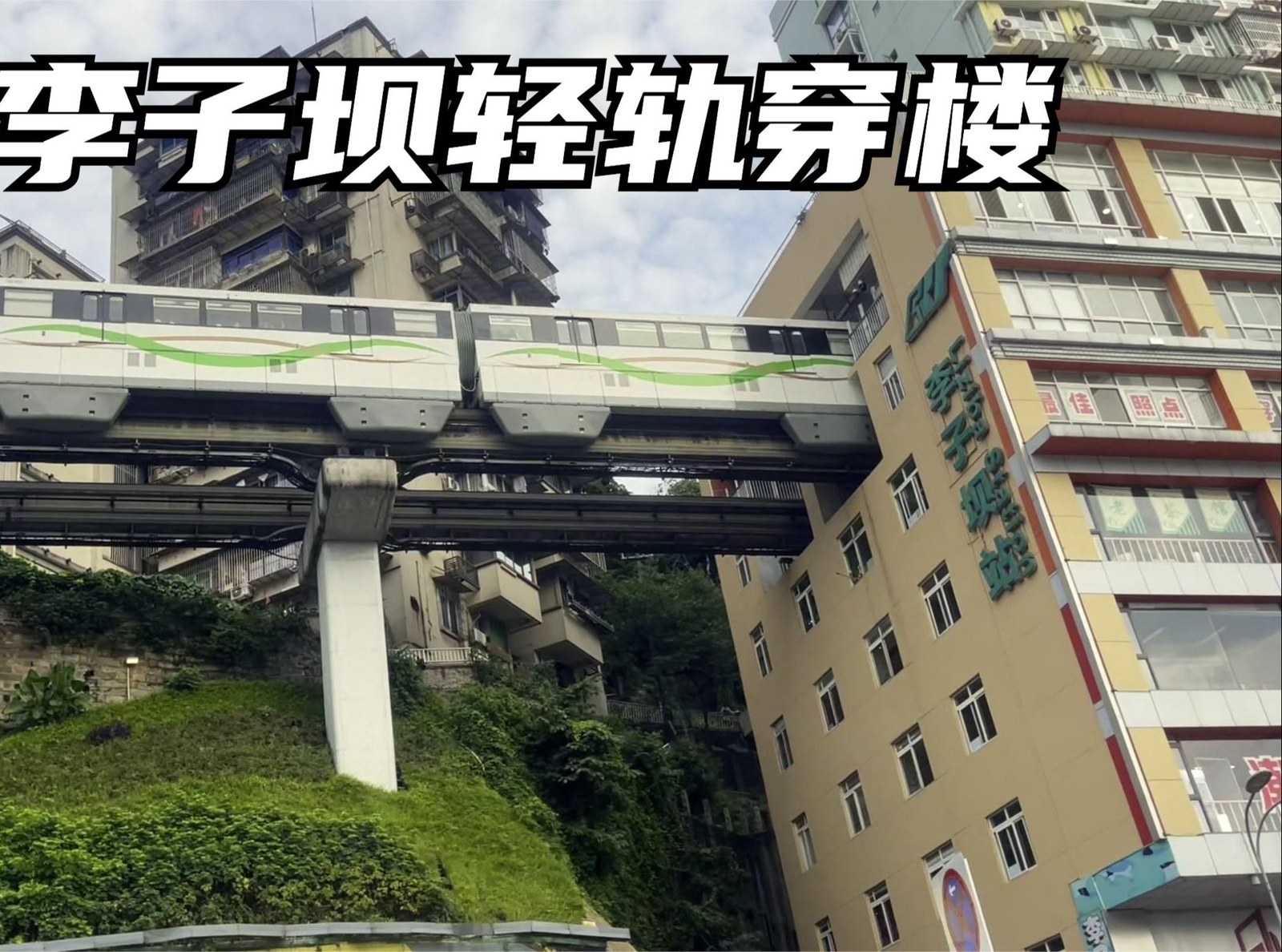
At Liziba the alignment had to cross a residential tower. The solution was not to demolish it and not to tunnel under it, but to build the station into it. The tracks run through the sixth to eighth floors, the concourse sits below, and the apartments carry on above. Building and railway were planned as one structure, which is why the two systems coexist without either interfering with the other.
The line opened in 2004. It has been a working commuter railway ever since, which is the part that gets lost in the photographs: people live in that building, and the train outside their windows is not an attraction, it is the 07:40 service.
2. What to Spot: The Train, the Gap, the Platform
🚝 The Train
- The Story: Line 2 runs articulated monorail stock, two cars to a set, on a concrete beam. At Liziba it enters one face of the tower and leaves the other, and the gap it passes through is open to the air on both sides.
- What to Look For: The speed. It does not slow down for the building — the alignment is straight and the clearance is engineered, so the train goes through at line speed.
🏢 The Building
- The Story: A residential block with a station threaded through its middle. The lower floors hold the concourse and the entrances; the upper floors are flats with a view of the river and a train every few minutes.
- What to Look For: The windows directly above and below the track. Somebody’s kitchen is about three metres from a railway line, and the curtains are usually open.
📸 The Platform
- The Story: The city built a dedicated viewing platform on the street below, free, with a railing and a clear line of sight to the tunnel mouth. It is the single most photographed piece of infrastructure in Chongqing.
- What to Look For: The far corner. From there you see the train emerge rather than arrive, which is the frame everyone is actually trying to get.
🪟 From Inside
- The Story: Riding the line is the other half of the experience, and the one most visitors skip.
- What to Look For: Stand at the front window of the leading car on the southbound service and watch the building swallow the track ahead of you. It takes about two seconds and it is far stranger from inside.
3. Cultural Contrast: A Ninety-Second Photograph
It is worth being honest about the time involved. From the platform, the event lasts as long as a train takes to pass: a few seconds, repeated every few minutes. There is no exhibition, no queue, nothing to read, and no reason to stay more than fifteen minutes unless you are waiting for a clean shot.
What makes the site interesting is not the spectacle but the fact that it was never designed as one. Other cities build observation decks and charge for them; Chongqing put a free railing on a pavement below a commuter station and let the thing speak for itself. That is a very Chongqing decision — the city’s engineering problems are its attractions, and nobody here treats them as sacred.
The comparison is with the river. A cruise or the cableway shows you the city as a panorama, arranged and lit for viewing. Liziba shows you the city solving a problem, at speed, with somebody’s laundry hanging above it. The second is the more truthful picture of the place.
4. Practical Essentials: Tickets, Transit & Scam Alerts
Tickets & Passport Booking
- Price: The viewing platform is free and open at all hours. Riding the train is public transport, charged by distance at the normal metro rate — it is a fare, not an attraction ticket, and you pay it with the same card or QR code you use everywhere else on the network.
- Hours: The line runs from early morning to around eleven at night. First and last trains shift with the operating calendar, so check the metro’s own notice on the day.
- Booking: None needed, for either the platform or the train.
How to Get There
- By Metro: Line 2 to Liziba (李子坝). The viewing platform is at street level directly below the station — take the lift or the stairs down and you are there.
- Show Your Driver: 师傅,去李子坝轻轨站观景平台(李子坝正街),谢谢!
Inside Tips & Scam Alerts
- Ride it first, then watch it. Take Line 2 one stop in either direction from the front window, come back, and watch the same thing happen from the pavement. Five minutes, and you understand what the residents hear all day.
- This is a real residential building. The slope opposite, where photographers climb for the angle, is private ground and people’s homes. Stay on the official platform.
- Watch your phone over the railing. The platform is at street level beside a main road, and the drop to the track is not guarded the way a paid attraction would guard it.
- The platform is flat and step-free. The station above it is not — it has lifts, but allow time at peak hours.
- Weekday mornings are quietest. Weekend afternoons bring coach parties and a wall of selfie sticks.
- Complaints or overcharging: the 12345 hotline is free from any local phone and has English-speaking operators.
Quick Answers
The 6 things visitors ask before setting out, answered from the same verified record used across this page.
- How much does it cost to visit Liziba: The Monorail Through the Building?
- FREE.
- What are the opening hours at Liziba: The Monorail Through the Building?
- Line 2 runs ~06:30 - 23:00; viewing platform 24/7.
- Is Liziba: The Monorail Through the Building wheelchair accessible?
- Yes. The street-level viewing platform is flat and ramped; Liziba station itself has elevators.
- How do I tell a taxi driver to take me to Liziba: The Monorail Through the Building?
- Copy this line into DiDi or show it to the driver: 师傅,请带我到李子坝轻轨站(2号线),看穿楼轻轨。谢谢!
- Can I leave my luggage at Liziba: The Monorail Through the Building?
- Station lockers.
- Will English work at Liziba: The Monorail Through the Building?
- Yes — staff used to foreign visitors handle English, and the site scores 5/5 on our foreign-friendliness scale.
Where to go next
Three short lists, recomputed at build time from the same coordinates and categories as the pages themselves — no paid placement, no hand-picked names. Every card is a published guide.
Next stop in Chongqing
Straight-line distance from this spot, so you can judge what is walkable and what needs a taxi.


More like this, elsewhere in China
If landmark is what you came for, these are the closest equivalents you can reach in another city — ordered by distance, one city per card.


Change the subject
Deliberately a different category, for when one more temple or garden would blur into the last one.


Lists are derived from coordinates and category alone. Fix a wrong pin or re-tag a place and every list that mentions it moves with it.
Before you go · arrival essentials
Practical guides that pair with this kind of place — picked by category, not sponsored placement.