
National Museum of China

Taxi & Street Navigation Help
师傅,请带我去中国国家博物馆,天安门广场东侧,谢谢!
Opening Hours & Best Time
09:00 - 17:00, closed Mondays; last entry 16:00
💡 Pro Tip: Reserve several days ahead—daily quotas fill fast in peak season. Head straight to the 'Ancient China' exhibition on the basement floor: it is the single best chronological walk through 5,000 years of Chinese civilization, and the Houmuwu Ding and Four-goat Square Zun are its stars.
Accessibility & Luggage Lockers
Accessibility: ♿ Wheelchair & Stroller Friendly
Fully wheelchair accessible with elevators and ramps throughout; wheelchairs available free at the entrance with deposit.
🧳 Luggage Storage: Free lockers at the entrance; large bags must be stored before entry.
Nearby Landmarks
The 2 places within reach of this spot — each one opens straight into Apple Maps or Amap, with the Chinese name you can show a driver.
 天安门广场Tiananmen SquareLandmarkAbout a 15-min walk0.39 kmwest side of the square

Also worth pairing: Forbidden City (10-min walk north) — real picks, just left off the grid so the cards stay in pairs.
Chinese names and pins are matched against each city's own map data at build time; a place only gets Directions once its pin has been verified, otherwise the button searches by name.
About National Museum of China
1. Historical Origins: Two Museums in One Building
The National Museum was created in 2003 by merging two institutions that had faced each other across Tiananmen Square: the Museum of Chinese History, whose building of 1959 was one of the Ten Great Buildings put up for the tenth anniversary of the republic, and the Museum of the Chinese Revolution next door. The two were joined by a single block-long hall and reopened in 2011 after a four-year rebuilding programme.
What that history produces is odd and useful at once. The building is one of the largest museum structures anywhere, around 200,000 square metres, and holds over 1.4 million objects. Part of it tells the story of Chinese civilisation, part tells the story of the twentieth century, and the two narratives share a building, a ticket, and a queue. The collection includes the Simuwu ding — the heaviest bronze vessel ever cast, at 832 kilograms — and the Four-goat Square Zun, both of which are on the standard itinerary.

2. What to Spot: The Bronze, the Chronology, the Building
🍶 The Simuwu ding
- The Story: A Shang-dynasty ritual cauldron of 832 kilograms, cast roughly 3,000 years ago, and the largest bronze vessel of the ancient world.
- What to Look For: The scale against the visitors around it. This is the object Chinese schoolchildren know by name, and the crowd behaves accordingly.
🐑 The Four-goat Square Zun
- The Story: A Shang ritual wine vessel with four rams’ heads moulded from the corners, one of the technical masterpieces of Chinese bronze casting.
- What to Look For: The decorative seams where the moulds joined; four views are needed, so walk round it.
🏺 Ancient China
- The Story: The chronological permanent exhibition on the basement floor — from paleolithic pottery through the imperial dynasties.
- What to Look For: The sequence itself. If you have limited time, walk this hall from the beginning to the Tang and stop.
🏛️ The building
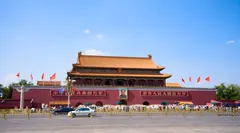
- The Story: A block-length hall on the square’s east side, with a colonnade that was kept from the 1959 design.
- What to Look For: The view from the steps across to Tiananmen gate at closing time, when the light is on the facade.


3. Cultural Contrast: The Hardest Ticket in Beijing
This is the museum that most Chinese families want their children to see, and in high season the daily quota of free bookings is gone within minutes. The queue at opening is a ritual in itself: passport checks, bag scans, then a slow shuffle into a hall that can absorb thousands of people and still feel crowded. People come with a plan — the bronze hall first, then the special exhibition — and often leave after three hours having seen one floor.
Foreign visitors get the same ticket for the same price, free, but usually underestimate the reservation system and turn up without one. The honest advice is that the Capital Museum, twenty minutes west, tells the city’s story with a tenth of the crowd; use this one for the archaeology and go early. Either way, the security line is long and large bags are refused, so travel light.

4. Practical Essentials: Tickets, Transit & Scam Alerts
Tickets & Passport Booking
- Price: Free, with an advance online reservation and passport required.
- How to Book: Reserve on the official ‘National Museum of China’ WeChat account several days ahead — the daily quota fills fast in peak season and there is no walk-up entry. Open 09:00–17:00, last entry 16:00, closed Mondays.
How to Get There
- By Metro: Line 1 to Tian’anmen East, Exit C, which puts you directly at the museum’s north entrance.
- Show Your Driver: 师傅,请带我去中国国家博物馆(东长安街16号),谢谢!
Inside Tips & Scam Alerts
- No reservation means no entry. The passport must match the booking, and staff check it twice.
- Security is airport-grade: large bags are refused and must be checked at the left-luggage office outside. Free lockers inside need registration.
- Go straight to the basement for ‘Ancient China’ — the chronological hall is the reason to come, and it fills up later in the morning.
- Closed Mondays, and the queues on public holidays can run an hour; book a weekday slot.
- Accessibility: lifts, ramps and accessible toilets on every floor, and wheelchairs can be borrowed at the information desk.
- Complaints: the national 12345 hotline is free to call from any local phone.
Quick Answers
The 6 things visitors ask before setting out, answered from the same verified record used across this page.
- How much does it cost to visit National Museum of China?
- Free (book online, passport required).
- What are the opening hours at National Museum of China?
- 09:00 - 17:00, closed Mondays; last entry 16:00.
- Is National Museum of China wheelchair accessible?
- Yes. Fully wheelchair accessible with elevators and ramps throughout; wheelchairs available free at the entrance with deposit.
- How do I tell a taxi driver to take me to National Museum of China?
- Copy this line into DiDi or show it to the driver: 师傅,请带我去中国国家博物馆,天安门广场东侧,谢谢!
- Can I leave my luggage at National Museum of China?
- Free lockers at the entrance; large bags must be stored before entry.
- Will English work at National Museum of China?
- Yes — staff used to foreign visitors handle English, and the site scores 5/5 on our foreign-friendliness scale.
Where to go next
Three short lists, recomputed at build time from the same coordinates and categories as the pages themselves — no paid placement, no hand-picked names. Every card is a published guide.
Next stop in Beijing
Straight-line distance from this spot, so you can judge what is walkable and what needs a taxi.


More like this, elsewhere in China
If museum is what you came for, these are the closest equivalents you can reach in another city — ordered by distance, one city per card.


Change the subject
Deliberately a different category, for when one more temple or garden would blur into the last one.


Lists are derived from coordinates and category alone. Fix a wrong pin or re-tag a place and every list that mentions it moves with it.
Before you go · arrival essentials
Practical guides that pair with this kind of place — picked by category, not sponsored placement.
- Pay with Alipay & WeChat PayPayment · Set up Alipay or WeChat Pay on a foreign card — needed at almost every counter.
- Get online with a China eSIMConnectivity · Maps and messaging that work without a VPN, the moment you land.
- Book China train tickets (12306)Trains · Buy high-speed rail tickets with a foreign passport, for getting here and back.