
Qianmen Street & Dashilan (Old Beijing's High Street)

Ignore touts inviting you to 'free tea tasting' or 'Peking opera shows' in nearby alleys—classic overpriced-teahouse traps. Buy souvenirs from established laozihao storefronts, not street stalls selling 'antiques'.
Taxi & Street Navigation Help
师傅,请带我去前门大街,谢谢!
Opening Hours & Best Time
Always open; shops ~10:00 - 21:00
💡 Pro Tip: Ride the sightseeing 'Dangdang' tram down the pedestrian street, then dive into the Dashilan hutong grid west of the avenue—the 600-year-old commercial lanes hold Beijing's oldest surviving shopfronts.
Accessibility & Luggage Lockers
Accessibility: ♿ Wheelchair & Stroller Friendly
The pedestrian avenue is flat and fully accessible; Dashilan side lanes are paved and mostly level.
🧳 Luggage Storage: No central storage; travel light.
Nearby Landmarks
The 2 places within reach of this spot — each one opens straight into Apple Maps or Amap, with the Chinese name you can show a driver.
- 北京大栅栏Dashilan hutong gridLandmarkAbout a 15-min walk0.17 kmwest of the avenue
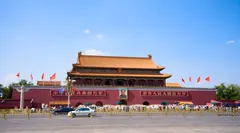
Also worth pairing: Temple of Heaven (2 metro stops east) — real picks, just left off the grid so the cards stay in pairs.
Chinese names and pins are matched against each city's own map data at build time; a place only gets Directions once its pin has been verified, otherwise the button searches by name.
About Qianmen Street & Dashilan (Old Beijing's High Street)
1. Historical Origins: The Street Outside the Gate
Qianmen means ‘front gate’ — Zhengyangmen, the southern gate of the inner city wall, built in 1419 and for five centuries the main entry to the capital from the south. Everything arriving from the Grand Canal or the southern provinces came through here, so the street immediately outside became the city’s commercial spine: shops, inns, guildhalls and theatres, all serving travellers who had just entered the wall.
The side lanes to the west, collectively called Dashilan, developed in the Ming as a denser grid of specialist retailers. This is where Beijing’s oldest surviving shop signs are — Tongrentang the pharmacist, Ruifuxiang the silk house, Neiliansheng the shoemaker, all founded in the Qing and several still trading from the original premises. The street was rebuilt as a pedestrian mall before the 2008 Olympics, which restored the tram tracks and the shopfront scale but also replaced a good deal of the original fabric.

2. What to Spot: The Arch, the Lanes, the Old Shops
🏯 The five-arch paifang
- The Story: The wooden memorial arch mid-way down the street, rebuilt to the Qing pattern.
- What to Look For: The painted beams underneath; look up rather than photographing it from the tram.
🚋 The Dangdang tram
- The Story: A short heritage tram running the length of the pedestrian street, named for the bell it rings.
- What to Look For: The tracks in the paving — the ride is short and mainly for children, but it saves the walk on a hot day.
🏪 The laozihao shopfronts
- The Story: The old houses of Dashilan: apothecary, silk, cloth shoes, tea. Several have traded on the same lane since the Qing.
- What to Look For: The carved timber facades above the modern signage, which most people walk past at eye level.
🏮 Dashilan lane at night
- The Story: The grid west of the avenue, now relit and repaved, but still a working neighbourhood above the shops.
- What to Look For: The lanterns and the narrow perspective down the lane after dark, when the day-trippers have gone.


3. Cultural Contrast: Buying Things Chinese Families Actually Buy
For Chinese visitors this is a shopping street with a purpose: Tongrentang for medicine, Neiliansheng for cloth shoes, Zhang Yiyuan for tea. These are brands people’s grandparents used, and the shops are still where you buy a serious gift — the equivalent of going to a trusted family firm rather than a souvenir kiosk.
Foreign visitors tend to walk the pedestrian avenue, photograph the arch and leave, which is a mistake. The avenue is a reconstruction; the lanes behind it are not. Cross west into Dashilan, look above the shop signs, and the street becomes interesting: nineteenth-century timber fronts, a working neighbourhood overhead, and prices that are the same as anywhere else in the city. One hour is enough, and it combines naturally with Tiananmen to the north or the Temple of Heaven to the south.

4. Practical Essentials: Tickets, Transit & Scam Alerts
Tickets & Passport Booking
- Price: Free. The tram ride is charged separately.
- How to Book: Nothing to book; the street is open at all hours and the shops generally run 10:00–21:00.
How to Get There
- By Metro: Line 2 or Line 8 to Qianmen, which opens directly onto the north end of the street.
- Show Your Driver: 师傅,请带我去前门大街,谢谢!
Inside Tips & Scam Alerts
- Ignore anyone inviting you to ‘free tea tasting’ or a ‘Peking opera show’ in the side alleys. These are the classic overpriced teahouse traps, and the bill arrives at the end.
- Buy from established laozihao shopfronts, not from street stalls selling ‘antiques’ — the souvenirs on the pavement are not old and the prices are not fixed.
- Do the lanes, not just the avenue. Dashilan is where the real shopfronts are; the main street is a 2008 reconstruction.
- Accessibility: the pedestrian avenue is flat and paved, easy for wheelchairs and strollers; the Dashilan lanes are narrower with some kerbs.
- Complaints: the national 12345 hotline is free to call from any local phone.
Quick Answers
The 6 things visitors ask before setting out, answered from the same verified record used across this page.
- How much does it cost to visit Qianmen Street & Dashilan?
- Free.
- What are the opening hours at Qianmen Street & Dashilan?
- Always open; shops ~10:00 - 21:00.
- Is Qianmen Street & Dashilan wheelchair accessible?
- Yes. The pedestrian avenue is flat and fully accessible; Dashilan side lanes are paved and mostly level.
- How do I tell a taxi driver to take me to Qianmen Street & Dashilan?
- Copy this line into DiDi or show it to the driver: 师傅,请带我去前门大街,谢谢!
- Can I leave my luggage at Qianmen Street & Dashilan?
- No central storage; travel light.
- Is there anything to watch out for at Qianmen Street & Dashilan?
- Ignore touts inviting you to 'free tea tasting' or 'Peking opera shows' in nearby alleys—classic overpriced-teahouse traps. Buy souvenirs from established laozihao storefronts, not street stalls selling 'antiques'.
Where to go next
Three short lists, recomputed at build time from the same coordinates and categories as the pages themselves — no paid placement, no hand-picked names. Every card is a published guide.
Next stop in Beijing
Straight-line distance from this spot, so you can judge what is walkable and what needs a taxi.


More like this, elsewhere in China
If historic district is what you came for, these are the closest equivalents you can reach in another city — ordered by distance, one city per card.


Change the subject
Deliberately a different category, for when one more temple or garden would blur into the last one.


Lists are derived from coordinates and category alone. Fix a wrong pin or re-tag a place and every list that mentions it moves with it.
Before you go · arrival essentials
Practical guides that pair with this kind of place — picked by category, not sponsored placement.
- Pay with Alipay & WeChat PayPayment · Set up Alipay or WeChat Pay on a foreign card — needed at almost every counter.
- Claim your tourist tax refundTax refund · Get 11% VAT back on what you buy here, at the airport on departure.
- Book China train tickets (12306)Trains · Buy high-speed rail tickets with a foreign passport, for getting here and back.