
Zhangjiajie National Forest Park (Wulingyuan Core)
ℹ️ ¥165 entry-only / ¥236 with shuttle buses (4 consecutive days; cable cars and elevators extra; off-season discount abolished 2025-01-01)

Ticket touts outside Zhangjiajie railway station and the coach station sell 'discount park tickets' and 'guide packages' that are not valid at the gates — the park is state-run and real-name, so buy only at the ticket office or the official WeChat mini-program with your passport. Also ignore anyone at the gate offering to 'walk you in without a ticket'.
Taxi & Street Navigation Help
师傅,请带我到张家界国家森林公园门票站(森林公园大门),谢谢!
Opening Hours & Best Time
07:00 - 18:00 (pass valid 4 consecutive days, last entry ~17:00)
💡 Pro Tip: Buy on the official mini-program the night before, with passport numbers for every traveler. Enter at the Forest Park gate (森林公园门票站) in the morning and leave by a different gate — the pass covers all four gates plus the shuttle network, so a one-way traverse is free once you are inside.
Accessibility & Luggage Lockers
Accessibility: ⚠️ Step thresholds, limited access
Stone staircases everywhere and shuttle buses with steps — no wheelchair route to any viewpoint. The valley floor (Golden Whip Stream) is the flattest part of the park but still unpaved in places.
🧳 Luggage Storage: No lockers inside the park. The gate-area hotels and the coach station keep paid luggage rooms (¥10-20 per bag per day).
Nearby Landmarks
The 2 places within reach of this spot — each one opens straight into Apple Maps or Amap, with the Chinese name you can show a driver.
Chinese names and pins are matched against each city's own map data at build time; a place only gets Directions once its pin has been verified, otherwise the button searches by name.
About Zhangjiajie National Forest Park (Wulingyuan Core)
1. Historical Origins: The First Forest Park in China
Wulingyuan is not a mountain in the ordinary sense. It is a plateau of Devonian quartz sandstone, 264 km² of it, sliced by vertical joints and then eroded downwards for tens of millions of years. The joints became corridors; the corridors became gorges; what survived between them is a forest of free-standing pillars 100 to 200 m tall. Three valleys cut into the block — Golden Whip Stream, the Suoxi, and the confluence at Shuirao Simen — and three flat plateaus sit on top of it: Yuanjiajie, Tianzi Mountain and Yangjiajie.
In 1982 this became China’s first national forest park, which is why the gate at the south entrance still carries that name. Ten years later UNESCO listed Wulingyuan as a World Natural Heritage site. Almost every photograph you have seen of ‘Zhangjiajie’ was taken on one of those three plateaus or in one of those three valleys — the city of the same name, 35 km away, is where the trains and the airport are.
The consequence for a visitor is structural: this is not a sight to be seen but a system to be worked. The two levels give you completely different pictures of the same rock. From the plateau you look down the tops of the columns; from the valley you look up their roots.

2. What to Spot: Two Ways to Look at the Same Rock
🏔️ The Plateau Rim
- The Story: Yuanjiajie, Tianzi Mountain and Yangjiajie are three flat tops looking down on the pillar forest.
- What to Look For: Each plateau is a half-day on its own. Pick one per morning; the rim paths are where the classic photographs come from.
💧 The Valley Floor
- The Story: The gorges that made the pillars — the same rock seen from the bottom, at 300 m of cliff above you.
- What to Look For: Golden Whip Stream is the flat, paved one. After a morning on a summit, a valley afternoon makes the scale land in a way the viewpoint never does.
🌫️ The Sea of Clouds
- The Story: The reason photographers come in the wet season at all.
- What to Look For: Cloud forms after rain, not during it. If the forecast shows rain clearing overnight, be on a plateau rim by 07:30 — and be aware that dense fog closes down visibility entirely and tickets are not refunded for weather.
🚪 The Gate System
- The Story: Five entrances share one ticket, and choosing the right one is half the logistics.
- What to Look For: The east gate at Wujiayu (Biaozhi Men) is the practical one for the elevator and Ten-Mile Gallery; the south gate is for Golden Whip Stream and Huangshizhai; the west gate at Yangjiajie is the quiet one; the north gate climbs straight to Tianzi Mountain by road.


3. Cultural Contrast: A Four-Day Ticket Used in One
The park is built for four consecutive days, and the most common mistake made by visitors — domestic and foreign alike — is trying to compress it into one. Chinese package tours do exactly that: a bus arrives at 10:00, a group photographs three viewpoints, and by then the queue for the elevator has eaten the afternoon. Independent travellers with the same intentions often end up on the same schedule by accident, arriving late and chasing the same three signposted platforms.
The locals’ reading of the place is the useful one. Wulingyuan families treat the park as a weekend hill: one plateau in the morning, home by three, the same pass again next weekend inside the four-day window. That habit — one height per day, leave the afternoon free, go back into town — is what the ticket is actually shaped for.

4. Practical Essentials: Tickets, Transit & Scam Alerts
🎫 Zhangjiajie Forest Park 4-Day Ticket & Pass Booking
- Price (new tariff from 1 Jan 2025, and most of what is online is out of date): ¥165 for entry only, ¥236 including the shuttle bus network — the ¥236 is what almost everyone actually pays. Concessions ¥83 / ¥119. The old ‘¥228 four-day ticket’ and the winter discount are both abolished; it is one price all year. Annual pass ¥310.
- Validity is four consecutive days, not four visits, counted from the first gate scan. Cable cars, the elevator and the sightseeing carts are all extra.
- Shuttle buses sold separately from 2026-01-01 at ¥72 — so an online reseller’s ‘¥165 ticket’ that excludes buses costs ¥237 in total, more than buying the ¥236 pass at the gate. Check the ticket face before you pay.
- How to Book: The official channel is the ‘Zhangjiajie Yijiyou’ WeChat mini-program — real-name, passport number accepted, international cards supported, and passport bookings can use facial recognition for fast entry. Without WeChat, every gate has a staffed window where a passport works directly (20–40 minutes in high season), or book through Trip.com’s English interface. Hotels buying on your behalf will need a photo of your passport page.
- Concessions (per the 2024 provincial tariff document): free entry for under-14s, over-65s, disabled visitors and serving military (transport still payable); half price for 14–18s, 60–65s and full-time students with ID.
- The ¥3 insurance is voluntary and bundling it is explicitly prohibited — say so if it is added.
How to Get There
- By Bus: From the long-distance station beside Zhangjiajie railway station, the Wulingyuan express runs every 10 minutes (35 km, 50 min, about ¥13); the Forest Park gate service also runs every 10 minutes (30 km, 45 min, about ¥12). A separate 25 km link connects Wulingyuan and the Forest Park gate for ¥10, every 25 minutes.
- Show Your Driver: 师傅,请带我到武陵源标志门(吴家峪门票站)。谢谢!
Inside Tips & Scam Alerts
- Use the four days properly: one plateau each morning, back in town before 15:00. People who try to ‘do Wulingyuan in a day’ spend six hours of it on buses.
- Fog plan B: if visibility is down to a few hundred metres, do not go in — the ticket is not refunded for weather. Switch to Yellow Dragon Cave, the museum, Puguang Temple or an evening show, and remember the four days start at your first gate scan.
- Luggage: every gate has left luggage at ¥10–20 per bag per day. The shuttle buses have no luggage space and drivers will refuse a suitcase — do not arrive with one.
- Touts at the railway station and airport selling ‘¥199 two-day tours’ are selling a compulsory shopping circuit (cinnabar, jade, tea), not a ticket.
- Signage is mainly Chinese, with English subtitles on some place names. Download an offline map; some windows have English-speaking staff but do not count on it all day.
- Complaints and enquiries: the national 12345 hotline is free to call from any local phone. The park ticket centre is 0744-5718833, visitor services 0744-5712345, price complaints 12315.
Quick Answers
The 6 things visitors ask before setting out, answered from the same verified record used across this page.
- How much does it cost to visit Zhangjiajie National Forest Park (Wulingyuan Core)?
- ¥165 entry / ¥236 with buses. ¥165 entry-only / ¥236 with shuttle buses (4 consecutive days; cable cars and elevators extra; off-season discount abolished 2025-01-01).
- What are the opening hours at Zhangjiajie National Forest Park (Wulingyuan Core)?
- 07:00 - 18:00 (pass valid 4 consecutive days, last entry ~17:00).
- Is Zhangjiajie National Forest Park (Wulingyuan Core) wheelchair accessible?
- Not fully. Stone staircases everywhere and shuttle buses with steps — no wheelchair route to any viewpoint. The valley floor (Golden Whip Stream) is the flattest part of the park but still unpaved in places.
- How do I tell a taxi driver to take me to Zhangjiajie National Forest Park (Wulingyuan Core)?
- Copy this line into DiDi or show it to the driver: 师傅,请带我到张家界国家森林公园门票站(森林公园大门),谢谢!
- Can I leave my luggage at Zhangjiajie National Forest Park (Wulingyuan Core)?
- No lockers inside the park. The gate-area hotels and the coach station keep paid luggage rooms (¥10-20 per bag per day).
- Is there anything to watch out for at Zhangjiajie National Forest Park (Wulingyuan Core)?
- Ticket touts outside Zhangjiajie railway station and the coach station sell 'discount park tickets' and 'guide packages' that are not valid at the gates — the park is state-run and real-name, so buy only at the ticket office or the official WeChat mini-program with your passport. Also ignore anyone at the gate offering to 'walk you in without a ticket'.
Zhangjiajie National Forest Park Photo Wall
1 / 24Twenty-four views of Zhangjiajie National Forest Park: the quartz-sandstone pillars of Yuanjiajie and Tianzi Shan, the Golden Whip Stream, seas of morning cloud, a lone macaque in the snow, and the cableway crossing the valley at dusk.
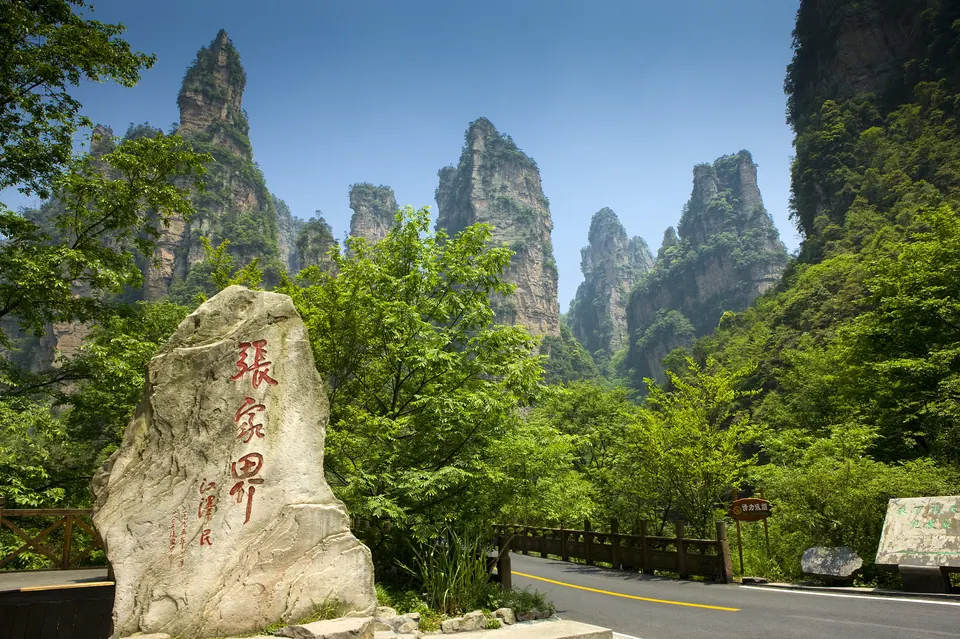
The park’s inscribed stone beneath the peaks.
Where to go next
Three short lists, recomputed at build time from the same coordinates and categories as the pages themselves — no paid placement, no hand-picked names. Every card is a published guide.
Next stop in Zhangjiajie
Straight-line distance from this spot, so you can judge what is walkable and what needs a taxi.


More like this, elsewhere in China
If park or garden is what you came for, these are the closest equivalents you can reach in another city — ordered by distance, one city per card.


Change the subject
Deliberately a different category, for when one more temple or garden would blur into the last one.


Lists are derived from coordinates and category alone. Fix a wrong pin or re-tag a place and every list that mentions it moves with it.
Before you go · arrival essentials
Practical guides that pair with this kind of place — picked by category, not sponsored placement.