
Longjing Tea Village & Plantations

The classic Hangzhou trap: a 'friendly local' or 'tea farmer' invites you to a free tasting, then the bill arrives — ¥680 for 50 grams, or thousands for a 'ceremonial set.' Genuine village tea houses post prices; pre-Shanghai-Mingqian tea legitimately costs ¥300-800/50g, so anything above that from a street invitation is a scam. Also: never buy 'Longjing' from street stalls or West Lake touts — real Longjing comes from this village's registered farms.
Taxi & Street Navigation Help
师傅,请带我到龙井村,龙井路,谢谢!
Opening Hours & Best Time
Village 24/7; tea houses 8:00 - 18:00
💡 Pro Tip: The China National Tea Museum (free, 2 km downhill) is the legitimate way to taste and learn — no sales pressure, English signage. Then walk up into the village for the terraced plantation photos.
Accessibility & Luggage Lockers
Accessibility: ♿ Wheelchair & Stroller Friendly
Village main street is flat and paved; plantation terraces are stepped dirt paths — wheelchair access ends at the village. Tea houses are ground-floor accessible.
🧳 Luggage Storage: No lockers; tea houses will watch bags while you sit.
Nearby Landmarks & A Short Train Ride
The 4 places worth pairing with this spot — each one opens straight into Apple Maps or Amap, with the Chinese name you can show a driver. One pick sits in Shanghai (HSR ~48 min) — a short high-speed ride, not a walk. Hangzhou's own list came out one short of a pair, and this is the nearest pick that fills it.

Chinese names and pins are matched against each city's own map data at build time; a place only gets Directions once its pin has been verified, otherwise the button searches by name. Cards with an amber city tag are in another city — the ride time shown is the fastest train of the day.
About Longjing Tea Village & Plantations
1. Historical Origins: The Village Behind China’s Most Faked Tea
Longjing tea has been grown on these slopes since the Tang dynasty and was elevated to imperial tribute in the Qing — the Qianlong emperor is said to have personally designated eighteen bushes on the hill above the village, which are still signposted. The village itself grew as the settlement of the families who worked those terraces, and it is still the registered origin of the tea: leaf sold as Longjing from anywhere else is, by definition, something else.
That prestige is the reason the village is also the most aggressively commercialised tea address in China. The tea is picked by hand in a narrow window — late March to mid-April for the pre-Qingming crop, the first flush, which is why it costs several times what the later harvest does. Outside that window the slopes are still green and the village is far quieter, and the difference in price for what is in your cup is one of the few genuine bargains in Chinese tourism.
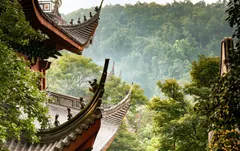
The slopes are what make the visit worthwhile regardless of commerce: terraced rows climbing a valley that traps mist in the morning, worked by pickers in conical hats during the season.

2. What to Spot: The Terraces, the Picking Season, the Tea Museum
🍃 The Terraces
- The Story: Contour rows cut into a valley floor that holds moisture and morning fog — the reason the leaf here tastes the way it does.
- What to Look For: Morning light on the upper terraces. Walk up from the village on the paths between the rows; the higher you go, the fewer people.
🧑🌾 The Picking Season
- The Story: Late March to mid-April, before the Qingming festival, is the first flush. Pickers work the rows by hand, taking only the bud and the first leaf.
- What to Look For: The hands. A good picker moves through a bush in seconds; this is the labour that the price of the tea is actually paying for.
🏛️ The China National Tea Museum
- The Story: Two kilometres downhill, free, and the honest way to learn what you are buying. Proper English labelling, tasting without sales pressure.
- What to Look For: The processing displays — the pan-firing that flattens Longjing leaves into their characteristic shape. Do this before you buy anything.


3. Cultural Contrast: How to Buy Tea Without Being Robbed
Hangzhou’s oldest tourist scam lives here, and it is entirely polite. A friendly local or a self-described “tea farmer” invites you in for a free tasting; the tea is genuinely good; then the bill arrives at ¥680-1,680 for 50 grams. A variant involves a “student” who offers to show you the real plantations and leads you to a relative’s shop. Both rely on the same thing — that you do not know what the tea costs.
So learn two numbers before you arrive. Pre-Qingming Longjing trades at roughly ¥1,600-3,000 per 500 grams; the ordinary-season crop at ¥400-800 per 500 grams. A vendor quoting ten times that has quoted you a tourist price, not a rare tea.
The clean sequence: start at the China National Tea Museum, taste there, learn the grades, then walk up into the village and buy from a shop with posted prices — or simply don’t buy. The terraces are free and the view is the same either way. If the village feels too staged, Meijiawu two kilometres west is larger, more local, and less aggressive.

4. Practical Essentials: Tickets, Transit & Scam Alerts
Tickets & Passport Booking
- Price: Free. The village and the tea museum both cost nothing; a tasting in a village tea house runs about ¥50-100 per person.
- How to Book: The museum is entered free with a WeChat reservation or on the day; it closes Mondays, and stays open on public holidays. No passport required.
How to Get There
- By Metro: No metro — this is hill country. Buses 27 and 87 run from the Longxiangqiao area in about 30 minutes; a taxi from West Lake is roughly ¥25. Free lockers at the tea museum.
- Show Your Driver: 师傅,请带我到龙井村,中国茶叶博物馆在龙井路双峰村。谢谢!
Inside Tips & Scam Alerts
- Never accept a street invitation to a “free tasting.” The tea is real, the bill is not: ¥680-1,680 for 50 grams of ordinary leaf is the standard trap.
- Ignore “students” offering to take you to the real plantations. They are walking you to a relative’s shop.
- Know the market before you negotiate. ¥1,600-3,000 per 500 grams for pre-Qingming, ¥400-800 for the later crop. Anything far above that is a tourist price.
- Buy only where prices are posted. Or buy nothing — the terraces are the real attraction and they are free.
- Complaints: the national 12345 hotline is free to call from any local phone.
Quick Answers
The 6 things visitors ask before setting out, answered from the same verified record used across this page.
- How much does it cost to visit Longjing Tea Village & Plantations?
- FREE (tea tasting ¥50-100/person).
- What are the opening hours at Longjing Tea Village & Plantations?
- Village 24/7; tea houses 8:00 - 18:00.
- Is Longjing Tea Village & Plantations wheelchair accessible?
- Yes. Village main street is flat and paved; plantation terraces are stepped dirt paths — wheelchair access ends at the village. Tea houses are ground-floor accessible.
- How do I tell a taxi driver to take me to Longjing Tea Village & Plantations?
- Copy this line into DiDi or show it to the driver: 师傅,请带我到龙井村,龙井路,谢谢!
- Can I leave my luggage at Longjing Tea Village & Plantations?
- No lockers; tea houses will watch bags while you sit.
- Is there anything to watch out for at Longjing Tea Village & Plantations?
- The classic Hangzhou trap: a 'friendly local' or 'tea farmer' invites you to a free tasting, then the bill arrives — ¥680 for 50 grams, or thousands for a 'ceremonial set.' Genuine village tea houses post prices; pre-Shanghai-Mingqian tea legitimately costs ¥300-800/50g, so anything above that from a street invitation is a scam. Also: never buy 'Longjing' from street stalls or West Lake touts — real Longjing comes from this village's registered farms.
Where to go next
Three short lists, recomputed at build time from the same coordinates and categories as the pages themselves — no paid placement, no hand-picked names. Every card is a published guide.
Next stop in Hangzhou
Straight-line distance from this spot, so you can judge what is walkable and what needs a taxi.


More like this, elsewhere in China
If park or garden is what you came for, these are the closest equivalents you can reach in another city — ordered by distance, one city per card.


Change the subject
Deliberately a different category, for when one more temple or garden would blur into the last one.


Lists are derived from coordinates and category alone. Fix a wrong pin or re-tag a place and every list that mentions it moves with it.
Before you go · arrival essentials
Practical guides that pair with this kind of place — picked by category, not sponsored placement.