
Prince Gong's Mansion (Heshen's Courtyard Palace)

Ignore 'reservation agents' at the gate offering to skip the line for a fee—book the official ticket online yourself with your passport.
Taxi & Street Navigation Help
师傅,请带我去恭王府,前海西街17号,谢谢!
Opening Hours & Best Time
08:30 - 17:00, closed Mondays; last entry 16:00
💡 Pro Tip: The mansion's fame rests on its first owner: Heshen, the most corrupt official in Chinese history. Don't miss the 'Fu' (福) stele hidden in the Secret Cloud Cave—a Kangxi Emperor calligraphy said to be the source of the character's luck.
Accessibility & Luggage Lockers
Accessibility: ♿ Wheelchair & Stroller Friendly
Main courtyards and garden paths are passable for wheelchairs; some side halls have thresholds. The garden is largely flat.
🧳 Luggage Storage: Storage at the visitor center near the entrance.
Nearby Landmarks
The 2 places within reach of this spot — each one opens straight into Apple Maps or Amap, with the Chinese name you can show a driver.

Chinese names and pins are matched against each city's own map data at build time; a place only gets Directions once its pin has been verified, otherwise the button searches by name.
About Prince Gong's Mansion (Heshen's Courtyard Palace)
1. Historical Origins: The House of the Emperor’s Favourite
The mansion was built in 1776 for Heshen, the official who ran the Qing government for two decades and who is remembered, without much exaggeration, as the most corrupt minister in Chinese history. After his death in 1799 the property passed to the imperial family and eventually to Prince Gong, who negotiated with the Western powers after 1860 — which is where the name comes from.
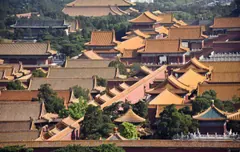
It is the largest and best-preserved princely mansion in Beijing, and its architecture sits in a category between commoner and emperor: five-bay halls on a north–south axis, a private theatre, and a garden behind that was designed to feel much bigger than it is. The phrase tourists are told here — ‘one Prince Gong’s mansion, half a Qing dynasty’ — is a bit of a souvenir line, but the house does track the empire’s decline: built by a favourite, inherited by negotiators, sold off after 1912.

2. What to Spot: The Fu Stele, the Theatre, the Garden
🪨 The Fu Stele in the Secret Cloud Cave
- The Story: A boulder carved with the character 福 (fortune) in the Kangxi Emperor’s handwriting, set into a man-made cave at the back of the garden. The carve is said to be the source of the luck everyone trades on here.
- What to Look For: The queue moves fast, so look at the stone rather than the photo screen. The stele is seen from the front only.
🎭 The private theatre
- The Story: A two-storey Qing theatre inside the residence — the household staged opera here rather than going out to the city.
- What to Look For: The painted ceiling and the stage’s acoustics; stand in the middle of the courtyard to hear the difference.
🌳 Cuijin Garden
- The Story: The garden behind the halls, laid out with a pond, rockeries and a Western-style gate that was fashionable in the late Qing.
- What to Look For: The curved corridor round the pond and the moon gate; it is 30 metres of garden that reads like a hundred.
🏮 The surrounding hutongs
- The Story: The mansion sits in the lake district, three minutes from Shichahai.
- What to Look For: Leave by the north gate and follow the crowd to Houhai for the evening — it is the logical continuation of the same visit.


3. Cultural Contrast: Fortune as a Queue
Chinese visitors come for the character 福. People queue to touch the stele’s protective glass, buy rubbings of the character in the shop, and pose for photos with it — because a fortune character written by the Kangxi Emperor is, in the logic of the place, the most potent version of the character you can get. The mansion’s own history of embezzlement and downfall is told by guides as a moral story about greed, not as a scandal.
Foreign visitors tend to arrive for the architecture and the theatre, which are the real justification for the ticket. The happy version of the visit does both: walk the residence and the theatre properly, glance at the stele, then leave through the garden into the hutongs while everyone else is still queueing. The garden in the late afternoon, with almost nobody in it, is the best half hour on the site.

4. Practical Essentials: Tickets, Transit & Scam Alerts
Tickets & Passport Booking
- Price: ¥40, with concessions available.
- How to Book: Reserve through the official ‘Gongwangfu’ WeChat account with your passport; book ahead in high season. Closed Mondays except for national holidays, and last entry is 16:00.
How to Get There
- By Metro: Line 6 to Beihai North, then about eight minutes on foot into the hutongs. The mansion is next to Shichahai.
- Show Your Driver: 师傅,请带我去西城恭王府(前海西街17号),谢谢!
Inside Tips & Scam Alerts
- Ignore the ‘reservation agents’ at the gate. They offer to skip the line for a fee; reserve yourself on the official mini-program and pay ¥40.
- The Fu stele is at the back of the garden — do the halls first so you are walking against the crowd rather than in it.
- Combine with Shichahai and the drum towers: the three sit within 15 minutes of each other and make a natural afternoon.
- Accessibility: many raised thresholds and steps in the garden; wheelchair users should ask at the gate for the accessible route.
- Complaints: the national 12345 hotline is free to call from any local phone.
Quick Answers
The 6 things visitors ask before setting out, answered from the same verified record used across this page.
- How much does it cost to visit Prince Gong's Mansion?
- ¥40.
- What are the opening hours at Prince Gong's Mansion?
- 08:30 - 17:00, closed Mondays; last entry 16:00.
- Is Prince Gong's Mansion wheelchair accessible?
- Yes. Main courtyards and garden paths are passable for wheelchairs; some side halls have thresholds. The garden is largely flat.
- How do I tell a taxi driver to take me to Prince Gong's Mansion?
- Copy this line into DiDi or show it to the driver: 师傅,请带我去恭王府,前海西街17号,谢谢!
- Can I leave my luggage at Prince Gong's Mansion?
- Storage at the visitor center near the entrance.
- Is there anything to watch out for at Prince Gong's Mansion?
- Ignore 'reservation agents' at the gate offering to skip the line for a fee—book the official ticket online yourself with your passport.
Where to go next
Three short lists, recomputed at build time from the same coordinates and categories as the pages themselves — no paid placement, no hand-picked names. Every card is a published guide.
Next stop in Beijing
Straight-line distance from this spot, so you can judge what is walkable and what needs a taxi.


More like this, elsewhere in China
If historic district is what you came for, these are the closest equivalents you can reach in another city — ordered by distance, one city per card.


Change the subject
Deliberately a different category, for when one more temple or garden would blur into the last one.


Lists are derived from coordinates and category alone. Fix a wrong pin or re-tag a place and every list that mentions it moves with it.
Before you go · arrival essentials
Practical guides that pair with this kind of place — picked by category, not sponsored placement.
- Pay with Alipay & WeChat PayPayment · Set up Alipay or WeChat Pay on a foreign card — needed at almost every counter.
- Claim your tourist tax refundTax refund · Get 11% VAT back on what you buy here, at the airport on departure.
- Book China train tickets (12306)Trains · Buy high-speed rail tickets with a foreign passport, for getting here and back.