
Jingshan Park (The Best Forbidden City View)

Taxi & Street Navigation Help
师傅,请带我去景山公园南门,景山西街44号,谢谢!
Opening Hours & Best Time
06:00 - 21:00 (peak) / 06:30 - 20:00 (off-peak)
💡 Pro Tip: The single best ¥2 you will spend in China: climb the 15 minutes to the Wanchun Pavilion at the top for the full aerial panorama of the Forbidden City's golden roofs. Exit the Forbidden City's north gate (Shenwumen), cross the street, and you are at Jingshan's south gate—the perfect finale to a Forbidden City visit.
Accessibility & Luggage Lockers
Accessibility: ⚠️ Step thresholds, limited access
The summit requires climbing steep stone stairways—wheelchairs and strollers cannot reach the top. The lower park gardens are flat and accessible.
🧳 Luggage Storage: No storage facilities; travel light.
Nearby Landmarks
The 2 places within reach of this spot — each one opens straight into Apple Maps or Amap, with the Chinese name you can show a driver.
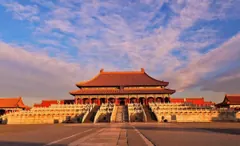 故宫博物院Forbidden CityLandmarkAbout a 15-min walk0.89 kmimmediately south
Also worth pairing: Shichahai & Houhai lakes (10-min walk north) — real picks, just left off the grid so the cards stay in pairs.
Chinese names and pins are matched against each city's own map data at build time; a place only gets Directions once its pin has been verified, otherwise the button searches by name.
About Jingshan Park (The Best Forbidden City View)
1. Historical Origins: A Hill Made of Spoil
Jingshan is artificial. When the Ming laid out the moat and the palace lakes in the early fifteenth century, the excavated earth had to go somewhere, and it was piled up here, directly north of the palace, as a prospect mound. In the imperial plan that position matters: a hill behind the throne and open ground in front is the classic geomantic arrangement, so a heap of dredging spoil became a deliberate part of the city’s design.
The park is small — about 23 hectares — and the hill itself is only 45 metres high, but it occupies the exact geometric centre of the old city and sits on the axis. It was opened to the public in 1928, which is why the view from the top is now a free-for-all of tripods rather than a court privilege.

2. What to Spot: The Pavilion, the Roofscape, the Peonies
🏯 Wanchun Pavilion
- The Story: The central pavilion on the summit, the highest point on the axis, with three others arranged symmetrically on the same ridge.
- What to Look For: The south parapet directly below the pavilion. That is the standard photograph: the palace’s golden roofs running away to the horizon.
📸 The axis line
- The Story: From here you can see why Beijing is described as a single north–south line: palace, square, gate towers all stacked in one view.
- What to Look For: Clear mornings after rain or snow, when the haze that normally eats the horizon lifts.
🌸 The peony beds
- The Story: The south slopes hold Beijing’s best-known peony garden, planted in the Qing and still worked.
- What to Look For: Late April to mid-May, when the beds are in flower and the park fills with photographers before 08:00.
🌳 The old cypresses
- The Story: Some of the trees on the slopes predate the park by centuries and were part of the palace’s northern screen.
- What to Look For: The twisted specimens on the west path, away from the main stair.


3. Cultural Contrast: Two Dollars for the Best View in Beijing
Foreign visitors discover Jingshan as the natural sequel to the Forbidden City: exit the north gate, cross the street, pay ¥2 and climb for fifteen minutes. For Beijing residents it is simply the park where you take the children after school, and where retired men bring their birds in cages and their thermoses in the morning. Both groups use the same stair at different hours.
That pairing of uses is what makes it work. There is nothing commercial inside — no shops of consequence, no guided tours worth the money, no queue except at the very top on holidays. It is also the one place where you can see the entire palace without entering it, which makes it the sensible last stop of a day rather than the first.

4. Practical Essentials: Tickets, Transit & Scam Alerts
Tickets & Passport Booking
- Price: ¥2 — the cheapest ticket in this guide, and arguably the best value in Beijing.
- How to Book: Buy at the gate with your passport, or reserve online in high season. Open 06:00–21:00 in peak season and 06:30–20:00 off-peak.
How to Get There
- By Metro: Line 8 to Shichahai or Line 6 to Nanluoguxiang, both about fifteen minutes on foot. The south gate is directly opposite the Forbidden City’s north exit.
- Show Your Driver: 师傅,请带我去景山公园(景山西街44号),谢谢!
Inside Tips & Scam Alerts
- Come out of the palace’s north gate and walk straight here — the classic combination, and the only way to see the roofs you have just walked under.
- The summit stair is crowded between 10:00 and 15:00. Go at opening or in the last hour before closing; the parapet is narrow and the crowd pushes.
- Stay behind the railings on the ridge. The slopes are steep and the stone is polished.
- Accessibility: the lower park is flat and fine for wheelchairs; the summit is stairs only, though the east path is the gentlest.
- Complaints: the national 12345 hotline is free to call from any local phone.
Quick Answers
The 6 things visitors ask before setting out, answered from the same verified record used across this page.
- How much does it cost to visit Jingshan Park?
- ¥2.
- What are the opening hours at Jingshan Park?
- 06:00 - 21:00 (peak) / 06:30 - 20:00 (off-peak).
- Is Jingshan Park wheelchair accessible?
- Not fully. The summit requires climbing steep stone stairways—wheelchairs and strollers cannot reach the top. The lower park gardens are flat and accessible.
- How do I tell a taxi driver to take me to Jingshan Park?
- Copy this line into DiDi or show it to the driver: 师傅,请带我去景山公园南门,景山西街44号,谢谢!
- Can I leave my luggage at Jingshan Park?
- No storage facilities; travel light.
- Will English work at Jingshan Park?
- Limited — ticketing and signage are mostly Chinese. Have a translation app with the offline Chinese pack ready, and keep the Chinese name (景山公园) on screen for staff.
Where to go next
Three short lists, recomputed at build time from the same coordinates and categories as the pages themselves — no paid placement, no hand-picked names. Every card is a published guide.
Next stop in Beijing
Straight-line distance from this spot, so you can judge what is walkable and what needs a taxi.


More like this, elsewhere in China
If park or garden is what you came for, these are the closest equivalents you can reach in another city — ordered by distance, one city per card.


Change the subject
Deliberately a different category, for when one more temple or garden would blur into the last one.


Lists are derived from coordinates and category alone. Fix a wrong pin or re-tag a place and every list that mentions it moves with it.
Before you go · arrival essentials
Practical guides that pair with this kind of place — picked by category, not sponsored placement.