
Huaqing Palace & Mount Li
ℹ️ ¥120 (winter ¥100) — 'Song of Everlasting Sorrow' show ¥238-988 separate

Two traps: 1) 'Historic hot spring bath' offers inside (¥100+) — you would be bathing in modern plumbing, not Tang water. 2) Mount Li chairlift touts quote '¥80' then it turns out to be per-leg plus insurance — confirm the full round-trip price before boarding.
Taxi & Street Navigation Help
师傅,请带我到华清宫景区大门,华清路38号。谢谢!
Opening Hours & Best Time
7:00 - 19:00 (show schedule separate, Apr-Oct evenings)
💡 Pro Tip: The pools are genuinely ancient (Tang, 7th century) but the buildings are 1950s+ reconstructions — come for the story and the gardens, not the architecture. The evening 'Song of Everlasting Sorrow' (长恨歌) open-air show on the actual mountain backdrop is Xi'an's best stage spectacle — book days ahead for Apr-Oct.
Accessibility & Luggage Lockers
Accessibility: ♿ Wheelchair & Stroller Friendly
Palace gardens are flat and fully wheelchair-accessible; Mount Li requires the cable car plus steps, so wheelchair users should do the lower palace only.
🧳 Luggage Storage: Gate lockers; Metro Line 9 station lockers nearby.
Nearby Landmarks
The 2 places within reach of this spot — each one opens straight into Apple Maps or Amap, with the Chinese name you can show a driver.
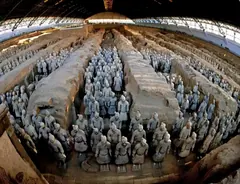 秦始皇帝陵博物院(兵马俑)Terracotta ArmyLandmark15 min by You-5 bus or Didi6.92 km
Also worth pairing: Lintong pomegranate orchards (autumn) — real picks, just left off the grid so the cards stay in pairs.
Chinese names and pins are matched against each city's own map data at build time; a place only gets Directions once its pin has been verified, otherwise the button searches by name.
About Huaqing Palace & Mount Li
1. Historical Origins: Hot Water and Two Assassination Attempts
Huaqing has been a bathing site since the Tang, when the court built a palace over natural hot springs at the foot of Mount Li. The stone pools you walk past are genuine seventh- and eighth-century fabric; the pavilions above them are 1950s reconstructions built to a Tang pattern. That combination is worth understanding before you arrive, because it explains why the place reads as new and feels old at the same time.
Two stories are layered here. The first is the emperor Xuanzong and his consort Yang Guifei, whose relationship became the most famous love story in Chinese literature and ended with her execution by his own guards during a mutiny. The second is much later: in December 1936 Chiang Kai-shek was kidnapped at Huaqing by his own generals and forced into an alliance with the Communists against Japan. Bullet holes from that night are still visible in one of the building walls.

2. What to Spot: Pools, Statues, Chairlift
♨️ The Tang Hot Spring Pools
- The Story: Excavated stone basins that the Tang court actually bathed in, including the one traditionally associated with Yang Guifei.
- What to Look For: The surviving stonework and drainage channels rather than the shelters built over them. The engineering is the authentic part.
🗿 The Court Sculptures
- The Story: Bronze groups of Tang figures on the palace grounds, restaging the court that the poems describe.
- What to Look For: Late afternoon light on the bronze; this is the most photographed spot on the site and it is free with admission.
🕳️ The 1936 Bullet Holes
- The Story: The wall of the building where Chiang Kai-shek was held during the Xi’an Incident, still pocked with the marks of that night.
- What to Look For: It is a small detail that most tour groups walk past, and it is the reason the site matters politically as well as romantically.
🚡 The Mount Li Chairlift
- The Story: A cableway up the mountain behind the palace, with views back over the whole complex and the plain toward Xi’an.
- What to Look For: The full round-trip price before boarding — quotes at the base are often per leg, or exclude the insurance add-on.


3. Cultural Contrast: The Imperial Love Story
Every Chinese visitor knows the plot. Bai Juyi’s poem about Xuanzong and Yang Guifei is taught in schools, the love story is a television staple, and the evening show rests entirely on the audience arriving already moved. The site is read as a setting for a story, not as a set of buildings.
Foreign visitors come without the poem, and the honest recommendation is to take it in that order: read a summary of the story first, then the pools and the 1936 wall mean something. The other adjustment is scale — this is a two-hour stop, and treating it as the morning half of a Terracotta Army day (both sit on Metro Line 9) is exactly how locals do it. The architecture will not impress anyone who came for antiquity; the narrative will.

4. Practical Essentials: Tickets, Transit & Scam Alerts
Tickets & Passport Booking
- Price: ¥120 in high season and ¥100 in winter. The evening show “Song of Everlasting Sorrow” is ticketed separately at ¥238-988 depending on seat.
- How to Book: Buy at the gate or through the official Huaqing Palace account; a passport works at the counter. For the show, book several days ahead — the open-air theatre sells out and its season varies, so confirm on the official announcement.
How to Get There
- By Metro: Line 9 to Huaqing Pool Station, exit B, which puts you at the palace entrance. The Terracotta Army is 15 minutes further on the same line, so the pair makes a natural day with Huaqing first.
- Show Your Driver: 师傅,请带我到华清宫景区大门,华清路38号。谢谢!
Inside Tips & Scam Alerts
- The hot spring “bath” offers inside are modern plumbing, not Tang water. Skip them; the historic pools are the point and they are included.
- Confirm the full round-trip chairlift price before boarding. Quotes of ¥80 are often per leg, or exclude insurance added at the top.
- Come for the story and the gardens, not the architecture — the buildings are twentieth-century reconstructions.
- Short on time? Skip this and go straight to the Terracotta Army. Huaqing is the starter, not the main course.
- Opening hours are roughly 07:00-19:00; the show runs separately on summer evenings between April and October.
- Complaints: the national 12345 hotline is free to call from any local phone.
Quick Answers
The 6 things visitors ask before setting out, answered from the same verified record used across this page.
- How much does it cost to visit Huaqing Palace & Mount Li?
- ¥120 (winter ¥100). ¥120 (winter ¥100) — 'Song of Everlasting Sorrow' show ¥238-988 separate.
- What are the opening hours at Huaqing Palace & Mount Li?
- 7:00 - 19:00 (show schedule separate, Apr-Oct evenings).
- Is Huaqing Palace & Mount Li wheelchair accessible?
- Yes. Palace gardens are flat and fully wheelchair-accessible; Mount Li requires the cable car plus steps, so wheelchair users should do the lower palace only.
- How do I tell a taxi driver to take me to Huaqing Palace & Mount Li?
- Copy this line into DiDi or show it to the driver: 师傅,请带我到华清宫景区大门,华清路38号。谢谢!
- Can I leave my luggage at Huaqing Palace & Mount Li?
- Gate lockers; Metro Line 9 station lockers nearby.
- Is there anything to watch out for at Huaqing Palace & Mount Li?
- Two traps: 1) 'Historic hot spring bath' offers inside (¥100+) — you would be bathing in modern plumbing, not Tang water. 2) Mount Li chairlift touts quote '¥80' then it turns out to be per-leg plus insurance — confirm the full round-trip price before boarding.
Where to go next
Three short lists, recomputed at build time from the same coordinates and categories as the pages themselves — no paid placement, no hand-picked names. Every card is a published guide.
Next stop in Xi'an
Straight-line distance from this spot, so you can judge what is walkable and what needs a taxi.


More like this, elsewhere in China
If landmark is what you came for, these are the closest equivalents you can reach in another city — ordered by distance, one city per card.


Change the subject
Deliberately a different category, for when one more temple or garden would blur into the last one.


Lists are derived from coordinates and category alone. Fix a wrong pin or re-tag a place and every list that mentions it moves with it.
Before you go · arrival essentials
Practical guides that pair with this kind of place — picked by category, not sponsored placement.