
Grand View Park and Tower

Fixed gate price. The 'ancient' boat rides quote per person and are slow; the walk is better. Lantern festival tickets are much higher and worth checking before you commit.
Taxi & Street Navigation Help
师傅,请带我到大观公园(大观楼),谢谢!
Opening Hours & Best Time
About 07:00-19:00 (to 22:00 in festival seasons).
💡 Pro Tip: The 大观楼 itself is a three-storey Qing pavilion from 1828, but what makes it famous is the **180-character couplet** on its doors by Sun Ranweng (1765) - the longest couplet in China, describing the view and 2,000 years of Yunnan's history. Read a translation first; it is the reason Chinese tourists come.
Accessibility & Luggage Lockers
Accessibility: ♿ Wheelchair & Stroller Friendly
Level lakeside paths, ramps to the tower terrace, accessible toilets. Boat hire and the far islands involve steps.
🧳 Luggage Storage: No storage.
Nearby Landmarks
The 2 places within reach of this spot — each one opens straight into Apple Maps or Amap, with the Chinese name you can show a driver.
Also worth pairing: Kunming city centre (4 km north-east) — real picks, just left off the grid so the cards stay in pairs.
Chinese names and pins are matched against each city's own map data at build time; a place only gets Directions once its pin has been verified, otherwise the button searches by name.
About Grand View Park and Tower
1. Historical Origins: A Building Made Famous by Its Doors
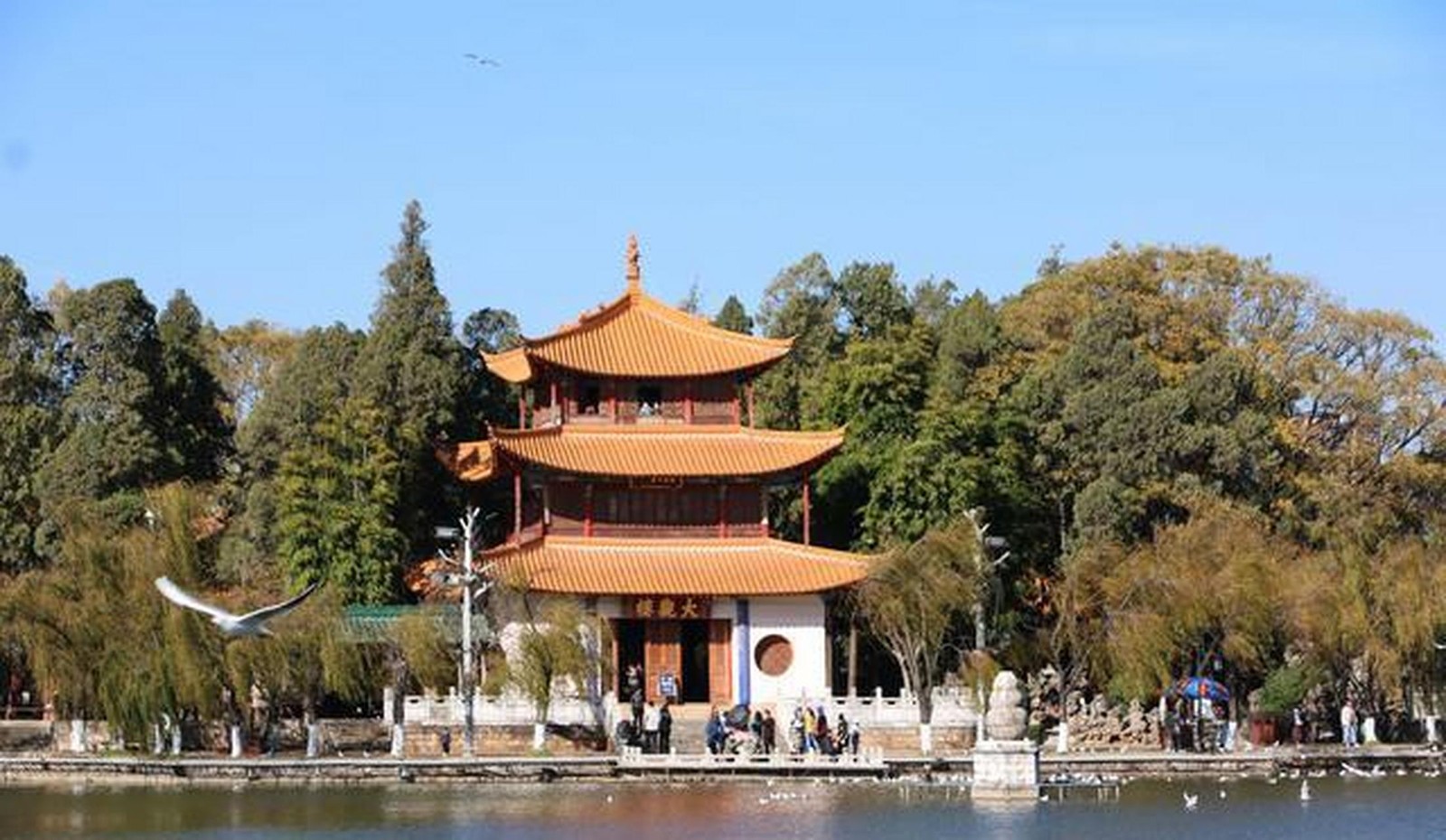
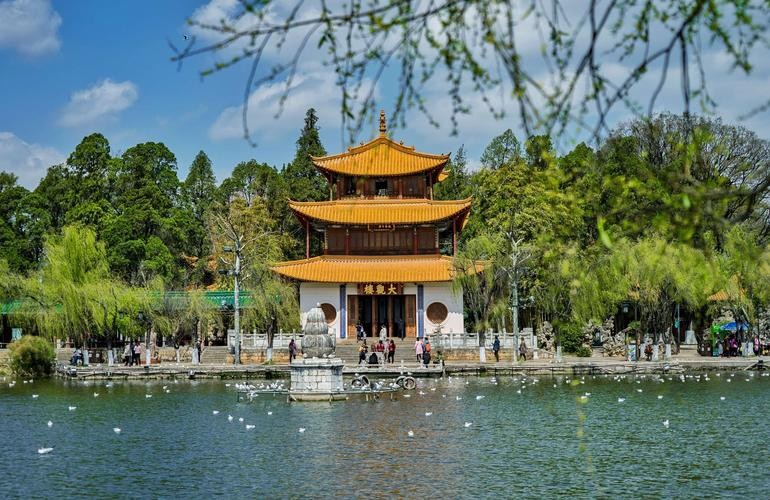
Grand View Park sits on the north shore of Dianchi, where the lake narrows into the city. It is a classical Chinese garden with a water gate, embankments, willows and a scattering of pavilions, and at the centre of it stands a three-storey timber tower built in 1828: the Tower of Grand View.
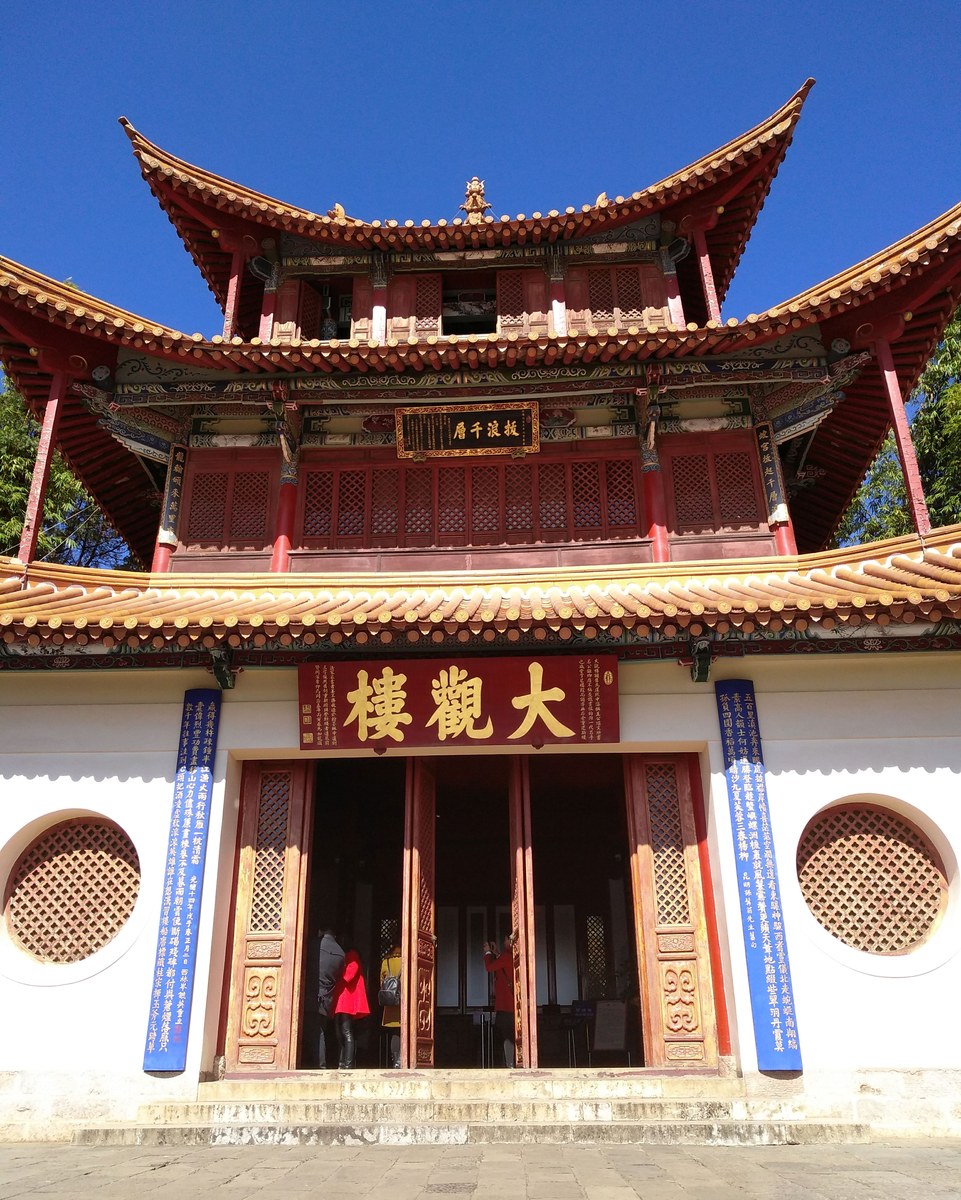
The building itself is not remarkable. What made it one of the most quoted structures in China is the couplet hanging on its doors, written by Sun Ranweng in 1765 — a hundred and eighty characters, the longest couplet in the country, and a piece of writing that schoolchildren still memorise.
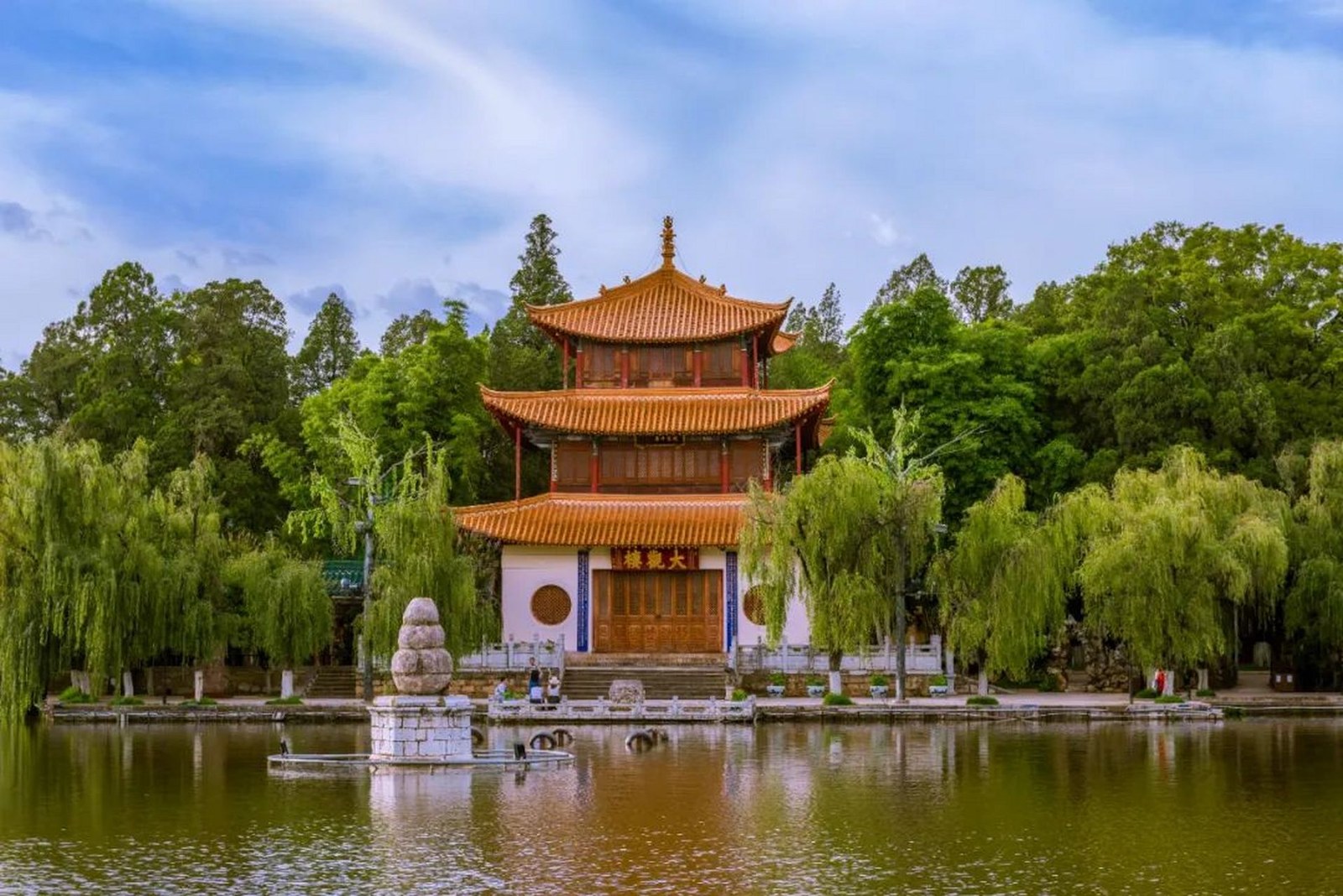
The first line opens on five hundred li of Dianchi rushing up to the eye; the second turns to several thousand years of Yunnan’s history arriving in the mind. It describes what the view was doing in the eighteenth century and it still works, which is why people queue to stand at the door and read it.
2. What to Spot: The Couplet, the Tower and the Water
🖌️ The Couplet
Read a translation before you arrive, because the Chinese is dense and the allusions run deep: the names in it are the old names of the hills and lakes around Kunming, and the history is a compressed account of every dynasty that has held Yunnan. Standing in front of it with a translation in your hand is the difference between looking at calligraphy and reading a poem.
- The Story: Sun Ranweng wrote it in 1765, and it was carved onto boards hung on the tower. It has been recut and restored since; the text is what survives.
- What to Look For: The scale. Each board is longer than a person, and the two halves face each other across the doorway — landscape on one side, history on the other.
🏯 The Tower
Climb it if you can get a slot. The tower is limited by daily quota and booked separately, and the view from the top floor — lake to the west, city to the east, the Western Hills closing the far shore — is the view the couplet describes.
🌾 The Garden and the Chrysanthemums
The park is a working garden for local people: lotus in summer, and in autumn the chrysanthemum show, which fills the beds and brings out half the city with cameras.
3. Cultural Contrast: Poetry as Public Infrastructure
In Europe a famous poem about a place is a plaque. In China it can be the reason the place exists on the tourist map. Grand View Tower is a modest pavilion that became a national site because of what is written on it, and the visit is structured around reading rather than looking — which is why free guided talks are given at the doors and why tour groups stop there instead of climbing.
- The building is secondary. If you skip the couplet you have seen a pleasant Qing pavilion and nothing else.
- The garden is the locals’ park. Morning is tai chi, cards and tea; afternoon is visitors.
- It is a stop on the lake circuit, not a destination in itself: half a day covers it together with Haigeng Dam or the Western Hills.
4. Practical Essentials: Tickets, Transit & Scam Alerts
Tickets & Passport Booking
- Entry and the tower are separate questions. Sources disagree on whether the park itself is free — one says the garden is free with the tower ticketed and quota-limited, the other lists a gate price that rises during festivals. No figures are quoted here; check the tower’s official account or ticketing mini-programme on the day.
- Climbing the tower is quota-limited and booked in advance. In peak season and during the chrysanthemum show the slots go early, and the queue for the tower is not always at the gate you came in by — confirm which entrance runs it.
- The free guided talks happen at set times and are worth timing your visit around; the schedule is published daily and is not quoted here.
- Passport: foreign visitors book or buy by real name at the window or in the mini-programme.
- No pets. It is a garden rule and it is enforced at the gate.
How to Get There
- Location: 284 Daguan Road (大观路), Xishan District, north shore of Dianchi.
- By bus or taxi: both are straightforward from the centre; “师傅,去【大观公园(大观楼)】(大观路),谢谢!”
- Combining it: Haigeng Dam and the Western Hills are on the same stretch of shoreline, so this works as a half day with either.
Inside Tips & Scam Alerts
- Read the couplet first, climb second. Doing it the other way round wastes the tower.
- Boat rides on the lake quote per person and are slow. The embankment walk gives you the same water and better photographs.
- Festival nights are crowded and priced differently. Lantern-season tickets cost more and the park stays open late; check before you commit.
- Carry little. There is no proper left-luggage point nearby, and the garden is all walking.
- Complaints or overcharging: call 12345. It is free from any local phone and has English-speaking operators.
Quick Answers
The 6 things visitors ask before setting out, answered from the same verified record used across this page.
- How much does it cost to visit Grand View Park and Tower?
- About ¥25-40.
- What are the opening hours at Grand View Park and Tower?
- About 07:00-19:00 (to 22:00 in festival seasons).
- Is Grand View Park and Tower wheelchair accessible?
- Yes. Level lakeside paths, ramps to the tower terrace, accessible toilets. Boat hire and the far islands involve steps.
- How do I tell a taxi driver to take me to Grand View Park and Tower?
- Copy this line into DiDi or show it to the driver: 师傅,请带我到大观公园(大观楼),谢谢!
- Can I leave my luggage at Grand View Park and Tower?
- No storage.
- Is there anything to watch out for at Grand View Park and Tower?
- Fixed gate price. The 'ancient' boat rides quote per person and are slow; the walk is better. Lantern festival tickets are much higher and worth checking before you commit.
Where to go next
Three short lists, recomputed at build time from the same coordinates and categories as the pages themselves — no paid placement, no hand-picked names. Every card is a published guide.
Next stop in Kunming
Straight-line distance from this spot, so you can judge what is walkable and what needs a taxi.


More like this, elsewhere in China
If park or garden is what you came for, these are the closest equivalents you can reach in another city — ordered by distance, one city per card.


Change the subject
Deliberately a different category, for when one more temple or garden would blur into the last one.


Lists are derived from coordinates and category alone. Fix a wrong pin or re-tag a place and every list that mentions it moves with it.
Before you go · arrival essentials
Practical guides that pair with this kind of place — picked by category, not sponsored placement.