
Qiyun Mountain

The classic name-confusion trap: 'Qiyun Mountain' is not Huangshan, and 'Huangshan' as a destination on a tour poster sometimes quietly means one mountain or the other — book and pay at Qiyun's own gate or official channel. Do not accept a driver's or touts' 'special combo' bridging the two scenic areas; they are different operators dozens of kilometres apart. On the mountain the watch-outs are ordinary ones: stick to the marked cliff paths (the red sandstone gets genuinely slippery when wet), and treat 'bargain' Daoist talismans and incense-package pitches around temples with polite scepticism. There are no official quoted transfer times from the transport hubs for this mountain; treat any promised drive time as an estimate.
Taxi & Street Navigation Help
师傅,去【齐云山景区】(黄山休宁),谢谢!
Opening Hours & Best Time
The mountain runs a day-visiting operating window set by its scenic operator; no single confirmed timetable is relied on here, so check the day's posted hours before setting out. As on any mountain the practical schedule is decided by weather and by the cable car: footpaths can be slick after rain and the ropeway can suspend in bad conditions. If you want the signature scene — mist rolling through the cliff-side Heavenly Street at dawn — plan an early start or an overnight stay on the mountain.
💡 Pro Tip: One of the four sacred Daoist mountains of China — ranked with Wudang, Longhu and Qingcheng — Qiyun was anciently called White Peak (Baiyue), and the old pairing 'Huangshan and Baiyue' made it the southern Anhui twin to the great granite massif. Its stage is danxia landform: red cliffs and rampart-like rock walls, so different from Huangshan's granite that visitors meet a completely different mountain poetry. The marvel is Yuehua Heavenly Street (Moon-Beam Sky Street) — a ridge-top lane where temples, dwellings and shops run in a single line along the cliff, and when cloud floods through it the street truly seems to float. Generations of cliff inscriptions line the paths, with imperial praise (Qianlong among them) in stone. Lower, softer and far less crowded than Huangshan, it is the region's best 'second mountain' — half-day to overnight, and magnificent in morning mist.
Accessibility & Luggage Lockers
Accessibility: ⚠️ Step thresholds, limited access
A mountain of stone stairways, cliff-side paths and temple courtyards at the end of climbs; the cable car eases the ascent but the core experience — the Heavenly Street along the rim and the cliff-pocket temples — is stair- and foot-based and not wheelchair- or stroller-practicable.
🧳 Luggage Storage: Storage at the base visitor/ticket centre; overnight guests carry light up to the ridge inns — there is no luggage service along the Heavenly Street itself.
Nearby Landmarks
The 2 places within reach of this spot — each one opens straight into Apple Maps or Amap, with the Chinese name you can show a driver.
- Tunxi Old Street and the city centre, the nearest rail/air gatewaysHistoric districtNearby
Also worth pairing: Mount Huangshan scenic area, to the north-west (separate operator, separate ticket) — real picks, just left off the grid so the cards stay in pairs.
Chinese names and pins are matched against each city's own map data at build time; a place only gets Directions once its pin has been verified, otherwise the button searches by name.
About Qiyun Mountain
1. Historical Origins: White Peak, the Daoist Twin of Huangshan
Before it was ranked among Daoism’s four sacred mountains, this was White Peak (Baiyue) — the mountain southern Anhui worshipped first, and for centuries the pairing ‘Huangshan and Baiyue’ treated the two as one region’s matched set: the granite sublime in the north, the red sandstone sacred in the south. Daoist institutional weight arrived early: the mountain became a headquarters of Zhengyi Daoism, its temples and rituals anchoring a living tradition rather than a ruined one.
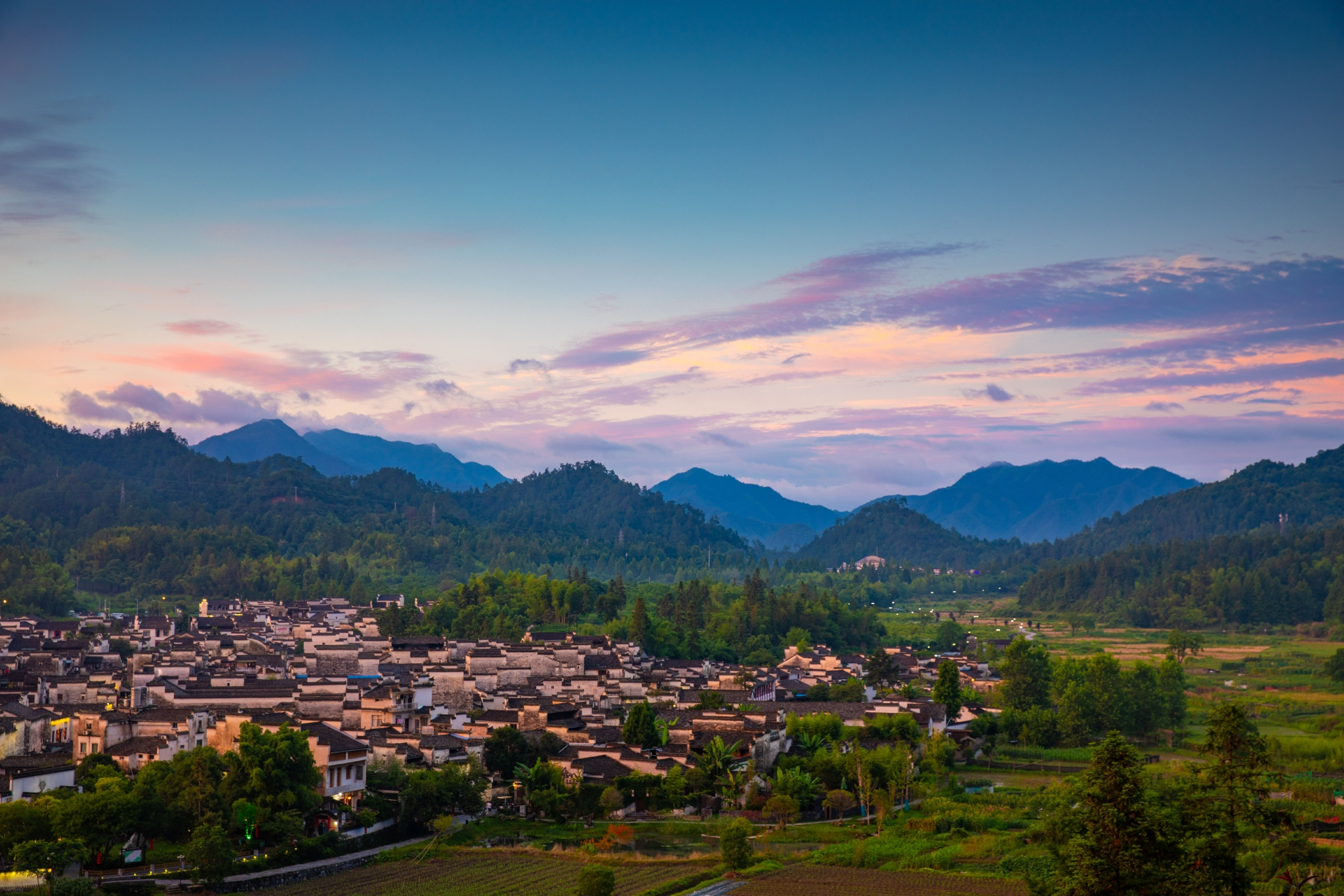
The mountain’s distinguishing glory is that its sacred architecture is strung along a single ridge lane — Yuehua Heavenly Street, ‘Moon-Beam Sky Street’ — where Daoist temples, old houses and shops sit shoulder to shoulder on the cliff rim, so that worship and daily life were literally built into one skyline. Scholars and emperors signed the rocks: the cliffs carry generations of cliff-face inscriptions (moya shike), and imperial tribute — Qianlong’s among them — records how seriously the court took Baiyue. To climb Qiyun is to walk a thousand years of Daoist landscape history in half a day, in the long shadow of its more famous twin.
2. What to Spot: The Heavenly Street, the Temples, the Inscribed Cliffs
🌫️ Yuehua Heavenly Street
- The Story: The ridge-top lane where temples, homes and shops line the cliff in one unbroken row.
- What to Look For: Morning mist pouring through the lane — the ‘street in the sky’ moment that made its name.
⛩️ The Daoist Temples & Cliff Pockets
- The Story: Zhengyi Daoism’s sacred mountain — shrines set into alcoves and terraces below the red walls.
- What to Look For: Temples hung under overhanging cliffs, incense against ochre stone; note how the architecture squeezes into geology.
🪨 The Inscribed Cliffs & Sea of Clouds
- The Story: Generations of scholar and imperial writing cut into the rock faces; after rain, cloud fills the valleys below.
- What to Look For: Read a few cliff inscriptions for the devotional verdict of nine centuries — and hunt the cloud sea at dawn.
3. Cultural Contrast: Two Mountains, Two Chinese Imaginations
Huangshan and Qiyun are the region’s study in contrasts, and almost every contrast runs deep. Huangshan is granite, soaring, painterly — the mountain of the literati landscape; Qiyun is danxia, red, ramparted — the mountain of Daoist practice. One was famous for its scenery and adopted by painters; the other was famous for its spirits and adopted by an religion’s hierarchy. A visitor who does both in one trip receives a compact lesson in how Chinese culture sacralises landscape in two entirely different registers.
The practical difference is just as real: Huangshan demands days, cable cars and summit-crowd logistics; Qiyun gives its essence — the Heavenly Street, the temples, the inscriptions — in a half-day, with a fraction of the traffic. That makes it the region’s best antidote to its own flagship: not a lesser Huangshan but a different answer to the same question of what a mountain is for. In mist it feels like a painting; in clear light it feels like a temple. Chinese pilgrims have never seen those as contradictory, and neither should you.
4. Practical Essentials: Tickets, Transit & Scam Alerts
Tickets & Passport Booking
- Price: Gate admission separate from Huangshan; no official figure is fixed here, and circulating OTA adult/half-price references contradict one another (two tiers, roughly the 68–75 / 55–60 band) — treat them only as non-official ballpark signals and confirm live prices officially. Cable car and descent options are usually extra.
- Passport & booking: Buy at the mountain’s own window or official channel with your passport; documents and reservation rules follow posted scenic-area policy.
How to Get There
- Where it is: In Xiuning county, south-west of Tunxi; this city publishes no official drive times from the airport or high-speed rail, so treat mapping estimates as indicative. Local buses and shared transfers run from Tunxi and Xiuning.
- Show Your Driver: 师傅,去【齐云山景区】(黄山休宁),谢谢!
Inside Tips & Scam Alerts
- Start early or stay overnight on the ridge for the mist-through-the-Sky-Street scene — it is the whole mountain’s best moment. Choose your ascent: steps or cable car (extra fare, official rate governs). Mind slick red sandstone after rain and keep to marked paths. Refuse bridging ‘combos’ sold between Huangshan and Qiyun — different operators. Complaints / lost property: 12345, free from a local number.
Quick Answers
The 6 things visitors ask before setting out, answered from the same verified record used across this page.
- How much does it cost to visit Qiyun Mountain?
- ≈¥68-75 (OTA ref).
- What are the opening hours at Qiyun Mountain?
- The mountain runs a day-visiting operating window set by its scenic operator; no single confirmed timetable is relied on here, so check the day's posted hours before setting out. As on any mountain the practical schedule is decided by weather and by the cable car: footpaths can be slick after rain and the ropeway can suspend in bad conditions. If you want the signature scene — mist rolling through the cliff-side Heavenly Street at dawn — plan an early start or an overnight stay on the mountain.
- Is Qiyun Mountain wheelchair accessible?
- Not fully. A mountain of stone stairways, cliff-side paths and temple courtyards at the end of climbs; the cable car eases the ascent but the core experience — the Heavenly Street along the rim and the cliff-pocket temples — is stair- and foot-based and not wheelchair- or stroller-practicable.
- How do I tell a taxi driver to take me to Qiyun Mountain?
- Copy this line into DiDi or show it to the driver: 师傅,去【齐云山景区】(黄山休宁),谢谢!
- Can I leave my luggage at Qiyun Mountain?
- Storage at the base visitor/ticket centre; overnight guests carry light up to the ridge inns — there is no luggage service along the Heavenly Street itself.
- Is there anything to watch out for at Qiyun Mountain?
- The classic name-confusion trap: 'Qiyun Mountain' is not Huangshan, and 'Huangshan' as a destination on a tour poster sometimes quietly means one mountain or the other — book and pay at Qiyun's own gate or official channel. Do not accept a driver's or touts' 'special combo' bridging the two scenic areas; they are different operators dozens of kilometres apart. On the mountain the watch-outs are ordinary ones: stick to the marked cliff paths (the red sandstone gets genuinely slippery when wet), and treat 'bargain' Daoist talismans and incense-package pitches around temples with polite scepticism. There are no official quoted transfer times from the transport hubs for this mountain; treat any promised drive time as an estimate.
Where to go next
Three short lists, recomputed at build time from the same coordinates and categories as the pages themselves — no paid placement, no hand-picked names. Every card is a published guide.
Next stop in Huangshan
Straight-line distance from this spot, so you can judge what is walkable and what needs a taxi.


More like this, elsewhere in China
If park or garden is what you came for, these are the closest equivalents you can reach in another city — ordered by distance, one city per card.


Change the subject
Deliberately a different category, for when one more temple or garden would blur into the last one.


Lists are derived from coordinates and category alone. Fix a wrong pin or re-tag a place and every list that mentions it moves with it.
Before you go · arrival essentials
Practical guides that pair with this kind of place — picked by category, not sponsored placement.