
Sun Yat-sen Memorial Hall

Taxi & Street Navigation Help
师傅,请带我到中山纪念堂(东风中路299号,纪念堂地铁站下)。谢谢!
Opening Hours & Best Time
Park 06:00 - 22:00; hall interior 09:00 - 17:00
💡 Pro Tip: The ¥10 interior ticket is worth it for the dome alone — an octagonal span of 71 meters with zero interior columns, built in 1931, holding 4,700 seats. Walk in, look straight up, then find the exhibit on the hall's 1930s engineering drawings. The park's grounds and the bronze statue of Sun are free.
Accessibility & Luggage Lockers
Accessibility: ♿ Wheelchair & Stroller Friendly
Step-free entry to the hall via the side ramps; interior seating rows have step access. The park's paths are flat and shaded.
🧳 Luggage Storage: Hall desk bag-hold.
Nearby Landmarks & A Short Train Ride
The 4 places worth pairing with this spot — each one opens straight into Apple Maps or Amap, with the Chinese name you can show a driver. One pick sits in Shenzhen (HSR ~36 min) — a short high-speed ride, not a walk. Guangzhou's own list came out one short of a pair, and this is the nearest pick that fills it.
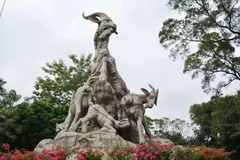
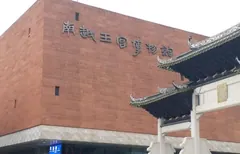
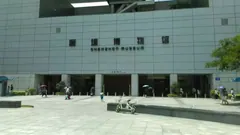
Chinese names and pins are matched against each city's own map data at build time; a place only gets Directions once its pin has been verified, otherwise the button searches by name. Cards with an amber city tag are in another city — the ride time shown is the fastest train of the day.
About Sun Yat-sen Memorial Hall
1. Historical Origins: A Dome Over a Revolution
Sun Yat-sen died in 1925, and this building is the city’s answer to what he meant. It went up between 1929 and 1931 on the site of the Qing governor’s office — a deliberate substitution, the provincial administration replaced by a memorial to the man who ended the system that office served. The architect was Lü Yanzhi, who had also designed the Sun Yat-sen Mausoleum in Nanjing.
What makes it more than a statue hall is the roof. The hall is octagonal in plan, and the dome across it spans about 71 metres with no interior columns at all — for its date that was a serious engineering problem, solved with a hidden steel frame carried on eight perimeter columns and a ring of trusses above. Four thousand seven hundred seats sit under that single span, and every one of them has a clear line to the stage.
The building was damaged in the war, repaired, and has been in continuous use ever since as a concert and conference hall rather than a museum. That is why it still feels in working order: the memorial part — the statue, the gardens, the axial approach — is outside, and the inside is a working auditorium.

2. What to Spot: The Dome, the Statue, the Engineering
🏛 The Dome
- The Story: an octagonal span of roughly 71 metres with nothing underneath it, the reason engineers still visit the building.
- What to Look For: walk to the centre of the floor and look straight up. The ring of trusses above the ceiling is partly visible at the edges, and the acoustic effect of the span is obvious when someone drops something.
🗿 The Bronze Statue
- The Story: Sun Yat-sen in a long coat, on a stone plinth facing south down the axis of the old city.
- What to Look For: the setting rather than the figure: from the plinth, the memorial, the gate and the road beyond are all aligned, which is how the 1930s wanted you to see the city.
📐 The Engineering Drawings
- The Story: a small exhibition inside covers the design and construction, including the structural solution for the dome.
- What to Look For: the original drawings, which are the clearest explanation of why an uncolumned span of that size was a big deal in 1931.


🌺 The Grounds
- The Story: a formal garden with lawns, kapok and banyan trees, free to enter all day.
- What to Look For: March, when the kapok trees along the eastern lawn drop red flowers onto the grass and the facade gets its best seasonal backdrop.
3. Cultural Contrast: What Sun Yat-sen Means Here
In Guangzhou, Sun Yat-sen is not a distant historical figure but a local one: he was born in Xiangshan, studied medicine in Hong Kong, and spent his political life moving between this city, Hong Kong and exile. The memorial is therefore treated less as a monument than as a civic hall — concerts, ceremonies, graduation photos and, on ordinary afternoons, students sketching the facade for art homework.
The contrast with foreign visitors is noticeable. Travellers come for the building and often skip the ¥10 interior; locals come for what is inside — the dome, the acoustics, and whatever performance is on. The axis does the rest of the work. Walk north out of the park and you are on the same line that runs to Yuexiu Park and the Sun Yat-sen Monument on the ridge, a route the city still describes as its ceremonial spine.

4. Practical Essentials: Tickets, Transit & Scam Alerts
Tickets & Passport Booking
- Price: the park and grounds are free; the interior of the hall is ¥10.
- How to Book: no reservation for the park. The ¥10 interior ticket is sold at the door or by phone payment, and a passport is enough — no advance WeChat booking is required.
- Hours: park roughly 06:00–22:00; the hall interior roughly 09:00–17:00. The interior closes on some days for performances and conferences, so check the notice board at the gate before buying.
How to Get There
- By Metro: Line 2 to Sun Yat-sen Memorial Hall Station, Exit C — the south gate is about 200 metres away.
- On foot: the north gate leads straight into Yuexiu Park, so the memorial, the Sun Yat-sen Monument and the Five Rams can be done as one walk.
- Show Your Driver: 师傅,请带我去中山纪念堂,东风中路 299 号,纪念堂地铁站下,谢谢!
Inside Tips & Scam Alerts
- Pay the ¥10. The dome is the sight, and the exterior alone does not explain why the building matters.
- Photograph the facade from in front of the statue, on the axis, early in the morning before the tour buses arrive.
- Photographers in the park who offer to shoot you with the hall will print at their own price and the quote rarely covers it. Your phone is fine.
- If the interior is closed for an event, the park, statue and gardens stay open and cost nothing.
- March, when the kapok flowers, is the most photogenic month; the rest of the year go at dusk, when the facade is lit.
- Complaints: the national 12345 hotline is free to call from any local phone.
Quick Answers
The 6 things visitors ask before setting out, answered from the same verified record used across this page.
- How much does it cost to visit Sun Yat-sen Memorial Hall?
- Park FREE; main hall interior ¥10.
- What are the opening hours at Sun Yat-sen Memorial Hall?
- Park 06:00 - 22:00; hall interior 09:00 - 17:00.
- Is Sun Yat-sen Memorial Hall wheelchair accessible?
- Yes. Step-free entry to the hall via the side ramps; interior seating rows have step access. The park's paths are flat and shaded.
- How do I tell a taxi driver to take me to Sun Yat-sen Memorial Hall?
- Copy this line into DiDi or show it to the driver: 师傅,请带我到中山纪念堂(东风中路299号,纪念堂地铁站下)。谢谢!
- Can I leave my luggage at Sun Yat-sen Memorial Hall?
- Hall desk bag-hold.
- Will English work at Sun Yat-sen Memorial Hall?
- Yes — staff used to foreign visitors handle English, and the site scores 4/5 on our foreign-friendliness scale.
Where to go next
Three short lists, recomputed at build time from the same coordinates and categories as the pages themselves — no paid placement, no hand-picked names. Every card is a published guide.
Next stop in Guangzhou
Straight-line distance from this spot, so you can judge what is walkable and what needs a taxi.


More like this, elsewhere in China
If landmark is what you came for, these are the closest equivalents you can reach in another city — ordered by distance, one city per card.


Change the subject
Deliberately a different category, for when one more temple or garden would blur into the last one.


Lists are derived from coordinates and category alone. Fix a wrong pin or re-tag a place and every list that mentions it moves with it.
Before you go · arrival essentials
Practical guides that pair with this kind of place — picked by category, not sponsored placement.