
CPC First Congress Memorial (1921 Founding Site)

Taxi & Street Navigation Help
师傅,请带我去黄陂南路【中共一大纪念馆】正门(黄陂南路374号),谢谢!
Opening Hours & Best Time
09:00 - 17:00 (Closed Mondays)
💡 Pro Tip: Located right next to trendy Xintiandi. Experience the preserved 1920s Shikumen stone-gate architecture alongside state-of-the-art interactive historical exhibits.
Accessibility & Luggage Lockers
Accessibility: ♿ Wheelchair & Stroller Friendly
Modern subterranean exhibition hall with full ramp and elevator accessibility.
🧳 Luggage Storage: Free lockers available on-site.
Nearby Landmarks & A Short Train Ride
The 4 places worth pairing with this spot — each one opens straight into Apple Maps or Amap, with the Chinese name you can show a driver. One pick sits in Hangzhou (HSR ~48 min) — a short high-speed ride, not a walk. Shanghai's own list came out one short of a pair, and this is the nearest pick that fills it.
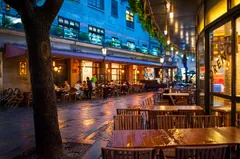 新天地Xintiandi North BlockHistoric districtAbout a 15-min walk0.17 km

Chinese names and pins are matched against each city's own map data at build time; a place only gets Directions once its pin has been verified, otherwise the button searches by name. Cards with an amber city tag are in another city — the ride time shown is the fastest train of the day.
About CPC First Congress Memorial (1921 Founding Site)
1. Historical Origins: A Shikumen House at 106 Wangzhi Road
In July 1921, thirteen delegates met in a two-storey shikumen house at 106 Wangzhi Road, in the French Concession — now 76 Xingye Road. The meeting was disrupted by a police search and moved to a boat on South Lake in Jiaxing, but it is the Shanghai address that is remembered: this is the founding site of the Communist Party of China, and the building has been preserved rather than rebuilt.

What you visit now is two things. The old lane house itself has been restored and staged as a period interior, down to the furniture and the room where the delegates sat. Immediately alongside it is a large modern exhibition hall that tells the wider history through documents, film and interactive displays. The juxtaposition is the point: a preserved 1920s shikumen on one side of the courtyard, a purpose-built contemporary museum on the other.
2. What to Spot: The Meeting Room, the Delegates, the Lane
🏠 The Restored Meeting Room
- The Story: The house was restored by removing later additions and returning the interior to its 1921 condition.
- What to Look For: The smallness of the room. The scale is the most striking fact in the whole site — this was a domestic dining room, not a hall.
🗿 The Thirteen Delegates
- The Story: A bronze group sculpture depicts the delegates who attended, and it has become the site’s most photographed object.
- What to Look For: The group and its setting, best lit in the morning before the courtyard fills.


🏛️ The Exhibition Hall
- The Story: Documents, photographs and reconstructed scenes carry the story forward from 1921.
- What to Look For: The artefacts that survive from the period — original publications and personal objects are the parts that hold attention.
🏘️ The Lane and the Neighbours
- The Story: The house sits in an intact stretch of shikumen lanes, and the surrounding block was protected because of it.
- What to Look For: The street itself, before you go in — look at the gate frames on both sides of the road.
3. Cultural Contrast: How a Political Site Is Visited
This is a pilgrimage site as much as a museum, and the visitor behaviour reflects that. Groups arrive in formation, photographs are taken in front of the emblem, and the tone inside is quiet and formal; school and party groups are frequent, especially at weekends. Visitors from outside China should not expect a neutral presentation — the narrative is didactic. What makes it worth an hour anyway is the building and the scale of the preservation, and the fact that the surrounding lanes are exactly the street that Xintiandi next door has reconstructed as a shopping precinct. Here it is the original.

4. Practical Essentials: Tickets, Transit & Scam Alerts
Tickets & Passport Booking
- Price: Free Admission (Online reservation required). There is no charge, but entry is by timed reservation only.
- How to Book: Reserve in advance through the memorial’s official WeChat account and bring the passport you booked with. Walk-up entry is not reliably available, especially at weekends and on holidays.
How to Get There
- By Metro: Line 1 to South Huangpi Road Station, then about five minutes on foot; the entrance is at 374 South Huangpi Road.
- Show Your Driver: 师傅,请带我去中共一大纪念馆,黄浦区黄陂南路 374 号,谢谢!
Inside Tips & Scam Alerts
- Hours: 09:00 to 17:00, closed Mondays, with last entry around 16:30.
- Weekday Morning: This is when the queue is short and the restored house is not crowded. Weekend afternoons are dominated by organised groups.
- Language: Displays are primarily in Chinese with partial English captions. If you read no Chinese, budget less time or bring a translation tool.
- Book Before You Go: Turning up without a reservation is the single most common wasted trip in this part of the city.
- Pair It With Xintiandi: The preserved lanes here and the redeveloped lanes at Xintiandi are five minutes apart, and seeing both in one afternoon is the most efficient hour you will spend in Shanghai.
- Complaints: the national 12345 hotline is free to call from any local phone.
Quick Answers
The 6 things visitors ask before setting out, answered from the same verified record used across this page.
- How much does it cost to visit CPC First Congress Memorial (1921 Founding Site)?
- Free Admission (Online reservation required).
- What are the opening hours at CPC First Congress Memorial (1921 Founding Site)?
- 09:00 - 17:00 (Closed Mondays).
- Is CPC First Congress Memorial (1921 Founding Site) wheelchair accessible?
- Yes. Modern subterranean exhibition hall with full ramp and elevator accessibility.
- How do I tell a taxi driver to take me to CPC First Congress Memorial (1921 Founding Site)?
- Copy this line into DiDi or show it to the driver: 师傅,请带我去黄陂南路【中共一大纪念馆】正门(黄陂南路374号),谢谢!
- Can I leave my luggage at CPC First Congress Memorial (1921 Founding Site)?
- Free lockers available on-site.
- Will English work at CPC First Congress Memorial (1921 Founding Site)?
- Yes — staff used to foreign visitors handle English, and the site scores 4/5 on our foreign-friendliness scale.
Where to go next
Three short lists, recomputed at build time from the same coordinates and categories as the pages themselves — no paid placement, no hand-picked names. Every card is a published guide.
Next stop in Shanghai
Straight-line distance from this spot, so you can judge what is walkable and what needs a taxi.


More like this, elsewhere in China
If museum is what you came for, these are the closest equivalents you can reach in another city — ordered by distance, one city per card.


Change the subject
Deliberately a different category, for when one more temple or garden would blur into the last one.


Lists are derived from coordinates and category alone. Fix a wrong pin or re-tag a place and every list that mentions it moves with it.
Before you go · arrival essentials
Practical guides that pair with this kind of place — picked by category, not sponsored placement.
- Pay with Alipay & WeChat PayPayment · Set up Alipay or WeChat Pay on a foreign card — needed at almost every counter.
- Get online with a China eSIMConnectivity · Maps and messaging that work without a VPN, the moment you land.
- Book China train tickets (12306)Trains · Buy high-speed rail tickets with a foreign passport, for getting here and back.